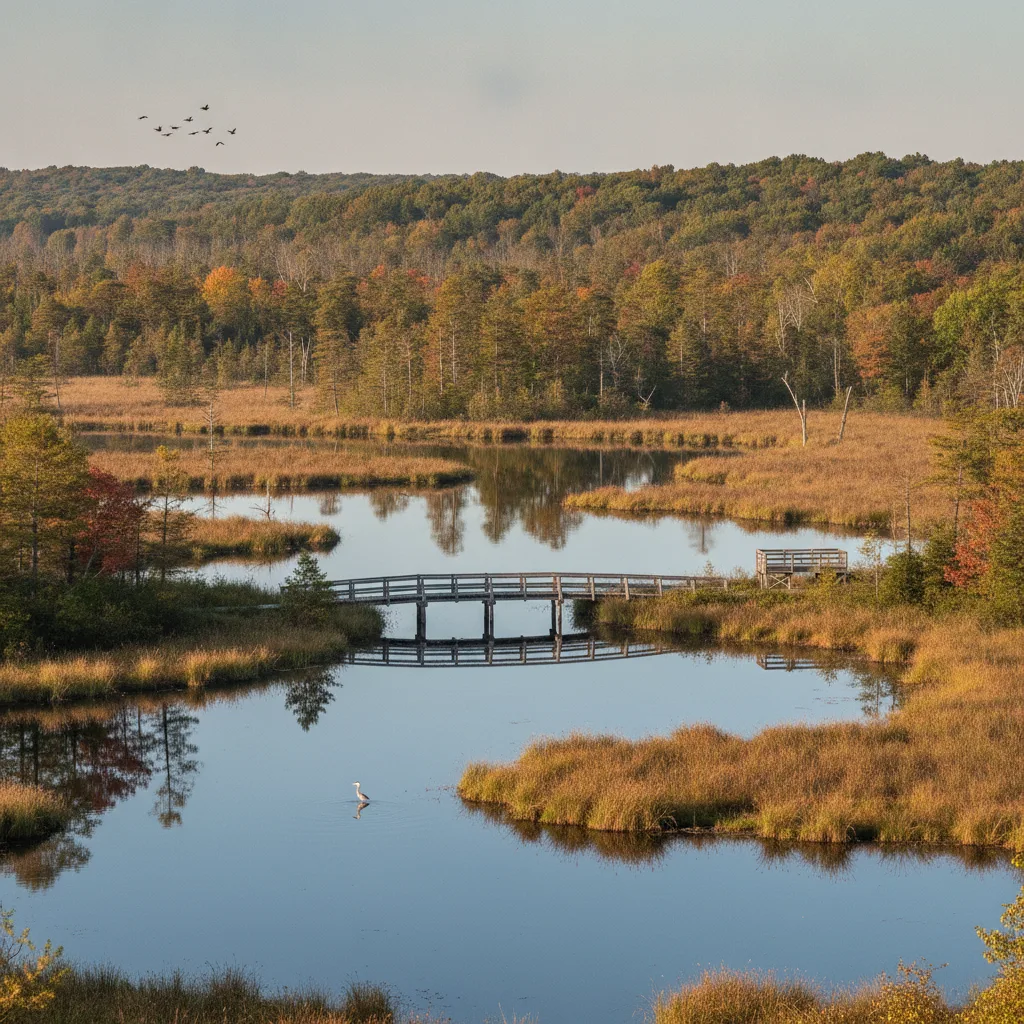
Our Great Swamp National Wildlife Refuge guide covers practical planning for Great Swamp National Wildlife Refuge New Jersey — best time to visit, getting there, and what to do on the ground. We're here to cut through the noise and provide you with confident, specific insights for your 2026 trip to this vital natural area.
Why Visit Great Swamp National Wildlife Refuge
The Great Swamp National Wildlife Refuge New Jersey is a true natural gem, offering a vital sanctuary for migratory birds and diverse wildlife just 26 miles west of New York City's Times Square. We've found that it provides a stark, beautiful contrast to the surrounding suburban landscape, making it an outstanding area for migrating waterfowl to stop, rest, and feed. Established in 1960, the refuge spans 12 square miles of protected wetlands and forests, a testament to a citizen-led fight to preserve this ecosystem from becoming a jetport.
For those seeking an escape into nature, the Great Swamp offers an unforgettable experience, reminding us that wild places still thrive even at the edge of one of the country's most populated corridors. Our team believes that the refuge's commitment to habitat restoration, scientific research, and grassland maintenance creates a thriving environment for over 244 bird species, 39 mammal species (including river otters, beavers, and coyotes), and 10 bat species, such as the endangered Indiana bat. You might even spot painted turtles, spring peepers, or the rare spotted turtle in its ponds and marshes.
Is Great Swamp National Wildlife Refuge worth visiting? Absolutely. We consider it a must-visit for anyone looking to connect with nature, observe wildlife, or simply enjoy a peaceful outdoor experience in New Jersey. The diversity of wildlife and habitats, combined with accessible trails and educational opportunities, makes it a rewarding destination for all ages and interests. This protected area truly showcases the enduring value of conservation.
Who It's Best For
The Great Swamp National Wildlife Refuge is ideal for a wide range of visitors. Our team particularly recommends it for:
- Birdwatchers and Nature Photographers: With over 244 bird species recorded, along with abundant mammals, reptiles, and amphibians, the refuge offers exceptional opportunities for wildlife observation and photography. The Wildlife Observation Center, with its boardwalks and blinds, is specifically designed for this purpose.
- Hikers and Walkers: The refuge boasts nearly 11.5 miles of foot access trails, ranging from easy boardwalks to more primitive paths in the Wilderness Area. It's a fantastic spot for a leisurely stroll or a more extended hike.
- Families with Children: The Helen Fenske Visitor Center offers interactive exhibits, a children's corner with seasonal crafts, and the Nature Detective Trail, a short self-guided woodland trail designed to engage kids with nature. The auto tour route also allows for wildlife viewing from the comfort of your car, which can be great with little ones.
- Peace Seekers: Despite its proximity to a major metropolitan area, the Great Swamp offers a serene environment for those looking to unplug and reconnect with nature. Early mornings are particularly quiet and rewarding for wildlife viewing.
However, we advise against visiting in summer if you're particularly sensitive to insects, as mosquitoes, ticks, and deer flies can be numerous from May to September. Waterproof footwear is also recommended during most seasons, especially in the Wilderness Area.
Getting There & Parking
Knowing how to get to Great Swamp National Wildlife Refuge is crucial for a smooth visit. The refuge is conveniently located in northern New Jersey, making it accessible from various points in the tri-state area.
By Car
The primary way to access the refuge is by car. We recommend using GPS coordinates for the Helen C. Fenske Visitor Center or the Wildlife Observation Center for the most accurate directions. For the Helen C. Fenske Visitor Center, the address is 32 Pleasant Plains Road, Basking Ridge, NJ 07920.
- From Interstate 78 (westbound): Take exit 40 (Gillette) and turn right onto Hillcrest Road (County Road 531). Continue to the stop sign (1 mile), cross Mountain Avenue, staying on Hillcrest Road (CR 531). Hillcrest Road becomes Mountain Avenue after crossing the Passaic River Bridge. Go straight through the traffic light at County Road 512, continuing on Mountain Avenue (now also County Road 638). Drive 1.3 miles to the top of the hill, cross Long Hill Road onto Meyersville Road. Go 0.8 miles down Meyersville Road to the Meyersville Circle, then turn left onto New Vernon Road. To reach the Helen C. Fenske Visitor Center, travel straight on New Vernon/Long Hill Road for approximately 4 miles, then turn left on Lee's Hill Road. Continue for about 2 miles, then turn left onto Wood Duck Way.
- From Interstate 78 (eastbound): Take exit 40 and turn left onto Hillcrest Road (County Road 531), then follow the westbound directions.
- From Interstate 287 (southbound and northbound): Take Exit 30A (Basking Ridge/North Maple Avenue) and bear right onto North Maple Avenue. At the first traffic light, turn left onto Madisonville Road. Continue on Madisonville Road, then Lee's Hill Road (you'll pass a refuge sign) for approximately 2.5 miles to the intersection with Long Hill Road. The Helen C. Fenske Visitor Center will be on your right.
To reach the Wildlife Observation Center (WOC) at 220 Long Hill Road, Harding Township, from the intersection of White Bridge and Long Hill/New Vernon Road, continue north on Long Hill/New Vernon Road for 0.9 miles and turn left at the sign for the Wildlife Observation Center.
Public Transportation
While public transportation can get you close, it doesn't offer direct access. The closest train stops are in Stirling and Gillette. However, there is no public transportation service between the train stations and the wildlife refuge, so you would need to arrange for a car service or taxi from there.
Parking
There are multiple parking lots available at the refuge, so we advise planning ahead to determine which area you intend to visit. The Helen C. Fenske Visitor Center has parking, as does the Wildlife Observation Center and the Overlook Parking Area on Pleasant Plains Road. Parking is generally free.
Top Things to Do
When planning your visit to Great Swamp National Wildlife Refuge, you'll find a variety of activities to immerse yourself in the natural world. Our team focuses on experiences that truly highlight the refuge's unique offerings, ensuring you get the most out of your time here.
Wildlife Observation and Photography
This is undeniably one of the top things to do at Great Swamp National Wildlife Refuge. The refuge is a haven for over 244 species of birds, including migratory waterfowl like mallards, wood ducks, teal, buffleheads, and pintails. You can also spot 39 mammal species such as white-tailed deer, red foxes, coyotes, river otters, and beavers. Reptiles and amphibians, including painted turtles, snapping turtles, green frogs, and spring peepers, are also abundant, especially along the boardwalks.
The Wildlife Observation Center (WOC), located at 220 Long Hill Road, is particularly excellent for photography and wildlife observation. It features approximately 1.5 miles of boardwalks and trails, an informational kiosk, and blinds specifically designed for observing wildlife. As of January 5th, 2026, the WOC was temporarily closed for a habitat restoration project, but it was anticipated to reopen by the end of February 2026. We recommend checking the official refuge website for the most up-to-date information on its status.
The Overlook Parking Area on Pleasant Plains Road offers two viewing scopes, providing another excellent opportunity to see many bird species. Early mornings and late afternoons are generally the best times for observing wildlife.
Great Swamp National Wildlife Refuge Hiking Trails
The refuge offers an extensive network of Great Swamp National Wildlife Refuge hiking trails, catering to various fitness levels. There are close to 11.5 miles of foot access trails throughout the refuge, with varying levels of difficulty.
- Helen C. Fenske Visitor Center Trails: Starting at the visitor center, you can explore the half-mile Bockoven Trail, which leads to views of a vernal pool and the Passaic River. The Nature Detective Trail is a short, self-guided woodland trail perfect for children to engage their senses. Directly across the street from the visitor center, the White Oak Trail is a generally flat, one-mile loop with a mix of boardwalk and compacted stone dust, offering views of a vernal pool.
- Wildlife Observation Center Boardwalks: As mentioned, the WOC provides 1.5 miles of boardwalks, offering easy, accessible walking through swampy areas and excellent wildlife viewing.
- Wilderness Area Trails: The eastern half of the refuge was designated as a National Wilderness Area in 1968, offering a more primitive outdoor experience. Here, you can hike on approximately 8.5 miles of trails. Waterproof footgear or old sneakers are highly recommended for these trails, especially from May to September when mosquitoes, ticks, and deer flies can be numerous.
- Pleasant Plains Road Auto Tour: While primarily an auto tour route, the 2-mile stretch on Pleasant Plains Road can also be used for hiking, allowing visitors to view wildlife from the comfort of their car or on foot.
We advise picking up a trail guide at the Helen C. Fenske Visitor Center to help navigate the various Great Swamp National Wildlife Refuge hiking trails.
Educational Programs and Visitor Center
The Helen C. Fenske Visitor Center is an excellent starting point for any visit. It features state-of-the-art exhibits showcasing refuge wildlife, habitats, history, and recreational opportunities. The "History Hallway" tells the compelling story of the citizen-led effort to save the Great Swamp from becoming a jetport. The visitor center is open Tuesday, Thursday, Friday, Saturday, and Sunday from 10 AM to 4 PM. It also houses the Friends of Great Swamp NWR Nature Shop, where you can find nature-themed items.
The Friends of Great Swamp National Wildlife Refuge also host a variety of educational programs, including monthly "Second Sunday" events with different educational topics. Interpretive tours can be arranged for small groups by contacting the Refuge Specialist.
Other Activities
- Auto Tours: The refuge offers auto tour routes, such as along Pleasant Plains Road, which provide a great all-season way to see wildlife and habitats from the comfort of your car.
- Hunting: The refuge hosts a four-day muzzleloader and shotgun deer hunt and a one-day youth deer hunt each year, in accordance with state and refuge regulations.
- Volunteer Opportunities: The Friends of Great Swamp National Wildlife Refuge are an all-volunteer organization that supports the refuge through volunteer efforts and funding. Opportunities include trail maintenance, habitat restoration, and staffing the visitor center.
Best Time to Visit
Our team has found that timing your visit to the Great Swamp National Wildlife Refuge can significantly enhance your experience. While the refuge is open year-round from sunrise to sunset, seven days a week, certain seasons offer distinct advantages.
Spring (March-May): We believe spring is an excellent time to witness the awakening of the swamp. Migratory birds return, and the refuge bursts with new life. Early spring brings the emergence of various amphibians and the first wildflowers. However, be aware that spring can also see a large number of visitors, especially on Sundays, which might make wildlife viewing less rewarding. Mosquitoes and ticks also begin to become active in May.
Fall (September-November): Our top recommendation for visiting is early fall. The air turns drier and cooler, reducing the mosquito population to more manageable levels. This season is fantastic for observing migratory birds as they pass through, and the changing foliage adds a beautiful backdrop to your visit. Like spring, fall can also be a popular time, so consider visiting on weekdays for a more tranquil experience.
Winter (December-February): For a truly serene and unique experience, our team enjoys visiting after a fresh snowfall. The nature is very quiet, and you might find yourself as one of the few visitors. Wildlife, such as deer and occasional raccoons, can be easier to spot against the snowy landscape. The Helen C. Fenske Visitor Center remains open during winter, offering a warm respite.
Summer (June-August): We generally advise caution for summer visits. While the refuge is lush and green, it can be very hot and humid, and you will likely encounter numerous biting insects like mosquitoes, ticks, and deer flies. If you do visit in summer, we strongly recommend ample insect repellent and protective clothing. Early mornings are still the best for wildlife viewing during this season.
Overall, for the best combination of pleasant weather, active wildlife, and fewer insects, our team confidently suggests early fall as the prime time to explore Great Swamp National Wildlife Refuge. If you prefer solitude and don't mind the cold, a winter visit after snowfall offers a magical experience.
Where to Stay Nearby
While Great Swamp National Wildlife Refuge itself does not offer on-site lodging or camping, there are numerous comfortable options in the surrounding towns of Basking Ridge, Morristown, Florham Park, and Berkeley Heights. Our team has identified several highly-rated hotels that provide convenient access to the refuge, ensuring your Great Swamp National Wildlife Refuge lodging needs are met.
Hotels in Basking Ridge and Surrounding Areas
Basking Ridge is the nearest sizable town to the refuge, offering a selection of hotels that balance convenience with comfort.
- The Olde Mill Inn Basking Ridge: Located in Basking Ridge, this hotel is within a 10-minute drive of Morristown Memorial Hospital and offers amenities like a 24-hour fitness center, a terrace, garden, complimentary Wi-Fi, and an on-site restaurant. It's a solid choice for Great Swamp National Wildlife Refuge lodging.
- Delta Hotels Basking Ridge: Situated in Liberty Corner, this hotel provides modern guest rooms with premium bedding, free Wi-Fi, and flexible workspaces. Guests can enjoy on-site dining, a 24-hour fitness center, and free parking. It's just minutes from various local attractions, including the refuge.
- Courtyard Basking Ridge: Also in Liberty Corner, this Marriott property offers comfortable accommodations with easy access to the refuge and other local sights.
- Somerset Hills Hotel, Tapestry Collection by Hilton: This hotel in Warren offers a quiet suburban location, just half a mile from Route 78. It features a fitness center, outdoor pool, and free Wi-Fi, with contemporary guest rooms.
- Embassy Suites by Hilton Berkeley Heights: A great option for both business and leisure travelers, offering modern all-suite accommodations, complimentary breakfast, and a prime location. It's a bit further but still a convenient choice for Great Swamp National Wildlife Refuge lodging.
Hotels in Morristown
Morristown, a vibrant town with historical significance, is also a good base for visiting the Great Swamp, approximately a 15-20 minute drive away.
- Hyatt Regency Morristown New Jersey at Hqs Plaza: A well-regarded hotel in the heart of Morristown, offering a range of amenities and easy access to both the refuge and Morristown's attractions.
- The Westin Governor Morris, Morristown: Known for its upscale accommodations and services, providing a comfortable stay for those exploring the region.
- Hyatt House Morristown: Offers spacious accommodations, a fitness center, and convenient access to local attractions, making it suitable for families and extended stays.
When selecting your Great Swamp National Wildlife Refuge lodging, we recommend considering the specific location within the refuge you plan to visit most frequently, as distances can vary. Many hotels offer free parking, which is a significant advantage when traveling by car.
Sample 2-Day Itinerary
To truly experience the Great Swamp National Wildlife Refuge and its surrounding area, our team has crafted a sample 2-day itinerary that balances nature exploration with local charm. This plan assumes you're staying in or around Basking Ridge.
Day 1: Immersion in the Refuge
Morning (8:00 AM - 12:00 PM): Wildlife Observation & Hiking
- Start your day early at the Helen C. Fenske Visitor Center (open Tuesday, Thursday-Sunday from 10 AM, but arrive earlier for prime wildlife viewing on trails). Pick up a map and get current information on wildlife sightings.
- Head directly to the Wildlife Observation Center (WOC) at 220 Long Hill Road. Spend 2-3 hours walking the 1.5 miles of boardwalks and trails, utilizing the observation blinds for birdwatching and nature photography. This is one of the best things to do at Great Swamp National Wildlife Refuge. Remember to check its current status as it was temporarily closed for restoration in early 2026.
- Alternatively, explore the White Oak Trail directly across from the Visitor Center for a pleasant 1-mile loop.
Lunch (12:00 PM - 1:30 PM): Picnic or Local Eatery
- Pack a picnic to enjoy at one of the designated picnic areas within the refuge, or head into Basking Ridge for a casual lunch. Options like Blue Café or Delaila Cafe offer fresh, locally sourced ingredients.
Afternoon (1:30 PM - 5:00 PM): Wilderness Area Exploration & Auto Tour
- For more extensive Great Swamp National Wildlife Refuge hiking trails, venture into the Wilderness Area. Choose a trail like the Orange Trail (accessible from the east end of White Bridge Road) for a more rustic experience. Be sure to wear waterproof footwear and insect repellent, especially between May and September.
- Conclude your refuge exploration with the Pleasant Plains Road Auto Tour. Drive slowly, keeping an eye out for deer, wild turkeys, and other wildlife at the edges of the woods or in the impoundment areas.
Evening: Relaxed Dinner
- Enjoy dinner at a local restaurant in Basking Ridge or Morristown. The Olde Mill Inn Basking Ridge has an on-site restaurant.
Day 2: Local Culture & Nearby Attractions
Morning (9:00 AM - 12:00 PM): Basking Ridge Charm or Historical Exploration
- Option A (Local Charm): Explore downtown Basking Ridge. You can stroll through the 250-year-old oak tree cemetery at the historic Presbyterian Church. Enjoy a coffee or brunch at a local spot like Blue Café.
- Option B (History Buffs): Drive to Morristown National Historical Park, a significant Revolutionary War site, just a short drive from Basking Ridge. Explore Washington's Headquarters Museum and the Ford Mansion.
Lunch (12:00 PM - 1:30 PM): Morristown or Basking Ridge
- Grab lunch in Morristown if you chose the historical option, or return to Basking Ridge for more local dining.
Afternoon (1:30 PM - 5:00 PM): Environmental Education or Art & Gardens
- Option A (Environmental Focus): Visit the Lord Stirling Park Environmental Education Center, which offers engaging programs highlighting local ecosystems, adjacent to the Great Swamp.
- Option B (Art & Gardens): For a change of pace, consider a visit to Grounds For Sculpture in Hamilton, NJ, about an hour's drive south. This renowned sculpture park and arboretum offers a unique blend of art and nature (Grounds For Sculpture).
Evening: Departure or Extended Stay
- Depending on your travel plans, you can depart or enjoy a final dinner in the area. If you're extending your trip in New Jersey, consider exploring other parts of the state, such as Best places in New Jersey, or even a trip to The Jersey Shore or the Atlantic City Boardwalk.
Great Swamp National Wildlife Refuge camping
There is no Great Swamp National Wildlife Refuge camping directly within the refuge itself. However, several private campgrounds and state parks in the wider New Jersey area offer camping options. For instance, Wildflower Hill, located on the ridgeline of the 3rd Watchung Mountain, sits above the Great Swamp National Wildlife Refuge and offers tent spots and amenities like a fire pit and free firewood. Other options further afield include Camp Taylor Campground, open from late April to late October, with primitive tent sites, electric and water hookups, and cabins. Turkey Swamp Park also offers wooded campsites with electrical and water service, cabins, and modern restrooms. Stokes State Forest provides tent sites and lean-tos, with some open year-round.
things to do in Basking Ridge
Beyond the Great Swamp National Wildlife Refuge, things to do in Basking Ridge include exploring its charming downtown area. You can visit the historic Presbyterian Church with its 250-year-old oak tree cemetery. For outdoor recreation, Pleasant Valley Park offers a seasonal pool, playground, fields, courts, and trails. Other parks like Southard Park and Mountain Park provide additional amenities for family-friendly activities. The Bernards Township Library offers cultural and educational programs. Nearby attractions also include Morristown National Historical Park, the United States Golf Association Museum, and Scherman Hoffman Wildlife Sanctuary. The Ross Farm also hosts events.
Great Swamp National Wildlife Refuge with kids
Visiting Great Swamp National Wildlife Refuge with kids can be a highly engaging experience. Our team recommends starting at the Helen C. Fenske Visitor Center, which features interactive exhibits, a children's corner with seasonal crafts, and the Nature Detective Trail, a short self-guided woodland trail designed to help children explore nature. The Wildlife Observation Center's boardwalks are stroller-friendly and provide easy viewing of turtles, frogs, and birds. You can also take a 2-mile auto tour route on Pleasant Plains Road to observe wildlife from your car. Remember to bring binoculars and a camera, and consider a hiking carrier for younger children on less accessible trails.
best hotels near Great Swamp National Wildlife Refuge
The best hotels near Great Swamp National Wildlife Refuge offer convenience and comfort for your stay. Top recommendations include The Olde Mill Inn Basking Ridge, known for its amenities and on-site dining. The Delta Hotels Basking Ridge and Courtyard Basking Ridge are also excellent choices in Liberty Corner, providing modern rooms and easy access. For those preferring a slightly more upscale experience, the Somerset Hills Hotel, Tapestry Collection by Hilton in Warren, or the Hyatt Regency Morristown New Jersey at Hqs Plaza in Morristown are highly rated. Many of these hotels offer amenities like fitness centers, pools, and complimentary Wi-Fi.
Great Swamp National Wildlife Refuge tips
For a successful visit to Great Swamp National Wildlife Refuge, our team offers these essential tips:
- Check Visitor Center Hours: The Helen C. Fenske Visitor Center is open Tuesday, Thursday-Sunday from 10 AM to 4 PM. It's a great place to start for orientation and current information.
- Visit Early or Late: Wildlife observation is best in the early morning and late afternoon.
- Wear Appropriate Footwear: Waterproof footgear or old sneakers are recommended, especially in the Wilderness Area, as trails can be muddy.
- Bring Insect Repellent: From May to September, mosquitoes, ticks, and deer flies can be numerous, so protective clothing and repellent are advisable.
- Carry Binoculars and Camera: Enhance your wildlife viewing and photography opportunities.
- Consult the Friends of Great Swamp NWR: Their website and visitor center provide valuable information on events, programs, and refuge status.
- Be Aware of Closures: Occasionally, the refuge or specific areas like the Wildlife Observation Center may be closed due to special events, hazardous weather, or habitat restoration projects. Always check before you go.
where to stay near Great Swamp National Wildlife Refuge
When considering where to stay near Great Swamp National Wildlife Refuge, you'll find a range of options in nearby towns. Basking Ridge, Morristown, Florham Park, and Berkeley Heights all offer convenient access. Popular choices include The Olde Mill Inn Basking Ridge, Delta Hotels Basking Ridge, Courtyard Basking Ridge, and the Somerset Hills Hotel, Tapestry Collection by Hilton. For those seeking an all-suite option, Embassy Suites by Hilton Berkeley Heights is a good choice. Morristown also provides excellent hotels like the Hyatt Regency Morristown and The Westin Governor Morris. These establishments generally offer a variety of amenities to ensure a comfortable stay while you explore the refuge.
Our team at Roam States hopes this guide provides you with all the essential information needed to plan a confident and rewarding trip to the Great Swamp National Wildlife Refuge New Jersey. This protected natural area is a testament to the beauty and resilience of New Jersey's ecosystems, offering unparalleled opportunities for wildlife observation, photography, and peaceful reflection. We encourage you to visit and discover the unique charm of this significant natural sanctuary.
Last updated: 2026-07-07 by the Roam States team.