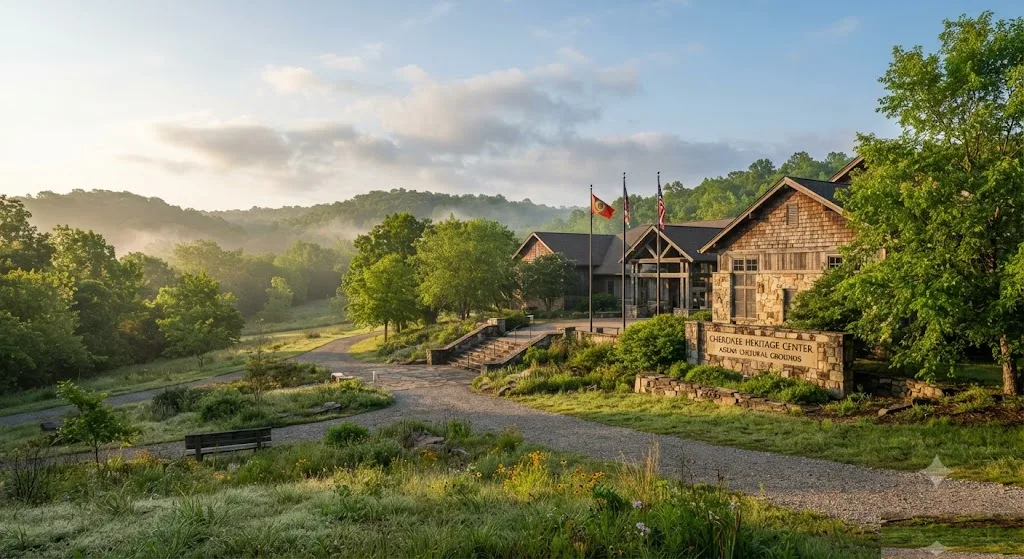
Cherokee Heritage Center Travel Guide — Oklahoma
Our Cherokee Heritage Center guide covers practical planning for Cherokee Heritage Center Oklahoma — best time to visit, getting there, and what to do on the ground. Please note that as of our last update in July 2026, the Cherokee Heritage Center is currently closed to the public for a significant redevelopment project. Our guide reflects what visitors can anticipate from the reimagined center once it reopens, alongside practical advice for exploring the surrounding Cherokee Nation.
Why Visit Cherokee Heritage Center
The Cherokee Heritage Center Oklahoma, located in Park Hill near Tahlequah, stands as a profound testament to the enduring spirit, rich history, and vibrant culture of the Cherokee Nation. While currently undergoing a transformative redevelopment, its significance as the premier cultural institution for the Cherokee people remains unwavering. Established in 1967 by the Cherokee National Historical Society on the grounds of the former Cherokee Female Seminary, the center has long been dedicated to preserving and promoting Cherokee history and culture.
Our team believes that a visit here, once the reimagined center opens, will be an essential experience for anyone seeking a deeper understanding of Indigenous history in the United States. The Cherokee Nation has a compelling story, from its ancient roots in the southeastern United States to the forced removal on the Trail of Tears and its remarkable resilience in rebuilding in Indian Territory (present-day Oklahoma).
The new campus, whose designs were unveiled in April 2026, promises to enhance this experience, transforming the 43-acre site into a state-of-the-art center for history and culture. It will feature a new museum, expanded educational and genealogical spaces, communal gathering areas, and a research center, all designed to protect and build upon the site's legacy. This commitment to storytelling, education, and cultural preservation is why we wholeheartedly recommend planning a future visit to the Cherokee Heritage Center Oklahoma.
Who It's Best For
The reimagined Cherokee Heritage Center will cater to a diverse range of visitors, making it a compelling destination for many. It will be particularly ideal for:
- **History Enthusiasts:** Those with a keen interest in Native American history, particularly the complex and resilient story of the Cherokee Nation, will find the new museum and exhibits deeply engaging. The permanent Trail of Tears exhibit is a powerful and essential experience.
- **Families and Educators:** The planned educational spaces and living history villages will offer interactive and immersive learning opportunities for children and students of all ages. It’s an excellent way to introduce younger generations to Indigenous cultures and historical events.
- **Genealogists and Researchers:** With dedicated genealogical spaces and a research center planned, individuals tracing their Cherokee ancestry or conducting scholarly research will find invaluable resources.
- **Cultural Explorers:** Anyone interested in experiencing and appreciating Indigenous art, traditions, and contemporary Cherokee life will find the center's offerings, including cultural demonstrations and art shows, enriching.
- **Travelers Seeking Authentic Experiences:** For those looking to move beyond generic tourist attractions and engage with a profound cultural narrative, the Cherokee Heritage Center Oklahoma offers an authentic and impactful journey.
We anticipate that the new center will be designed to be accessible and engaging for visitors of all ages and backgrounds, fostering understanding and appreciation for Cherokee heritage.
Getting There & Parking
The Cherokee Heritage Center is situated in Park Hill, Oklahoma, approximately six miles south of downtown Tahlequah, the capital of the Cherokee Nation. For those wondering how to get to Cherokee Heritage Center, the most common approach is by car.
- **From Tulsa:** The drive from Tulsa to the Cherokee Heritage Center is roughly an hour to an hour and a half, depending on traffic. You'll generally take US-64 E and US-62 E towards Tahlequah.
- **From Oklahoma City:** Traveling from Oklahoma City, expect a drive of about 2 hours and 30 minutes. The route typically involves I-44 E and then various state highways towards Tahlequah.
- **Local Directions:** Once you reach the Tahlequah area, take Highway 62 (also known as Cherokee Hills Scenic Byway) south. Turn east onto Willis Road, and then turn right onto South Keeler Drive to reach the center.
Regarding Cherokee Heritage Center parking, the unveiled designs for the reimagined center indicate that the new campus will integrate into the existing landscape, and we expect ample parking facilities to be included as part of this major redevelopment. While specific parking layouts and fees for the new center are not yet available, we anticipate that visitor parking will be well-organized to accommodate the expected increase in visitors. Historically, parking at such cultural institutions is often free or included with admission, but this will be confirmed closer to the reopening date.
Anticipating the Top Experiences at the Reimagined Center
While the Cherokee Heritage Center is currently closed for redevelopment, the unveiled designs provide an exciting glimpse into the future, promising an even richer and more immersive experience for visitors. Our team is eager to see the realization of these plans, which will undoubtedly offer a wealth of things to do at Cherokee Heritage Center once it reopens.
Here’s what we anticipate will be the top things to do at Cherokee Heritage Center:
- **Explore the New Cherokee National Museum:** The heart of the reimagined campus will be a brand-new museum. We expect this to house expanded permanent and rotating exhibits, offering a comprehensive journey through Cherokee history, culture, and contemporary life. This will include artifacts, interactive displays, and personal narratives, providing a deeper understanding of Cherokee resilience and sovereignty.
- **Walk the Trail of Tears Exhibit:** A permanent exhibit dedicated to the Trail of Tears is a critical component of the center's mission. Designed in conjunction with the National Park Service, this exhibit explores the forced removal of Cherokee ancestors from their indigenous territory to Indian Territory. This emotional and educational experience is vital for understanding a pivotal moment in Cherokee history.
- **Step Back in Time at Diligwa, the 1710 Cherokee Village:** The reconstructed 1710 Cherokee Village, known as Diligwa, is a living history exhibit that transports visitors to an early 18th-century Cherokee community. We expect this outdoor attraction to continue offering engaging interpretive stations, residential sites, and demonstrations of traditional Cherokee life, including crafts like basketry and flint knapping, and perhaps even traditional games like stickball or blowgun use.
- **Visit the Adams Corner Rural Village:** Depicting a Cherokee community in the 1890s, the Adams Corner Rural Village provides insight into Cherokee life during a later historical period. This village, with its historic buildings like a church, schoolhouse, and log cabins, offers a glimpse into how the Cherokee Nation rebuilt and thrived after removal.
- **Engage with the Cherokee Family Research Center:** For those interested in their own Cherokee ancestry, the Family Research Center will be an invaluable resource. We anticipate enhanced genealogical spaces to assist visitors in exploring their lineage and connecting with their heritage.
- **Experience Cultural Workshops and Events:** The center has historically hosted cultural workshops and events year-round. We expect the new campus to expand upon these offerings, providing opportunities to learn traditional arts, language, and storytelling directly from Cherokee citizens. Keep an eye on the Cherokee Nation's official tourism site for future event schedules.
- **Explore the Tsa-La-Gi Amphitheater:** The site also includes the Tsa-La-Gi amphitheater, designed by Charles 'Chief' Boyd, the first AIA-recognized Cherokee architect. This venue has historically hosted cultural performances, and we anticipate it will continue to be a vibrant space for storytelling, dance, and other theatrical presentations that bring Cherokee history to life.
Beyond the Cherokee Heritage Center, there are also things to do in Park Hill and the surrounding Tahlequah area. You can explore other Cherokee Nation museums, such as the Cherokee National History Museum, the Cherokee National Supreme Court Museum, and the Cherokee National Prison Museum, all located in downtown Tahlequah and offering free admission. Hunter's Home, a preserved 19th-century plantation home offering insights into pre-Civil War Cherokee life, is also a short drive from Tahlequah in Park Hill. The Cherokee Cultural Pathway in Tahlequah connects several museums with native art installations. Additionally, outdoor activities at nearby state parks like Cherokee Landing State Park or exploring Lake Tenkiller offer recreational opportunities.
Best Time to Visit
When considering the best time to visit the Cherokee Heritage Center Oklahoma, we recommend factoring in both the regional climate and potential future event schedules. Since the center is currently closed for redevelopment, specific event dates are not yet available for its reopening. However, general advice for visiting this part of Oklahoma holds true.
- **Spring (April to May):** Spring offers pleasant temperatures, typically ranging from the 60s to 70s Fahrenheit (15-25°C), with blooming wildflowers. This is an excellent time to explore outdoor exhibits like Diligwa without the intense summer heat. There is a higher chance of rain, so be prepared.
- **Fall (September to October):** Fall is arguably the most beautiful time to visit, with comfortable temperatures and stunning autumn foliage in the Ozark foothills. Temperatures are usually in the 60s and 70s Fahrenheit (15-25°C). The Cherokee National Holiday, a major annual celebration commemorating the signing of the Cherokee Nation Constitution in 1839, typically takes place around Labor Day weekend in Tahlequah. While the main Heritage Center is closed, other Cherokee Nation attractions in Tahlequah often participate in related events.
- **Summer (June to August):** Summers in Oklahoma can be very hot and humid, with temperatures often reaching into the 90s Fahrenheit (30s°C) or higher. While the center's indoor museum will offer respite from the heat, exploring the outdoor villages might be less comfortable during midday. If visiting in summer, we suggest early morning or late afternoon visits for outdoor areas.
- **Winter (November to March):** Winters are generally mild but can include cold snaps and occasional ice or snow. Temperatures can vary widely. This might be a quieter time to visit, focusing more on indoor exhibits.
Once the reimagined Cherokee Heritage Center reopens, we advise checking their official website for updated hours, event calendars, and any seasonal programming that might influence your visit. For now, planning for spring or fall will generally provide the most comfortable weather conditions for exploring the broader Cherokee Nation attractions.
Where to Stay Nearby
Finding suitable Cherokee Heritage Center lodging is straightforward, with options available in nearby Tahlequah and surrounding communities. While Park Hill itself is small, Tahlequah, as the capital of the Cherokee Nation, offers the most extensive selection of accommodations and amenities.
Tahlequah, Oklahoma
Just a short drive from the Cherokee Heritage Center, Tahlequah provides a variety of hotels, motels, and vacation rentals. We recommend staying in Tahlequah for convenience, as it also hosts several other significant Cherokee Nation museums and cultural sites. Options typically range from budget-friendly motels to more comfortable chain hotels. For those seeking a unique experience, local guesthouses or bed-and-breakfasts might also be available.
Lake Tenkiller Area
If you're looking to combine your cultural visit with outdoor recreation, consider lodging near Lake Tenkiller, which is a short drive southeast of Park Hill. This area offers cabins, vacation rentals, and campsites, particularly appealing to families or those who enjoy fishing, boating, and hiking. You might find modern shipping container homes or motels in this area.
Other Nearby Towns
Larger cities like Muskogee (about 45 minutes west) or Fort Smith, Arkansas (about an hour southeast), offer more extensive lodging choices, including a wider range of hotel chains and dining options. However, for direct access to the Cherokee Nation's cultural heart, Tahlequah remains our top recommendation for Cherokee Heritage Center lodging.
We always advise booking your accommodations in advance, especially if you plan to visit during peak seasons or major Cherokee Nation events like the Cherokee National Holiday.
Sample 2-Day Itinerary
While the Cherokee Heritage Center is undergoing its exciting transformation, we've crafted a sample 2-day itinerary that anticipates its future reopening and combines it with other vital Cherokee Nation sites in the area. This plan ensures a rich immersion into Cherokee history and culture.
Day 1: Immersion in Cherokee History and Culture
- **Morning (Anticipated Reopening of Cherokee Heritage Center):** Begin your day at the reimagined Cherokee Heritage Center Oklahoma in Park Hill. Dedicate ample time (3-4 hours) to explore the new Cherokee National Museum, delving into the comprehensive exhibits on Cherokee history, art, and contemporary life. Experience the profound Trail of Tears exhibit, a poignant and essential part of the visit.
- **Late Morning/Early Afternoon:** Step outside to the reconstructed 1710 Diligwa Cherokee Village. Wander through the residential sites, observe living history interpreters demonstrating traditional crafts like basketry and flint knapping, and gain insight into early 18th-century Cherokee life. Afterwards, explore the 1890s Adams Corner Rural Village to see how the Cherokee Nation rebuilt and thrived.
- **Lunch:** Enjoy a meal at a local eatery in Tahlequah, perhaps sampling some regional cuisine.
- **Afternoon:** Head into downtown Tahlequah to explore more of the Cherokee Nation's cultural pathway. Visit the Cherokee National History Museum (housed in the historic Cherokee National Capitol Building), the Cherokee National Supreme Court Museum, and the Cherokee National Prison Museum. These museums offer fascinating insights into Cherokee governance and justice systems, and admission is free.
- **Evening:** Dine in Tahlequah. Consider attending a cultural event or performance at the Tsa-La-Gi amphitheater if one is scheduled, once the Heritage Center reopens and events resume.
Day 2: Further Exploration and Natural Beauty
- **Morning:** Start your day with a visit to Hunter's Home, a preserved 19th-century plantation home located a short drive from Tahlequah in Park Hill. This unique historical site offers guided tours and living-history demonstrations, providing insight into Cherokee life before the Civil War. Admission is free for some categories, including Oklahoma Historical Society Members and children 5 and under.
- **Late Morning:** Drive to the John Ross Museum in Park Hill, dedicated to Principal Chief John Ross, who led the Cherokee Nation through some of its most critical times, including the Trail of Tears and the Civil War. The museum, housed in a former rural school, offers exhibits and interactive displays. Admission is free.
- **Lunch:** Picnic at a scenic spot near Lake Tenkiller or enjoy a casual lunch in a nearby community.
- **Afternoon:** Embrace the natural beauty of the region with a visit to Cherokee Landing State Park on Lake Tenkiller. Enjoy hiking, birdwatching, or simply relaxing by the water. Alternatively, for those interested in more history, consider a visit to the Fort Gibson Historic Site, instrumental in the settlement of Indian Territory.
- **Evening:** Enjoy a final dinner in Tahlequah or at a lakeside restaurant if staying near Lake Tenkiller.
This itinerary provides a comprehensive cultural experience, combining the anticipated offerings of the Cherokee Heritage Center with other significant sites within the Cherokee Nation. For a broader Oklahoma experience, consider extending your trip to include destinations like the Oklahoma City National Memorial, the National Cowboy & Western Heritage Museum, or exploring more of Oklahoma's diverse attractions.
The Future: Is the Reimagined Cherokee Heritage Center Worth Visiting?
Given that the Cherokee Heritage Center is currently closed for a major redevelopment, the question "is Cherokee Heritage Center worth visiting" shifts to "will it be worth visiting" once the new campus opens. Our team confidently asserts that the reimagined Cherokee Heritage Center will undoubtedly be a worthwhile and essential destination for travelers to Oklahoma.
The plans unveiled in April 2026 by Safdie Architects, with Anishinabe Design, PWP Landscape, and the Cherokee Nation, describe a transformative project. The new campus will feature a state-of-the-art museum, expanded educational and genealogical spaces, and communal gathering areas, all designed to deepen the visitor's understanding and appreciation of Cherokee history and culture. This significant investment in preserving and promoting the Cherokee narrative speaks volumes about the Nation's commitment to sharing its legacy with the world.
The center's historical significance, located on the grounds of the former Cherokee Female Seminary and designated as an interpretive site for the western terminus of the Trail of Tears, cannot be overstated. The opportunity to engage with living history at the reconstructed Diligwa village and to explore the profound Trail of Tears exhibit will continue to offer unparalleled educational and emotional experiences.
For those seeking authentic cultural immersion, a deeper understanding of American history from an Indigenous perspective, or a connection to Cherokee ancestry, the future Cherokee Heritage Center will be an invaluable resource. We believe that the enhancements and expansions planned will elevate the visitor experience, making the question "is Cherokee Heritage Center worth visiting" an emphatic yes for anyone traveling through this historically rich region of Oklahoma.
FAQ
Cherokee Heritage Center with kids
While the Cherokee Heritage Center is currently closed for redevelopment, we anticipate the reimagined center will be an excellent destination for families with kids. The planned new museum, educational spaces, and especially the reconstructed Diligwa (1710 Cherokee Village) and Adams Corner Rural Village are designed to be interactive and engaging. Children can learn through living history demonstrations, traditional crafts, and immersive exhibits. We recommend checking the center's official website closer to its reopening for specific family-friendly programming, workshops, or guided tours tailored for younger visitors. Nearby attractions like Lake Tenkiller also offer outdoor activities that families can enjoy.
best hotels near Cherokee Heritage Center
The best hotels near Cherokee Heritage Center are primarily located in Tahlequah, Oklahoma, which is just a short drive away. As the capital of the Cherokee Nation, Tahlequah offers several chain hotels and local lodging options suitable for various budgets. For those seeking a more rustic or recreational experience, cabins and vacation rentals can be found near Lake Tenkiller. While the Cherokee Heritage Center lodging options are limited directly in Park Hill, Tahlequah provides convenient access to the center and other Cherokee Nation attractions.
Cherokee Heritage Center tips
Since the Cherokee Heritage Center is currently closed for redevelopment, our primary tip is to **monitor their official website** for announcements regarding its reopening date, new hours, and admission fees. Once open, we recommend allocating at least 3-4 hours to fully experience the museum and outdoor villages. Wear comfortable shoes, especially for exploring the living history sites. Consider visiting during the spring or fall for the most pleasant weather. If traveling with kids, look for specific family programs. Also, plan to visit other nearby Cherokee Nation attractions in Tahlequah, such as the Cherokee National History Museum and Hunter's Home, to enrich your cultural immersion.
where to stay near Cherokee Heritage Center
For visitors wondering where to stay near Cherokee Heritage Center, the most convenient base is Tahlequah, Oklahoma. This vibrant town, the capital of the Cherokee Nation, offers a range of hotels, motels, and some vacation rentals. It provides easy access to the Heritage Center and other important Cherokee Nation cultural sites. Alternatively, for those interested in combining culture with outdoor activities, the Lake Tenkiller area offers cabins and lakeside accommodations. Larger cities like Muskogee also offer more extensive hotel choices but are a longer drive from the center.
Cherokee Heritage Center parking
While the Cherokee Heritage Center is currently undergoing redevelopment, the plans for the reimagined campus are expected to include well-designed parking facilities. Historically, parking at the center has been available on-site. We anticipate that once the new center reopens, ample parking will be provided to accommodate visitors, likely with designated areas for cars and potentially buses. Specific details on parking fees or designated areas will be released closer to the center's grand reopening.
best time to visit Cherokee Heritage Center
The best time to visit Cherokee Heritage Center, once it reopens, will likely be during the **spring (April-May)** or **fall (September-October)**. These seasons offer comfortable temperatures, making it ideal for exploring both the indoor museum and the outdoor living history villages like Diligwa. Spring brings pleasant weather and blooming landscapes, while fall provides beautiful foliage and often coincides with significant Cherokee Nation events, such as the Cherokee National Holiday in Tahlequah. Summers can be very hot, and winters can be chilly, so plan accordingly if visiting during those times.
Last updated: 2026-07-08 by the Roam States team.