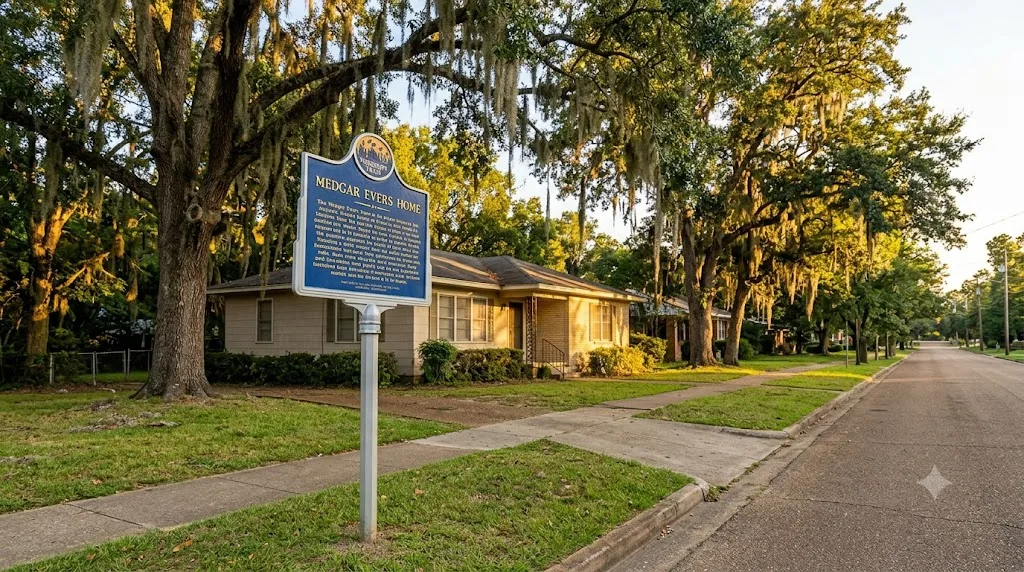
Our Mississippi Freedom Trail guide covers practical planning for Mississippi Freedom Trail Mississippi — best time to visit, getting there, and what to do on the ground.
The Mississippi Freedom Trail commemorates key people, places, and events of the Civil Rights Movement in Mississippi, featuring historical markers at significant locations throughout the state. Visitors can follow the trail to learn about the struggle for racial equality and its impact. The Mississippi Freedom Trail Mississippi was established in 2011 to recognize the profound role the state played in the American Civil Rights Movement. Since its inception, the trail has expanded, with new markers continuously being added, highlighting the stories of both prominent figures and everyday heroes who fought for justice.
Why Visit Mississippi Freedom Trail
Visiting the Mississippi Freedom Trail offers a deeply moving and educational experience, allowing us to walk in the footsteps of those who bravely fought for civil rights. It's an opportunity to connect with a pivotal era in American history, understanding the sacrifices made and the progress achieved. The trail isn't just a collection of historical markers; it's a journey through the heart of a movement that reshaped the nation. Each site tells a powerful story, from the homes of courageous activists to the courthouses where justice was sought, and often denied, during the struggle for racial equality. We believe the Mississippi Freedom Trail is absolutely worth visiting for anyone seeking a profound understanding of American history and the enduring fight for human dignity.
The trail provides a unique perspective on the Civil Rights Movement, focusing on Mississippi's specific contributions and challenges. We gain insight into the systemic oppression faced by Black Mississippians and the resilience they demonstrated in their fight for equality. The markers, often located at the exact sites where history unfolded, offer a tangible link to the past, making the stories of Medgar Evers, Fannie Lou Hamer, and Emmett Till incredibly real and impactful. It's a journey that fosters reflection, empathy, and a deeper appreciation for the ongoing pursuit of civil liberties. This immersive experience makes the Mississippi Freedom Trail worth visiting for both its historical significance and its contemporary relevance.
Who It's Best For
The Mississippi Freedom Trail is best for history enthusiasts, students, educators, and anyone with a keen interest in the Civil Rights Movement and American social justice. It's particularly impactful for those who prefer an immersive, self-guided exploration of historical sites rather than a single museum experience. Families with older children who are ready for serious historical topics will also find it incredibly valuable, as the trail offers concrete examples of courage and perseverance.
Our team finds that the trail appeals to travelers who appreciate a journey of reflection and learning, rather than just sightseeing. It's ideal for those who want to understand the complexities of the past and how they continue to shape the present. While many sites are accessible, visitors should be prepared for a driving tour with various stops, some of which are outdoor markers. It’s also suitable for those looking to combine historical exploration with a broader tour of Mississippi, linking the Civil Rights narrative with other cultural and natural attractions across the state, such as Vicksburg National Military Park or Natchez Historic Homes.
Getting There & Parking
Navigating the Mississippi Freedom Trail primarily involves driving, as its markers are spread across the state. We recommend planning your route in advance, as the trail is not a single contiguous path but rather a series of significant locations. Major hubs like Jackson serve as excellent starting points, offering access to several key markers. To get to Mississippi, visitors can fly into Jackson-Medgar Wiley Evers International Airport (JAN), which is centrally located and provides good access to many trail sites. For those driving, Mississippi is well-connected by interstates such as I-55, I-20, and I-59.
Parking and Accessibility
Parking at most Mississippi Freedom Trail sites is generally straightforward, often involving street parking near the historical markers or dedicated lots for museums and larger attractions. For example, the Mississippi Civil Rights Museum in Jackson has ample parking available for visitors. The Medgar Evers Home Museum also has limited street parking, with additional accessible parking available at Myrlie's Garden nearby.
Many of the sites along the Mississippi Freedom Trail are committed to accessibility. The Mississippi Civil Rights Museum is ADA accessible, as is the Medgar Evers Home Museum, which features an accessible ramp. The Fannie Lou Hamer Memorial Garden in Ruleville is also ADA accessible. While the trail itself consists of individual markers, which are generally accessible from public areas, some historic sites may have varying degrees of accessibility. We advise checking specific site information for detailed accessibility notes, especially for older buildings. For groups of 10 or more, reservations are often encouraged or required for guided tours at many of the museums and historic homes along the trail.
Top Things to Do
Exploring the Mississippi Freedom Trail offers a profound journey through American history, with numerous sites that bring the Civil Rights Movement to life. Our team has identified key experiences and things to do at Mississippi Freedom Trail to help you plan your visit.
Immersive Museum Experiences
- Mississippi Civil Rights Museum (Jackson): This is a cornerstone of the Mississippi Freedom Trail. The museum features eight interactive galleries that tell the stories of the movement, highlighting the systematic oppression and the heroic fight for equality. A central gallery, "This Little Light of Mine," features a dramatic sculpture that glows brighter as visitors gather, symbolizing the power of collective action. We recommend allowing at least 2-3 hours for a thorough visit. Admission in 2026 is $15 for adults, $8 for youth (ages 4-22), and $13 for seniors or military personnel. Admission is free every Sunday. The museum is open Tuesday-Saturday from 9 AM to 5 PM and Sunday from 11 AM to 5 PM, closed on Mondays. Group visits for 10 or more people may receive a special rate, and reservations are encouraged.
- Medgar Evers Home Museum (Jackson): This National Historic Landmark was the home of NAACP field secretary Medgar Evers, where he was assassinated in 1963. The house has been restored to its 1960s appearance, offering a poignant glimpse into the life and sacrifice of a civil rights icon. Guided tours are available, and reservations are required for groups larger than 15, with a maximum group size of 30. The museum is free to enter and is open Tuesday-Saturday from 9 AM to 4 PM, with a closure from noon to 1 PM for lunch.
- Emmett Till Interpretive Center (Sumner): This center is housed in the Tallahatchie County Courthouse, where Till's murderers were tried and acquitted. It serves as a beacon for restorative justice, telling the story of the tragedy and promoting racial healing. Visitors can book tours for $5. The center is open Tuesday through Saturday, 12 PM to 5 PM CT. Appointments are needed for groups of 10 or more.
Visiting Outdoor Markers and Memorials
The Mississippi Freedom Trail is comprised of over 30 markers across the state, each commemorating a significant person or event. We encourage visitors to seek out these markers, often located in public spaces, to gain a broader understanding of the movement.
- Fannie Lou Hamer Memorial Garden (Ruleville): This garden honors the sharecropper and voting rights activist Fannie Lou Hamer. Visitors can pay respects at her gravesite and view a bronze statue depicting her giving an impassioned speech, with some of her famous quotes displayed. The garden is ADA accessible.
- Bryant's Grocery (Money): This site is infamous as the location where 14-year-old Emmett Till was accused of flirting with a white shopkeeper in 1955, leading to his brutal murder. While the building itself is a ruin, the historical marker provides crucial context to this pivotal event.
- Canton Freedom House (Canton): A new Mississippi Freedom Trail marker was unveiled here in February 2026, honoring its role as a crucial headquarters for the Congress of Racial Equality (CORE) during the Civil Rights Movement.
Mississippi Freedom Trail Hiking Trails & Related Outdoor Activities
While the Mississippi Freedom Trail itself is primarily a driving and walking tour between historical markers, Mississippi offers numerous opportunities for outdoor activities and hiking trails that can complement your historical journey. Many of these trails are within state parks or natural areas, providing a chance for reflection and enjoying the state's natural beauty.
- Vicksburg National Military Park: While primarily a Civil War site, this park offers 16 miles of paved roads that can be toured by vehicle or on foot, providing a chance for walking and reflection amidst historical monuments. The park is wheelchair accessible, with accessible parking and visitor facilities.
- LeFleur's Bluff State Park (Jackson): Home to the Mississippi Museum of Natural Science, this park also features accessible outdoor trails. It's a great option for a leisurely walk or a short hike to break up your historical touring.
- Other Mississippi Hiking Trails: For those interested in more dedicated hiking, Mississippi boasts trails like the Clark Creek Primitive Trail near Woodville (a 4.3-mile loop with waterfalls) or the Bear Creek Outcropping Trail near Dennis (an easier 1.8-mile loop). These are not directly part of the Mississippi Freedom Trail but offer excellent opportunities for outdoor recreation across the state.
When considering things to do at Mississippi Freedom Trail, we encourage visitors to embrace both the solemnity of the historical sites and the broader beauty of Mississippi. This combination creates a rich and memorable travel experience.
Best Time to Visit
Our team recommends visiting the Mississippi Freedom Trail during the spring (March to May) or fall (October to November) for the most comfortable weather and a pleasant travel experience. During these seasons, Mississippi experiences mild temperatures and lower humidity, making it ideal for exploring outdoor markers and walking between sites.
Spring brings blooming wildflowers and comfortable temperatures ranging from 63°F to 75°F (17°C to 24°C), though occasional heat waves reaching 85°F (29°C) are possible in May. Fall offers a similar comfortable climate, with temperatures between 80°F and 88°F (26°C and 31°C) lasting until November, when it cools to 63°F to 72°F (17°C to 22°C). There's also less rain and many calm, sunny days, perfect for historical sightseeing.
The summer months (June to September) can be very hot and humid, with temperatures often rising to 87°F to 92°F (30°C to 33°C), which can make extensive outdoor exploration challenging. Additionally, June can see the possibility of cyclones and hurricanes from the Gulf of Mexico. While winter (December to February) offers mild temperatures, ranging from 29°F to 64°F (-1°C to 17°C), it's generally cooler and may have more rainy days. For those seeking warm and sunny weather, April and October are particularly recommended.
Where to Stay Nearby
When planning your trip along the Mississippi Freedom Trail, finding comfortable and convenient Mississippi Freedom Trail lodging is key. Since the trail spans the state, we recommend choosing accommodations in cities that serve as good bases for exploring clusters of markers. Major cities like Jackson, Vicksburg, and Natchez offer a range of options, from historic inns to modern hotels.
Jackson, MS
As the state capital and home to several crucial Freedom Trail sites, Jackson is an excellent place to base yourself. You'll find a variety of hotels, from budget-friendly to upscale. Consider staying near downtown for easy access to the Mississippi Civil Rights Museum and the Medgar Evers Home Museum. Jackson also offers a vibrant dining scene and other cultural attractions.
Vicksburg, MS
Vicksburg, known for its significant Civil War history, is another strategic location for Mississippi Freedom Trail lodging, especially if your itinerary includes sites in the western part of the state. The city offers historic bed & breakfasts, riverfront hotels, and chain options. Some popular choices include the Anchuca Historic Mansion & Inn, known for its luxurious comfort, and the Hampton Inn & Suites Vicksburg. The Holiday Inn Express & Suites Vicksburg is also a good option, located near the Vicksburg National Military Park. Many hotels in Vicksburg offer amenities like pools and pet-friendly options.
For more detailed information on lodging in the area, check out our guide to Vicksburg National Military Park.
Natchez, MS
Further south, Natchez provides a charming historical backdrop for your stay. Renowned for its antebellum homes, Natchez offers unique bed & breakfast experiences and hotels that immerse you in Southern charm. It's a great base for exploring the Natchez NAACP Headquarters Freedom Trail marker and other historical sites in the region. Our guide to Natchez Historic Homes can provide further lodging recommendations.
Regardless of where you choose for your Mississippi Freedom Trail lodging, we advise booking in advance, especially during peak travel seasons, to secure your preferred accommodations.
Sample 2-Day Itinerary
This sample itinerary focuses on key sites along the Mississippi Freedom Trail, primarily in the central and northern parts of the state, offering a deep dive into the Civil Rights Movement's history. This itinerary assumes you're starting and ending in Jackson.
Day 1: Jackson's Civil Rights Legacy
- Morning (9:00 AM - 1:00 PM): Mississippi Civil Rights Museum. Begin your journey at the Mississippi Civil Rights Museum in Jackson. Allow at least three to four hours to fully engage with its powerful exhibits, which chronicle the struggle for freedom and equality in Mississippi. The museum is open Tuesday-Saturday from 9 AM to 5 PM, and Sunday from 11 AM to 5 PM. Admission is $15 for adults, with free entry on Sundays.
- Lunch (1:00 PM - 2:00 PM): Downtown Jackson. Enjoy lunch at a local restaurant in downtown Jackson.
- Afternoon (2:00 PM - 4:00 PM): Medgar Evers Home Museum. Drive to the Medgar Evers Home National Monument, the preserved home of slain civil rights leader Medgar Evers. Take a ranger-led tour to learn about his life and tragic assassination. The museum is free and open Tuesday-Saturday from 9 AM to 4 PM.
- Late Afternoon (4:00 PM - 5:30 PM): Jackson Freedom Trail Markers. Explore other significant Freedom Trail markers in Jackson, such as the Greyhound Bus Station, Mississippi State Capitol, and the site of the 1963 Woolworth's sit-in.
- Evening: Dinner and Reflection in Jackson. Enjoy dinner in Jackson. Consider visiting the Mississippi Civil Rights Museum if you missed anything earlier, or simply reflect on the day's profound experiences.
Day 2: The Delta's Pain and Progress
- Morning (8:00 AM - 11:00 AM): Journey to the Delta. Depart Jackson and drive north into the Mississippi Delta region (approximately 2-3 hours depending on your first stop). Your first destination will be Money, Mississippi.
- Late Morning (11:00 AM - 12:00 PM): Bryant's Grocery, Money. Visit the site of Bryant's Grocery, where Emmett Till's tragic story began. While the building is a ruin, the historical marker provides essential context.
- Lunch (12:00 PM - 1:00 PM): Local Delta Eatery. Grab a quick lunch in a nearby town like Greenwood or Sumner.
- Afternoon (1:00 PM - 3:00 PM): Emmett Till Interpretive Center, Sumner. Continue to Sumner to visit the Emmett Till Interpretive Center, located in the Tallahatchie County Courthouse. This center offers a deeper understanding of Till's murder and its lasting impact. Tours are $5, and the center is open Tuesday-Saturday from 12 PM to 5 PM.
- Late Afternoon (3:00 PM - 4:30 PM): Fannie Lou Hamer Memorial Garden, Ruleville. Drive to Ruleville to pay respects at the Fannie Lou Hamer Memorial Garden, honoring the courageous voting rights activist.
- Evening: Return to Jackson or Overnight in the Delta. You can choose to return to Jackson (approximately 2.5-3 hours drive) or find lodging in a Delta town like Cleveland or Greenwood for a more immersive experience in the region.
This itinerary provides a robust overview of significant sites. For a more extensive trip, consider adding stops in other parts of Mississippi, such as the Best places in Mississippi, or exploring the Plan Your US Trip guide for broader travel ideas.
FAQ Longtails
Mississippi Freedom Trail camping
While dedicated Mississippi Freedom Trail camping sites aren't specifically part of the historical trail itself, Mississippi offers numerous state parks and private campgrounds throughout the state where visitors can set up camp. Many of these are located within a reasonable driving distance of various Freedom Trail markers, offering a budget-friendly and nature-immersed lodging option. For instance, LeFleur's Bluff State Park in Jackson, near several key sites, offers camping facilities. We recommend checking individual state park websites or private campground directories for reservations, amenities, and 2026 availability.
things to do in Various (across Mississippi)
Beyond the Mississippi Freedom Trail, Mississippi boasts a rich tapestry of attractions. In Jackson, explore the Museum of Mississippi History alongside the Civil Rights Museum, or visit the Mississippi Museum of Art. Vicksburg offers the historic Vicksburg National Military Park. Natchez charms with its Natchez Historic Homes and picturesque river views. Music lovers can delve into the state's musical heritage at the GRAMMY Museum Mississippi in Cleveland or the Elvis Presley Birthplace in Tupelo. For a taste of coastal life, head to the Gulf Coast for beaches and seafood. The state also offers numerous outdoor activities, from hiking trails in state parks to exploring the Mississippi Delta's unique culture.
Mississippi Freedom Trail with kids
Visiting the Mississippi Freedom Trail with kids can be a powerful educational experience, especially for older children who can grasp the gravity of the history. We recommend tailoring the visit to their age and attention span. Interactive museums like the Mississippi Civil Rights Museum are particularly engaging, with exhibits that can captivate younger audiences and help them understand complex topics. The Medgar Evers Home Museum offers a more intimate, tangible connection to a historical figure. Balance intense historical sites with breaks and other family-friendly activities in nearby towns. Discussing the stories and significance of each site beforehand can also enhance their understanding and engagement. Many sites are ADA accessible, making them suitable for strollers or wheelchairs.
best hotels near Mississippi Freedom Trail
The best hotels near the Mississippi Freedom Trail depend on which part of the trail you're focusing on. In Jackson, we recommend hotels in the downtown area for proximity to the Mississippi Civil Rights Museum and Medgar Evers Home. Options range from well-known chains to boutique hotels. Near Vicksburg, consider historic inns like the Anchuca Historic Mansion & Inn or modern hotels such as the Hampton Inn & Suites Vicksburg or Holiday Inn Express & Suites Vicksburg for comfort and convenience. In Natchez, historic bed & breakfasts are plentiful and offer a unique Southern experience. For specific recommendations, refer to our "Where to Stay Nearby" section, which details Mississippi Freedom Trail lodging options in key cities.
Mississippi Freedom Trail tips
Our top tips for visiting the Mississippi Freedom Trail include planning your route in advance, as the markers are spread across the state. We highly recommend starting with the Mississippi Civil Rights Museum in Jackson to gain a comprehensive overview before visiting individual sites. Allow ample time at each location, especially museums, to fully absorb the information. Consider visiting during the spring or fall for the most pleasant weather. Pack comfortable shoes for walking, and bring water and snacks, particularly for longer driving segments. Check individual site websites for current 2026 hours, any fees, and reservation requirements, especially for groups. Finally, approach the trail with an open mind and heart, ready to learn from the profound stories it shares.
where to stay near Mississippi Freedom Trail
When deciding where to stay near the Mississippi Freedom Trail, we suggest focusing on key cities that offer a concentration of markers and good amenities. Jackson is an ideal central hub, providing access to numerous significant sites and a wide array of hotels. Vicksburg and Natchez are excellent choices for exploring the western and southern portions of the trail, respectively, each offering unique lodging experiences from historic mansions to modern accommodations. For those venturing into the Delta, towns like Cleveland or Greenwood can serve as convenient bases. Our "Where to Stay Nearby" section provides more specific recommendations for Mississippi Freedom Trail lodging in these areas.
Our team at Roam States believes that the Mississippi Freedom Trail offers an unparalleled opportunity for deep historical engagement. It’s a journey that challenges, educates, and inspires, providing essential context to the ongoing pursuit of civil rights. We highly recommend this profound travel experience for anyone seeking to understand a pivotal chapter in American history.
Last updated: 2026-07-06 by the Roam States team.