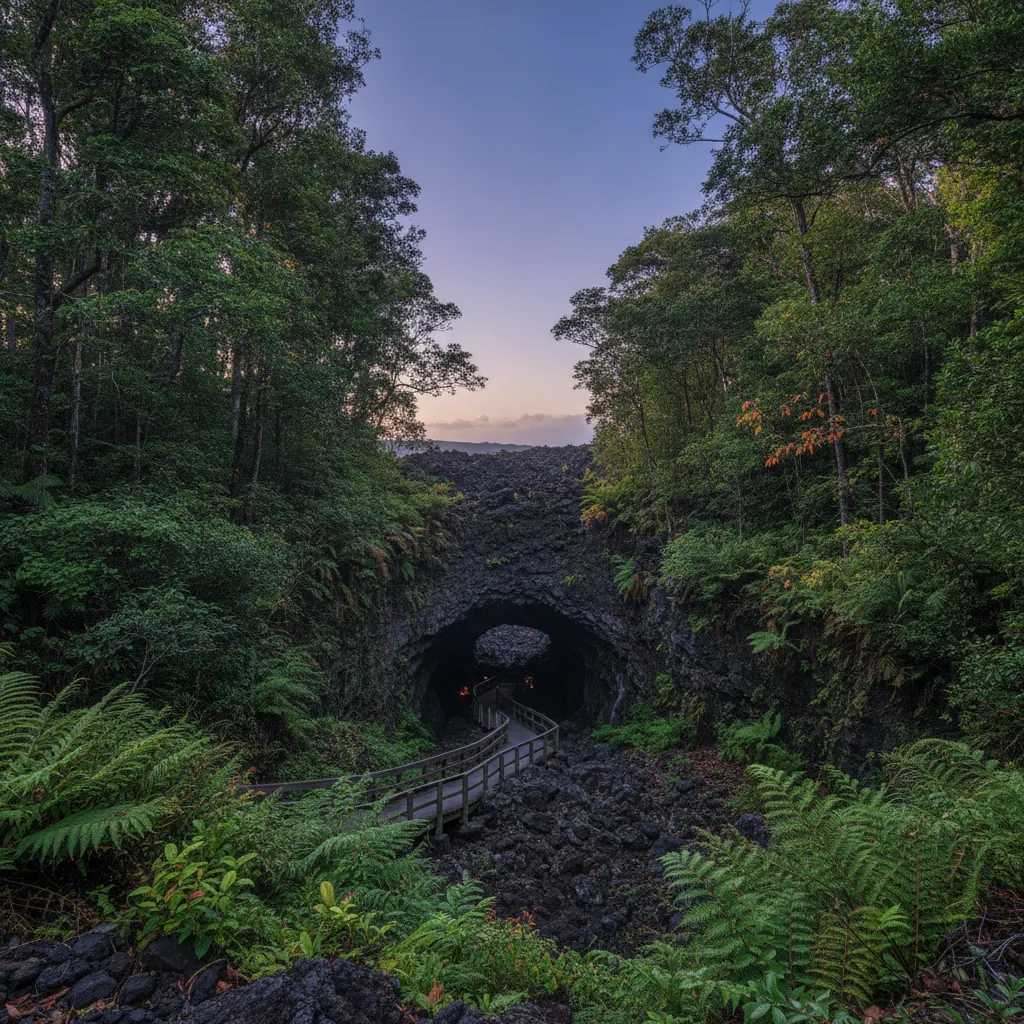
Our Nāhuku (Thurston Lava Tube) guide covers practical planning for Nāhuku (Thurston Lava Tube) Hawaii — best time to visit, getting there, and what to do on the ground. We’ve sifted through the noise to bring you the essential details for exploring this iconic geological wonder within Hawaiʻi Volcanoes National Park.
For travelers seeking an unparalleled geological experience on the Big Island, Nāhuku (Thurston Lava Tube) Hawaii stands out as a must-visit destination. This massive, accessible lava tube, formed by flowing lava approximately 500 years ago, offers a unique opportunity to walk through the earth's ancient plumbing system. The tube is lit for easy exploration, showcasing its impressive size and fascinating formations, making it a highlight of any trip to Hawaiʻi Volcanoes National Park.
Why Visit Nāhuku (Thurston Lava Tube)
Stepping into Nāhuku (Thurston Lava Tube) is like entering another world, a cool, damp subterranean passage that tells a vivid story of Kīlauea volcano's fiery past. We recommend visiting for the sheer awe of walking through a geological formation created by molten rock. The tube, also known by its Hawaiian name Nāhuku, meaning "the protuberances," was discovered in 1913, though many of its original lava drippings were unfortunately lost to souvenir collectors over time. Today, it remains a testament to the powerful forces that shaped the Hawaiian Islands. The well-maintained trail and installed lighting make it an easy and safe adventure for nearly all visitors, offering a tangible connection to the earth's volcanic processes.
Beyond the tube itself, the surrounding lush rainforest, rich with native plants and birds, provides a beautiful contrast to the dark interior of the cave. It's a place where you can truly immerse yourself in the unique biodiversity of Hawaiʻi, listening to the calls of endemic birds as you approach the tube's entrance.
Who It's Best For
Nāhuku (Thurston Lava Tube) is an ideal destination for a wide range of visitors. It's particularly well-suited for families with children, as the easy, paved, and shaded hike through the rainforest to the lit lava tube is both thrilling and manageable for young walkers. The sense of mystery and adventure in exploring an underground cave, coupled with the educational aspect of understanding volcanic geology, makes it a captivating experience for curious minds of all ages.
It's also perfect for casual hikers and those with limited mobility who still want to experience a significant natural wonder without strenuous effort. The 0.4-mile (0.6 km) loop trail is considered easy, with minimal elevation changes, making it accessible for most fitness levels. While there are some stairs and potentially steep sections on the paved trail, the overall experience is designed for broad accessibility. For those who might be nervous about caves, Nāhuku is an excellent entry point, offering a well-lit and clearly marked path without the anxiety of deep, dark, or confusing passages.
Getting There & Parking
Nāhuku (Thurston Lava Tube) is conveniently located within Hawaiʻi Volcanoes National Park, near the summit of Kīlauea volcano. To get to Nāhuku (Thurston Lava Tube), you'll first need to enter Hawaiʻi Volcanoes National Park. From Hilo, head southwest on Highway 11 for approximately 30 miles until you reach the park's entrance. After entering the park, turn left onto Crater Rim Drive and follow the signs for Nāhuku (Thurston Lava Tube).
Parking for Nāhuku (Thurston Lava Tube) is available directly off Chain of Craters Road in a small lot. However, our team has found that parking at Nāhuku is notoriously tight and often fills up by mid-morning, especially between 10 a.m. and 7 p.m.. If the main parking area is full, we highly recommend parking at the Kīlauea Iki Overlook, which is about 0.5 miles (0.8 km) away. From there, you can enjoy a scenic walk along the Crater Rim Trail to reach the lava tube. This alternative adds a pleasant, short hike through the rainforest and offers views overlooking the crater rim.
As of late April 2026, there is a bridge replacement project underway at the entrance to Nāhuku, which is expected to be complete by the end of June 2026. During this time, the lava tube remains open but is only accessible one way, in and out from the east "exit" end. The rainforest trail to the front of the lava tube, the bridge, and about 50 feet into the cave are temporarily closed. Always check the official Hawaiʻi Volcanoes National Park website for the most current updates on closures and conditions before your visit.
Top Things to Do
The primary draw and one of the best things to do at Nāhuku (Thurston Lava Tube) is, of course, the walk through the lava tube itself. This 600-foot (183 m) ancient lava tube provides an intimate look at a geological marvel. The path inside is well-lit from 8 a.m. to 8 p.m., allowing you to observe the unique textures and shapes of the tunnel walls. We recommend bringing a flashlight even during lit hours to enhance your view of the tube's features and to be prepared if visiting outside of the main lighting schedule.
Beyond the tube, the short 0.4-mile (0.6 km) loop trail that leads to and from Nāhuku winds through a lush Hawaiian rainforest. This is another one of the essential things to do at Nāhuku (Thurston Lava Tube). Take your time to enjoy this verdant environment, rich with native plants and birds. Birdwatching is particularly rewarding in the early morning hours. Informational signs along the trail provide insights into the formation of lava tubes and the broader geological activity of the area, enriching your understanding of this incredible landscape.
For a longer adventure, the Nāhuku trail connects to the Crater Rim Trail and the Kīlauea Iki Loop Trail. You can extend your visit by hiking a portion of the Kīlauea Iki Trail, a stunning 3.6-mile (5.8 km) loop that descends into a solidified lava lake and ascends back through the rainforest, offering diverse landscapes. This offers a more comprehensive experience of the park's volcanic terrain. Remember to stay on marked trails and avoid touching the delicate walls or hanging roots inside the lava tube to help protect this fragile ecosystem.
Best Time to Visit
To maximize your experience at Nāhuku (Thurston Lava Tube) and avoid the largest crowds, our team strongly advises visiting early in the morning, ideally before 9 a.m., or later in the afternoon, after 5 p.m.. The lava tube is lit from 8 a.m. to 8 p.m. daily, so visiting during these shoulder hours ensures you'll have illumination while experiencing fewer people. If you opt to visit outside these hours, remember to bring a strong flashlight or headlamp, as cell phone lights may not be sufficient for safe navigation in the dark.
Regarding the best time of year, the drier months from May to October generally offer clearer skies and less rainfall, which can make the walk through the lush rainforest leading to the tube more pleasant and minimize slippery paths. However, Hawaiʻi Volcanoes National Park is known for its intermittent rain showers, so packing light rain gear, such as a waterproof jacket or poncho, is always a good idea regardless of the season. The park is open 24 hours a day, allowing for flexible planning.
Where to Stay Nearby
When planning your visit to Nāhuku (Thurston Lava Tube), finding the right Nāhuku (Thurston Lava Tube) lodging is key to a seamless experience within Hawaiʻi Volcanoes National Park. The town of Volcano Village, located just outside the park entrance, offers a variety of accommodations, from cozy bed and breakfasts to charming vacation rentals. This proximity allows for easy access to the park's attractions, including Nāhuku, and the opportunity to explore the park during less crowded times, like early mornings or evenings.
Some highly-rated options for Nāhuku (Thurston Lava Tube) lodging in Volcano Village include Aloha Junction Bed and Breakfast, Volcano Village Estates, Lokahi Lodge, and Kilauea Lodge and Restaurant. These establishments are typically within a short drive of Nāhuku (Thurston Lava Tube), some as close as 0.8 to 2.1 miles. Staying in Volcano Village also provides access to local dining options and art galleries. For a comprehensive guide to exploring the wider area, check out our Hawaii Volcanoes NP guide.
Inside Hawaiʻi Volcanoes National Park, there are also two drive-in campgrounds available on a first-come, first-served basis, with no additional fees beyond the park entrance fee. Stays are limited, offering a more immersive experience for those who prefer camping.
Sample 2-Day Itinerary
For an unforgettable exploration of Nāhuku (Thurston Lava Tube) and the surrounding Hawaiʻi Volcanoes National Park, we recommend a two-day itinerary that balances iconic sights with deeper dives into the park's unique geology.
Day 1: Volcanic Wonders and Subterranean Exploration
- Morning (Early Start): Begin your day by heading straight to Nāhuku (Thurston Lava Tube). Arriving before 9 a.m. ensures you beat the crowds and secure parking more easily. Enjoy the serene walk through the rainforest to the lava tube, then marvel at the lit interior. Take your time to appreciate the geological formations.
- Late Morning: After Nāhuku, drive to the Kīlauea Visitor Center (currently operating out of the Welcome Center in Kilauea Military Camp during renovations). Gather maps, check current conditions, and learn about ranger-guided programs.
- Lunch: Grab a bite at a local eatery in Volcano Village or pack a picnic to enjoy at one of the park's scenic overlooks.
- Afternoon: Explore other key features along Crater Rim Drive. Walk the Haʻakulamanu (Sulphur Banks) Trail to see colorful mineral deposits and steaming vents. Then, visit the Steam Vents & Steaming Bluff for more geothermal activity.
- Evening: Enjoy dinner in Volcano Village. If Kīlauea is actively erupting, return to the Halemaʻumaʻu Crater Lookout (formerly Jaggar Museum area) after dark to witness the mesmerizing glow of the lava lake, which is best viewed after 9 p.m. or before sunrise to avoid peak crowds.
Day 2: Crater Hikes and Coastal Drives
- Morning: Embark on the Kīlauea Iki Trail, a moderately challenging 3.6-mile (5.8 km) loop hike that descends into a solidified lava lake. This trail offers incredible diversity, from lush rainforest to barren crater floor. Park at the Kīlauea Iki Overlook.
- Late Morning: Drive down the Chain of Craters Road, an 18-mile (28 km) scenic route that descends from the summit to the coast. Along the way, stop at various overlooks to see past lava flows and craters.
- Lunch: Pack snacks and water, as there are no food services along Chain of Craters Road.
- Afternoon: Continue to the end of Chain of Craters Road to see the Hōlei Sea Arch, a dramatic rock formation carved by the ocean. On your way back up, take a short, easy walk to the Puʻuloa Petroglyphs, where you can see ancient Hawaiian rock carvings.
- Evening: Consider a stargazing tour (many operate outside the park near Mauna Kea) or simply find a dark spot within the park to admire the incredible Hawaiian night sky.
Is It Worth Visiting?
Our resounding answer is yes, Nāhuku (Thurston Lava Tube) is absolutely worth visiting. This unique geological formation offers a rare opportunity to walk through the interior of a 500-year-old lava tube, providing a tangible connection to the powerful volcanic forces that shaped the Hawaiian Islands. The experience of transitioning from a lush, bird-filled rainforest into a cool, dimly lit underground cavern is truly unforgettable.
What makes Nāhuku (Thurston Lava Tube) particularly compelling is its accessibility. Unlike many other lava tubes that require specialized gear or guided tours, Nāhuku is well-lit, has a relatively flat floor, and features a well-maintained path, making it suitable for almost all visitors, including families with young children and those with limited mobility. The short, easy loop trail ensures that you can experience this natural wonder without a strenuous hike. While some visitors might find the experience shorter than anticipated, its ease and unique nature firmly establish that Nāhuku (Thurston Lava Tube) is worth visiting for anyone exploring Hawaiʻi Volcanoes National Park.
How to Get There
Understanding how to get to Nāhuku (Thurston Lava Tube) is straightforward once you're inside Hawaiʻi Volcanoes National Park. The lava tube is located near the summit of Kīlauea volcano. From the park entrance, you will turn left onto Crater Rim Drive and follow the signs leading to Nāhuku (Thurston Lava Tube). The drive itself offers scenic views and is part of the overall park experience.
As we've noted, parking directly at the Nāhuku (Thurston Lava Tube) trailhead can be extremely limited, especially during peak hours. To avoid frustration, our team recommends having a backup plan. The most common and advised alternative for how to get to Nāhuku (Thurston Lava Tube) if the main lot is full is to park at the Kīlauea Iki Overlook, located approximately 0.5 miles (0.8 km) away. From there, a pleasant, short walk along a paved trail will lead you directly to the lava tube. Public transportation directly to the park is limited, so a rental car is generally the most practical way to reach the site and explore the wider park.
FAQ Longtails
Nāhuku (Thurston Lava Tube) camping
While there is no direct Nāhuku (Thurston Lava Tube) camping, Hawaiʻi Volcanoes National Park offers two drive-in campgrounds: Nāmakanipaio and Kulanaokuaiki. These campgrounds are available on a first-come, first-served basis and do not require additional fees beyond the park entrance fee. Stays are limited to 7 days per month and 30 days per year. Nāmakanipaio Campground, located at 4000 feet elevation off Highway 11, provides facilities including restrooms, barbecue pits, and picnic tables. Camping within the park allows for early morning or late evening visits to Nāhuku, avoiding the busiest times.
Things to do in Hawaii Volcanoes National Park, Big Island
Hawaiʻi Volcanoes National Park on the Big Island offers a wealth of activities beyond Nāhuku (Thurston Lava Tube). Our team recommends driving the scenic Crater Rim Drive, which provides access to iconic features like the Halemaʻumaʻu Crater Lookout, Steaming Bluffs, and Sulphur Banks. The Kīlauea Iki Trail is a must-do hike, taking you across a solidified lava lake. Driving the Chain of Craters Road down to the Hōlei Sea Arch offers dramatic coastal views and opportunities to see ancient petroglyphs at Puʻuloa. For more in-depth exploration, consider ranger-guided programs or backcountry hiking. Don't forget to visit the Kīlauea Visitor Center (currently the Welcome Center) for updates and information.
Nāhuku (Thurston Lava Tube) with kids
Nāhuku (Thurston Lava Tube) is an excellent activity for families visiting with kids. The short, 0.4-mile (0.6 km) loop trail is paved and relatively easy, making it manageable for most young walkers. The experience of walking through a real lava tube is often described as dark, mysterious, and thrilling for children. The tube is lit from 8 a.m. to 8 p.m., ensuring visibility, but bringing a flashlight can add to the adventure. The surrounding rainforest also offers a pleasant, shaded walk. Our team finds it to be one of the most kid-friendly and unique geological experiences in the park.
Best hotels near Nāhuku (Thurston Lava Tube)
The best hotels near Nāhuku (Thurston Lava Tube) are primarily found in Volcano Village, offering convenient access to Hawaiʻi Volcanoes National Park. Top-rated options include Aloha Junction Bed and Breakfast, Volcano Village Estates, Lokahi Lodge, and Kilauea Lodge and Restaurant. These accommodations are typically within a short driving distance, ranging from 0.8 to 2.1 miles from the lava tube. Other notable choices include Volcano Forest Inn and Aloha Crater Lodge. These establishments provide a comfortable base for exploring the park's attractions.
Nāhuku (Thurston Lava Tube) tips
Our top Nāhuku (Thurston Lava Tube) tips for a smooth visit include arriving early (before 9 a.m.) or late (after 5 p.m.) to avoid crowds and secure parking. While the tube is lit from 8 a.m. to 8 p.m., bringing a flashlight or headlamp is recommended for better visibility and if you visit outside these hours. Wear sturdy walking shoes, as the trail can be graveled and potentially wet or muddy. Be prepared for intermittent rain with light rain gear. Most importantly, protect this fragile environment by not touching the walls or hanging roots inside the tube. Always check the Hawaiʻi Volcanoes National Park website for current conditions and any closures, especially regarding the ongoing bridge replacement project.
Where to stay near Nāhuku (Thurston Lava Tube)
For those wondering where to stay near Nāhuku (Thurston Lava Tube), the community of Volcano Village is your best bet. It's situated just outside the entrance to Hawaiʻi Volcanoes National Park, providing easy access to Nāhuku and other park attractions. Options like Aloha Junction Bed and Breakfast, Volcano Village Estates, and Lokahi Lodge are highly recommended and are typically within a few miles of the lava tube. These accommodations offer a peaceful retreat after a day of exploring the volcanic landscapes. For a broader understanding of Hawaiian travel, consider our Best places in Hawaii guide and our Plan Your US Trip resource.
Our team at Roam States confidently asserts that Nāhuku (Thurston Lava Tube) is an essential stop on any Big Island itinerary. Its accessibility, combined with the sheer geological wonder of walking through an ancient lava flow, offers a unique and memorable experience that transcends typical sightseeing. We’ve explored countless natural wonders across the US, and Nāhuku consistently ranks as one of the most impactful and easily enjoyed for all ages.
Last updated: 2026-07-06 by the Roam States team.