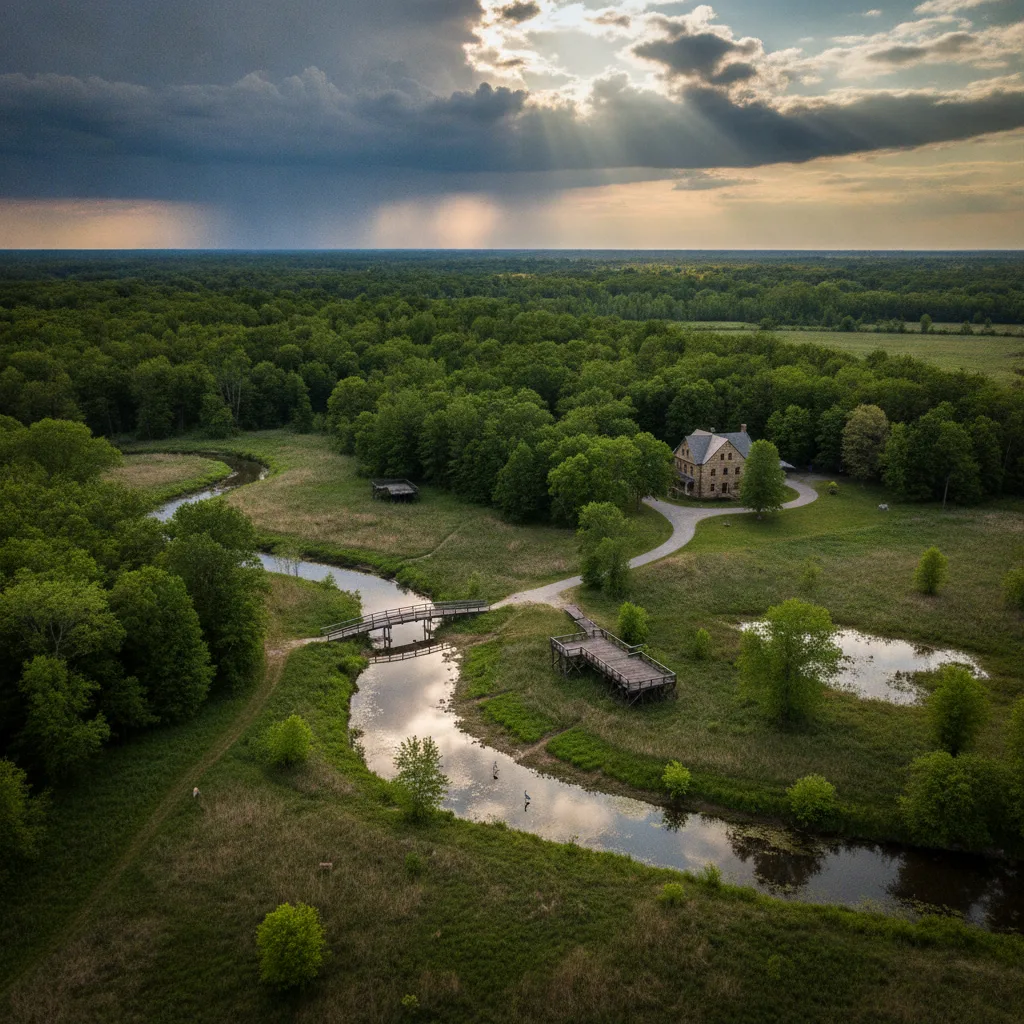
Our Muscatatuck National Wildlife Refuge guide covers practical planning for Muscatatuck National Wildlife Refuge Indiana — best time to visit, getting there, and what to do on the ground.
As the Roam States editorial team, we’ve explored countless natural wonders across the US, and we can confidently say that Muscatatuck National Wildlife Refuge Indiana stands out as a true gem. Established in 1966, this refuge was created with a vital mission: to provide essential habitat for migratory birds. Spanning over 7,700 acres in south-central Indiana, it's a diverse landscape encompassing wetlands, bottomland and upland forests, grasslands, and brushlands. For anyone passionate about birdwatching, wildlife photography, or simply immersing themselves in nature, Muscatatuck National Wildlife Refuge Indiana offers an unparalleled experience.
Why Visit Muscatatuck National Wildlife Refuge
Muscatatuck National Wildlife Refuge is more than just a protected area; it's a vibrant ecosystem teeming with life, a testament to successful conservation efforts. Its designation as a "Continentally Important Bird Area" speaks volumes about its significance to avian populations. We've witnessed firsthand the incredible spectacle of diverse bird species, from resident raptors like bald eagles and red-shouldered hawks to a stunning array of migratory songbirds and waterfowl.
Beyond the birds, the refuge's varied habitats support a wide range of other wildlife, including white-tailed deer, raccoons, turkeys, and even reintroduced river otters. The landscape itself is a photographer's dream, with its serene lakes, winding creeks, and lush forests offering endless opportunities for stunning shots. Whether you're a seasoned birder or a casual nature enthusiast, the sheer biodiversity and tranquil beauty of Muscatatuck provide a refreshing escape from the everyday.
Who It's Best For
Muscatatuck National Wildlife Refuge caters to a wide audience, making it a versatile destination for various types of travelers:
- Birdwatchers: This is arguably the refuge's primary draw. With over 280 bird species recorded, including critical stopover points for migratory birds in spring and fall, it's a prime location for both casual and serious birders.
- Wildlife Photographers: The abundant and diverse wildlife, coupled with picturesque landscapes, offers endless photographic opportunities throughout the seasons.
- Nature Enthusiasts: Anyone seeking a peaceful retreat into nature, where they can observe animals in their natural habitats and enjoy scenic beauty, will find Muscatatuck deeply rewarding.
- Families: With accessible trails, an auto tour, and educational opportunities at the Visitor Center, it's an excellent place for families to introduce children to wildlife and conservation. Pets are welcome on a leash, too.
- Hikers and Cyclists: The refuge offers a network of trails and roads suitable for walking, hiking, and biking, providing a gentle outdoor experience.
- Anglers: Fishing is permitted in certain areas, offering another recreational outlet for visitors.
Getting There & Parking
Navigating to Muscatatuck National Wildlife Refuge is straightforward, though there's one crucial detail we want to emphasize. The refuge is located approximately three miles east of the junction of U.S. Highway 31 and U.S. Highway 50, near Seymour, Indiana.
For those wondering how to get to Muscatatuck National Wildlife Refuge, the main entrance is clearly marked on U.S. Highway 50 with large brown signs. It's important to note that many GPS apps may incorrectly direct visitors to a now-closed west entrance, so we strongly advise using the official address: 12985 E. U.S. Hwy. 50, Seymour, IN 47274. The refuge is conveniently located about an hour's drive from both Indianapolis and Louisville, Kentucky, making it an accessible day trip or weekend getaway.
Once you arrive, parking is readily available in designated parking lots or along road edges throughout the refuge. There are no entrance fees to access Muscatatuck National Wildlife Refuge, making it a budget-friendly destination for outdoor exploration. While there are no reservations required for general entry, specific hunting activities may have permit requirements.
Top Things to Do
The array of things to do at Muscatatuck National Wildlife Refuge is diverse, catering to various interests while keeping nature at its core. Our team finds that the best way to experience the refuge is to embrace its tranquility and focus on wildlife observation.
Birdwatching
As a "Continentally Important Bird Area," birdwatching is undoubtedly one of the top things to do at Muscatatuck National Wildlife Refuge. Over 280 species have been observed here, making it a hotspot for both common and rare sightings. The Visitor Center even features a dedicated bird viewing room where you can watch birds at feeders. Peak migration periods in late April and September are particularly rewarding for songbirds, while winter brings a variety of ducks, geese, grebes, and even tundra swans and sandhill cranes. Bald eagles are present year-round.
Auto Tour Route
For a comprehensive overview of the refuge's diverse habitats and an excellent opportunity for wildlife viewing from the comfort of your vehicle, we highly recommend the 4-mile self-guided Auto Tour loop. This route features twelve unique locations with interpretive information, allowing you to explore at your own pace. It's particularly useful for those with limited mobility or when weather conditions aren't ideal for extensive walking. Indigo buntings are widespread along the Auto Tour, and deer are often seen in the beech woods.
Wildlife Observation & Photography
Beyond birds, Muscatatuck is home to a healthy population of white-tailed deer, raccoons, turkeys, and river otters. Keep an eye out for the rare copperbelly water snake, which is common here due to the protected wetland habitat. Early mornings are generally the best time to view wildlife. The diverse landscapes, from wetlands and forests to grasslands, provide stunning backdrops for nature photography.
Fishing
Fishing is permitted in certain areas of the refuge. Stanfield Lake allows hand- or foot-propelled boats, while Richart Lake permits kayaks and nonmotorized canoes. A pit toilet is located at the Persimmon Pond Fishing Area. Always check the refuge's specific regulations and leaflets for details on permitted areas and species.
Visitor Center
The staffed Visitor Center is a valuable resource, open Tuesday through Saturday from 8:30 a.m. to 4:30 p.m.. It offers exhibits, water fountains, and a nature bookstore operated by the Muscatatuck Wildlife Society. This is also where you can pick up maps and brochures to enhance your visit.
Biking
Both traditional and e-bikes are permitted on designated refuge roads and multi-use trails. The 4-mile auto tour loop is suitable for biking, and in total, there are 9 miles of refuge roads accessible year-round. The generally flat to gently rolling terrain makes it suitable for various skill levels.
Muscatatuck National Wildlife Refuge Hiking Trails
For those who prefer to explore on foot, Muscatatuck National Wildlife Refuge offers a network of hiking trails that allow for intimate encounters with its diverse habitats. We find that walking these trails provides a deeper appreciation for the refuge's natural beauty and the subtle movements of its wildlife.
There are five hiking trails, most of which are about 1 mile in length. The Chestnut Ridge Interpretive Trail, located near the Visitor Center, is a ¼-mile paved loop that is wheelchair accessible, making it a great option for all visitors. Other trails include Turkey, Bird, Wood Duck, and Hunt-Richart. In total, the refuge boasts eight hiking trails of various lengths, ranging from 1/5 to 4 miles of easy to moderate hiking. The Hackman Overlook on the Richart Lake Hiking Trail provides breathtaking views of Richart Lake.
When exploring Muscatatuck National Wildlife Refuge hiking trails, remember that pets must be kept on a leash. While hunting activities occur at certain times, hiking trails are located in non-hunting areas to ensure visitor safety. During flood events, some roads and trails may be inaccessible, so it's always a good idea to check the refuge's website or Facebook page for current conditions.
Best Time to Visit
The best time to visit Muscatatuck National Wildlife Refuge largely depends on your interests, as each season offers a unique experience:
- Spring (March-May): This is an excellent time for birdwatching, particularly in May when migrating warblers pass through. Wood ducks, Canada geese, and mallards begin nesting, and great blue herons nest in the Moss Lake area.
- Summer (June-July): Summer birding can be productive, especially in the early morning. You'll see geese and wood duck broods, and the mature forests are home to species like Kentucky warblers, wood thrushes, and summer tanagers.
- Fall (August-November): Late September is another peak time for songbird migration. Osprey and cormorants appear over the lakes, and sandhill cranes begin their migration south. Early migrant blue-wing teal arrive in August.
- Winter (December-February): The refuge's wetlands host a variety of ducks, geese, grebes, and tundra swans. Northern harriers and other raptors are attracted to the open fields, and bald eagles are present year-round. December and January typically see peak numbers of greater sandhill cranes, sometimes accompanied by whooping cranes.
Regardless of the season, early morning is consistently the best time to view wildlife at Muscatatuck National Wildlife Refuge. The refuge is generally open one hour before sunrise to one hour after sunset, seven days a week. However, during refuge deer hunts in December and January, hours may be adjusted to 6 a.m. to 6 p.m..
Where to Stay Nearby
While Muscatatuck National Wildlife Refuge itself does not offer camping or lodging within its boundaries, there are several convenient options in nearby Seymour, Indiana, and surrounding areas. When considering Muscatatuck National Wildlife Refuge lodging, we recommend looking at Seymour, which is approximately four miles west of the refuge.
Seymour offers a range of accommodations to suit different preferences and budgets. Hotels such as Days Inn by Wyndham Seymour, Hampton Inn Seymour, Holiday Inn Express & Suites Seymour by IHG, Fairfield Inn & Suites Seymour, Econo Lodge Seymour, Quality Inn Seymour I-65, and Travelodge by Wyndham Seymour are all located within a short drive of the refuge. Many of these provide amenities like free breakfast, Wi-Fi, and pools. For example, the Hampton Inn Seymour is right off I-65 and about 4 miles from the refuge, offering free hot breakfast and an indoor pool. The Days Inn by Wyndham Seymour, also near the refuge, provides free light breakfast, Wi-Fi, and an outdoor pool.
For those interested in public campgrounds, options are available nearby in Brownstown and Vernon. While camping is generally prohibited within the refuge itself, except for individuals involved in refuge wildlife-dependent activities with specific restrictions, these nearby campgrounds provide an alternative for a more immersive outdoor experience.
If you're looking to extend your Indiana adventure, consider exploring other fantastic destinations. For a taste of the state's racing heritage, the Indianapolis Motor Speedway is an iconic must-see. Or, for more natural beauty, Indiana Dunes National Park offers a completely different coastal landscape along Lake Michigan. For a broader look at what the state has to offer, our guide to the Best places in Indiana is an excellent resource.
Sample 2-Day Itinerary
To help you make the most of your visit, our team has crafted a sample 2-day itinerary for Muscatatuck National Wildlife Refuge:
Day 1: Immersion in Wildlife and Trails
- Morning (Sunrise - Noon): Arrive at Muscatatuck National Wildlife Refuge shortly after it opens (one hour before sunrise for optimal viewing). Head straight to the Visitor Center (if open, Tuesday-Saturday from 8:30 AM) to pick up a map and get current wildlife sighting information. Spend the early morning hours driving the 4-mile Auto Tour loop, making frequent stops at the twelve interpretive locations to observe birds and other wildlife. Keep an eye out for bald eagles, deer, and various waterfowl.
- Lunch (Noon - 1 PM): Enjoy a packed lunch at one of the picnic areas near the Visitor Center or in Seymour.
- Afternoon (1 PM - 5 PM): Explore some of the Muscatatuck National Wildlife Refuge hiking trails. Start with the accessible Chestnut Ridge Interpretive Trail (¼ mile, paved). Then, venture onto one or two of the longer, mile-long trails like the Turkey or Bird Trail, focusing on different habitats such as forests and wetlands for diverse sightings.
- Evening: Check into your chosen lodging in Seymour. Enjoy dinner at a local restaurant in Seymour, which offers numerous motels and restaurants just four miles west of the refuge.
Day 2: Deeper Exploration and Nearby Attractions
- Morning (Sunrise - Noon): Return to the refuge for another early morning of birdwatching, perhaps focusing on areas you didn't explore thoroughly on Day 1, or revisiting a spot where you had good sightings. Consider a non-motorized boating excursion on Stanfield Lake (hand- or foot-propelled boats only) or Richart Lake (kayaks and nonmotorized canoes only) for a different perspective of the wetlands.
- Lunch (Noon - 1 PM): Grab lunch in Seymour or pack a picnic to enjoy at the refuge.
- Afternoon (1 PM - 5 PM): Depending on your interests, you have a few options:
- More Nature: Explore any remaining Muscatatuck National Wildlife Refuge hiking trails you haven't yet experienced.
- Local Culture: Visit some of Seymour's other attractions, such as the Southern Indiana Center for the Arts or the Freeman Army Airfield Museum. You could also check out the John Mellencamp Mural or Crossroads Community Park.
- Extended Indiana Exploration: If you're ready for a change of scenery, consider a drive to Brown County State Park, known for its stunning fall foliage and extensive trail system, approximately 30 miles away.
- Evening: Depart for home or continue your journey through Indiana.
Is It Worth Visiting?
From our perspective as seasoned travelers, the question "is Muscatatuck National Wildlife Refuge worth visiting?" receives an unequivocal "yes." This refuge offers a genuine and accessible slice of Indiana's natural beauty, far removed from generic tourist traps. Its primary mission to protect migratory birds has created an environment that is a haven for wildlife and a delight for visitors.
The absence of an entrance fee makes it an incredibly accessible destination, and the diverse range of things to do at Muscatatuck National Wildlife Refuge—from extensive birdwatching and photography to peaceful hikes and scenic auto tours—ensures there's something for everyone. We appreciate its commitment to conservation and the opportunities it provides for people to connect with nature. If you're seeking an authentic outdoor experience in Indiana, Muscatatuck National Wildlife Refuge should be high on your list.
Muscatatuck National Wildlife Refuge camping
Camping is generally prohibited within Muscatatuck National Wildlife Refuge. However, the refuge does allow camping for individuals involved in refuge wildlife-dependent activities, with restrictions such as a maximum stay of 14 days within any 30-day period and daily occupancy. Disturbances, including generator use, are prohibited after 10 p.m.. For general public camping, public campgrounds are available nearby in Brownstown and Vernon.
Things to do in Seymour
Seymour, Indiana, located just a short drive from Muscatatuck National Wildlife Refuge, offers several attractions. You can explore the Southern Indiana Center for the Arts, visit the Freeman Army Airfield Museum, or admire the John Mellencamp Mural. Crossroads Community Park and the Seymour Oktoberfest (seasonal) also provide local entertainment. Seymour also has various restaurants and motels.
Muscatatuck National Wildlife Refuge with kids
Muscatatuck National Wildlife Refuge is an excellent destination for families with kids. The paved, wheelchair-accessible Chestnut Ridge Interpretive Trail is perfect for young children or strollers. The 4-mile auto tour allows kids to observe wildlife from the car. The Visitor Center offers exhibits and a bird viewing room. Kids can enjoy spotting various birds, deer, and other animals, making it an engaging outdoor educational experience. Pets are also allowed on a leash.
Best hotels near Muscatatuck National Wildlife Refuge
Several well-regarded hotels are located in Seymour, Indiana, just a few miles from Muscatatuck National Wildlife Refuge. Top options include Hampton Inn Seymour, Days Inn by Wyndham Seymour, Holiday Inn Express & Suites Seymour by IHG, Fairfield Inn & Suites Seymour, and Quality Inn Seymour I-65. These hotels typically offer amenities like complimentary breakfast and Wi-Fi, providing comfortable lodging after a day of exploring the refuge.
Muscatatuck National Wildlife Refuge tips
Our top tips for visiting Muscatatuck National Wildlife Refuge include: arrive early in the morning for the best wildlife viewing opportunities, use the main entrance on U.S. Highway 50 and avoid relying solely on GPS for directions to prevent going to a closed entrance, and pick up a map at the Visitor Center. Bring binoculars for birdwatching, wear comfortable shoes for hiking, and check the refuge's website or social media for any flood-related closures before your visit. Remember that pets must be on a leash.
Where to stay near Muscatatuck National Wildlife Refuge
The best place to stay near Muscatatuck National Wildlife Refuge is in Seymour, Indiana, which is only about four miles away. Seymour provides a variety of hotels, including well-known chains like Hampton Inn, Days Inn, and Holiday Inn Express. For those interested in camping, public campgrounds can be found in nearby Brownstown and Vernon.
Our team at Roam States believes Muscatatuck National Wildlife Refuge is a truly special place, offering an authentic and enriching natural experience in Indiana. Its dedication to migratory birds creates a vibrant ecosystem that captivates visitors, making it a highly recommended destination for anyone seeking tranquility and a connection with the wild. We encourage you to plan your trip and discover the beauty of this remarkable refuge for yourself.
Last updated: 2026-07-06 by the Roam States team.