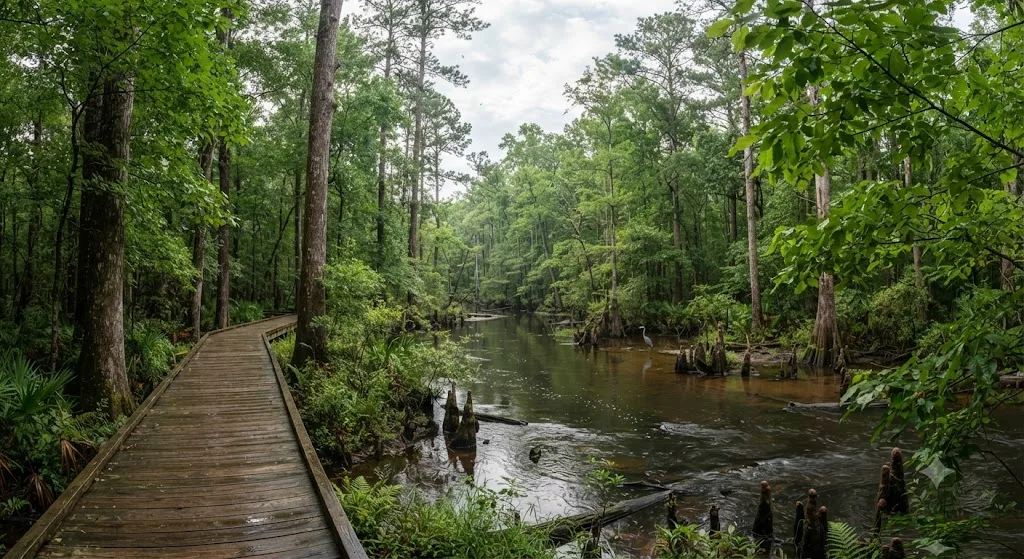
As the Roam States editorial team, we’re here to tell you that if you're seeking an unparalleled natural escape, our guide to Congaree National Park South Carolina offers an in-depth look at one of the Southeast's most unique ecosystems. This remarkable park protects the largest intact expanse of old-growth bottomland hardwood forest remaining in the Southeast, a truly rare and vital landscape. It's a place where towering trees reach for the sky, mysterious waterways wind through ancient forests, and wildlife thrives in a rich, biodiverse environment. We aim to provide you with all the specific, verified 2026 facts you need to plan an unforgettable trip, free from generic travel fluff.
Why Visit Congaree National Park
Congaree National Park stands out as a testament to the raw beauty and ecological significance of the South Carolina lowcountry. For those wondering if Congaree National Park is worth visiting, our team unequivocally says yes. This is not just another patch of woods; it's a dynamic floodplain forest, shaped by the Congaree and Wateree Rivers, that nurtures some of the tallest trees on the East Coast, including national and state champion specimens. The sheer scale of these "champion trees" is breathtaking, offering a humbling perspective on nature's grandeur.
Beyond the impressive arboreal giants, the park offers a unique opportunity to immerse yourself in a thriving, ancient ecosystem. The seasonal flooding enriches the soil, creating a haven for diverse wildlife and plant life. Whether you're gliding silently through Cedar Creek in a canoe, walking the elevated boardwalk, or simply sitting and listening to the sounds of the forest, the experience is profoundly restorative. It's a place where you can truly disconnect and witness a wilderness that has largely disappeared elsewhere. So, if you're contemplating whether Congaree National Park is worth visiting, consider the chance to explore a living, breathing ancient forest unlike any other.
Who It's Best For
Congaree National Park is an ideal destination for nature enthusiasts, hikers, paddlers, and birdwatchers. If you thrive on quiet contemplation amidst towering trees and seek an active outdoor experience, this park is for you. It's particularly well-suited for those who appreciate unique ecosystems and are comfortable with a more rustic, immersive wilderness experience. Families with children will find the boardwalk trails accessible and engaging, offering a gentle introduction to the wonders of the forest. Backpackers can explore designated wilderness areas, while photographers will find endless opportunities to capture the interplay of light and shadow in the dense canopy. While it's not a park for grand scenic vistas in the traditional sense, it offers an intimate connection with an ancient, living landscape.
Getting There & Parking
Reaching Congaree National Park is straightforward, with the main entrance located off Old Bluff Road in Hopkins, South Carolina. For those driving, the park is approximately 20 miles (30 minutes) southeast of Columbia, South Carolina. From I-77, take Exit 5 onto SC Highway 48 East/Bluff Road. Follow the brown and white "Congaree National Park" directional signs for about 8 miles, then take a slight right onto Old Bluff Road. Continue for 4.5 miles to the park entrance sign on your right, then proceed one mile to the Harry Hampton Visitor Center.
If you're wondering how to get to Congaree National Park via air, the closest airport is Columbia Metropolitan Airport (CAE), about 25 miles away. Other options include Charlotte Douglas International Airport (CLT) and Charleston International Airport (CHS), both roughly 100 miles (1 hour 48 minutes) away. We recommend renting a car for flexibility in exploring the park and surrounding areas.
Parking at Congaree National Park is available at the Harry Hampton Visitor Center. There are three parking lots; the first two have accessible spaces, and the third lot is designated for oversized vehicles, including RVs and trailers, with one accessible space. However, parking can fill up by midday, especially on weekends and during firefly season, so arriving in the morning is advisable. RVs towing trailers may need to unhook to turn around in the visitor center parking lot on busy days. While there are no specific fees for parking, the park is free to enter year-round.
Top Things to Do
There are many things to do at Congaree National Park, catering to various interests and activity levels, all centered around its remarkable old-growth bottomland hardwood forest. Our team's top recommendation for things to do at Congaree National Park starts with the iconic Boardwalk Loop Trail. This 2.4-mile (roundtrip) elevated pathway is easily accessible and provides an immersive experience through the ancient forest canopy, allowing you to observe bald cypress and tupelo trees without getting your feet wet. Pick up a self-guided tour brochure at the visitor center to enhance your understanding of the ecosystem.
For those seeking a deeper dive into the wilderness, Congaree National Park hiking trails offer a range of options. Beyond the Boardwalk, popular routes include the Weston Lake Loop Trail, a 4.7-mile journey that follows Cedar Creek and loops around Weston Lake, providing excellent wildlife viewing opportunities. The Sims Trail (3.2 miles roundtrip) follows an old gravel road to Cedar Creek, intersecting with the Boardwalk. For more strenuous adventures, the Kingsnake Trail (11.7 miles out-and-back) is a favorite for birders, winding through diverse vegetation. Always check with rangers at the Harry Hampton Visitor Center for current trail conditions, as some areas may be impassable due to seasonal flooding.
Paddling is another exceptional way to experience the park. The Cedar Creek Canoe Trail, a 15-mile marked waterway, allows you to glide through the flooded forest, offering unique perspectives of the towering trees and abundant wildlife. You'll need to bring your own canoe or kayak, as the park does not offer rentals, but outfitters are available in nearby Columbia. Ranger-led canoe tours are also available and highly recommended for an educational experience.
Birdwatching is a rewarding activity, with the park designated as a Globally Important Bird Area. Keep an eye out for various species, especially along Cedar Creek and the River Trail. In late spring, typically between mid-May and mid-June, the park hosts a spectacular synchronous firefly display, a rare natural phenomenon that draws visitors globally and requires a lottery reservation for viewing.
Best Time to Visit
Our team agrees that the best time to visit Congaree National Park is during the spring (March to May) and fall (September to November). During these seasons, temperatures are mild and comfortable, and humidity levels are lower. The spring brings pleasant weather and the highly anticipated synchronous firefly display, usually from mid-May to mid-June, which requires advance lottery reservations. However, spring can also see higher chances of rain and potential flooding, so checking water levels is crucial.
Fall, particularly October and early November, is another excellent choice, offering cooler weather, beautiful foliage, and fewer crowds. Mosquito activity is significantly reduced during these cooler months, making for a more comfortable experience on the trails. While winter (December to February) offers quiet trails and mild temperatures, it can also be prone to flooding. We generally advise against visiting in the summer (June to August) due to intense heat, high humidity, and abundant mosquitoes, which can be a "war zone" according to the park's own "Mosquito Meter".
Where to Stay Nearby
While Congaree National Park offers primitive camping options, our team finds that many visitors prefer to stay in nearby towns for more amenities. The closest major city with a wide range of lodging and dining options is Columbia, South Carolina, located about 20-30 minutes away. Columbia offers various hotels, from boutique stays like Hotel Trundle and Graduate Columbia to more budget-friendly options.
For those interested in Congaree National Park camping, the park has two frontcountry campgrounds: Longleaf Campground and Bluff Campground. Both are tent-only and require reservations through Recreation.gov. Longleaf Campground sites are a short walk from the parking lot (up to 100 yards), while Bluff Campground sites are approximately a 1-mile hike from the parking area. Fees for Longleaf are $15 for a regular tent site and $25 for a group site, while Bluff Campground is $10 per night. Backcountry camping is also available and requires a free permit requested at least 72 hours in advance via email. RV camping is not available within the park, but several private and state park campgrounds in the region can accommodate RVs and trailers. Towns like Gadsden (3 miles away) and Hopkins (6 miles away) also offer a few vacation rentals and a more rural feel.
Sample 2-Day Itinerary
We've crafted a sample 2-day itinerary to help you make the most of your visit to Congaree National Park, focusing on its unique features and ensuring a comprehensive experience.
Day 1: Boardwalk, Hiking & Wildlife
- **Morning (9:00 AM - 1:00 PM):** Arrive at the Harry Hampton Visitor Center. Pick up maps, check the "Mosquito Meter," and chat with rangers about current trail conditions. Start with the 2.4-mile Boardwalk Loop Trail, taking your time to absorb the old-growth forest. Consider adding the Weston Lake Loop Trail (4.7 miles total) for a longer hike and enhanced wildlife viewing along Cedar Creek.
- **Lunch (1:00 PM - 2:00 PM):** Enjoy a packed lunch at one of the picnic areas near the visitor center. Remember, there are no restaurants or food vendors inside the park.
- **Afternoon (2:00 PM - 5:00 PM):** Explore another one of the Congaree National Park hiking trails. The Sims Trail (3.2 miles) offers a different perspective through the floodplain forest. Alternatively, join a ranger-led program if available, which can offer valuable insights into the park's ecology.
- **Evening:** Head back to Columbia for dinner and to relax.
Day 2: Paddling & Deeper Exploration
- **Morning (9:00 AM - 1:00 PM):** Dedicate your morning to a paddling adventure on Cedar Creek. Launch your own kayak or canoe from South Cedar Creek Canoe Landing or Bannister Bridge, or book a guided tour with a local outfitter. This is an incredible way to experience the "liquid landscape" of the park.
- **Lunch (1:00 PM - 2:00 PM):** Picnic lunch by Cedar Creek or grab a bite in nearby Hopkins or Gadsden.
- **Afternoon (2:00 PM - 5:00 PM):** Depending on your energy levels, you could revisit a favorite spot, explore a different section of the park like the Bates Ferry Trail or Fork Swamp Trail (accessible from US 601), or simply relax and enjoy the tranquility. For a deeper dive into South Carolina's history, consider visiting Magnolia Plantation and Gardens or the Charleston Historic District, both within a couple of hours' drive.
- **Evening (Seasonal - Mid-May to Mid-June):** If your visit aligns with the synchronous firefly display, and you secured a lottery reservation, head back to the park just after dark for this magical experience.
Last updated: 2026-07-08 by the Roam States team.