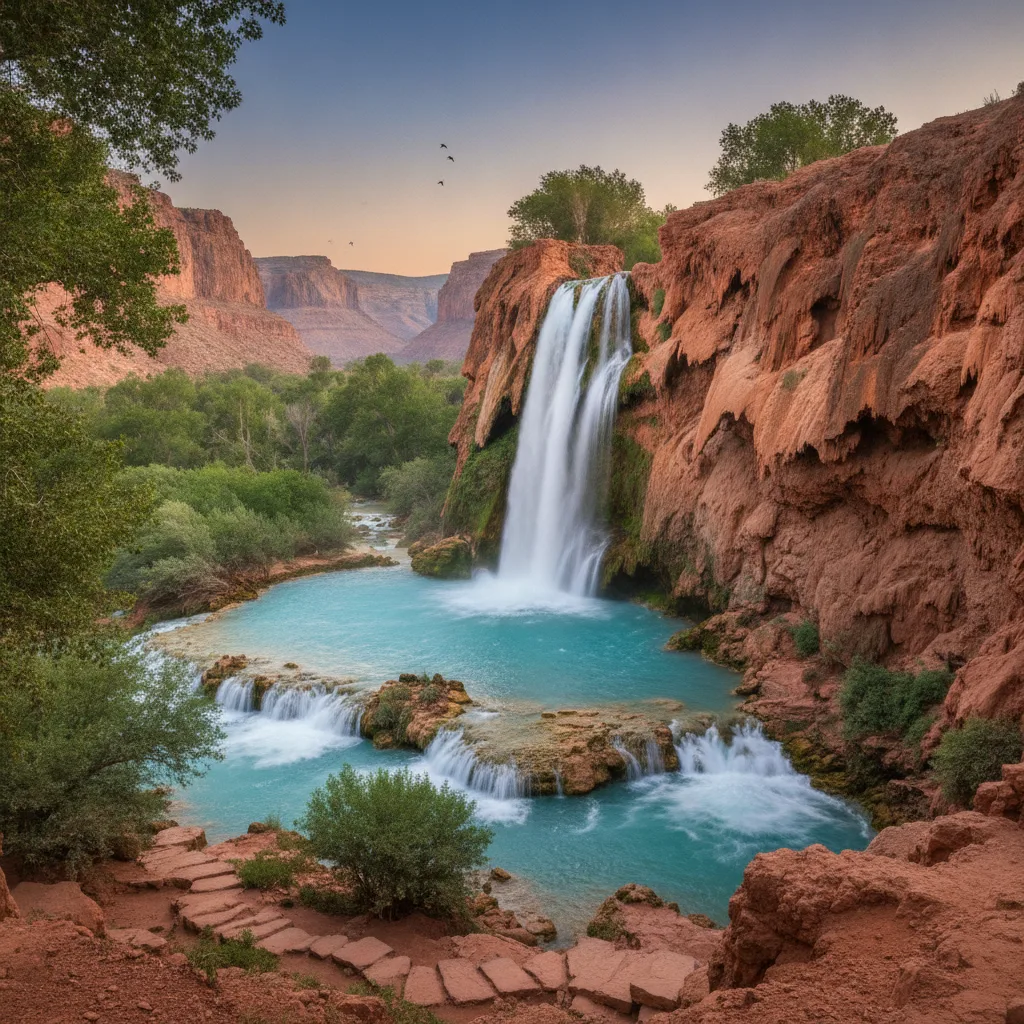
Welcome to the definitive guide to Havasu Falls Arizona, brought to you by the Visit America editorial team. We cut through the noise to bring you confident, specific, and actionable advice for experiencing one of America's most sought-after natural wonders.
Why Visit Havasu Falls
Imagine a landscape where vibrant turquoise waterfalls cascade over fiery red travertine cliffs, nestled deep within a remote canyon. This isn't a dream; it's Havasu Falls, a breathtaking oasis within the Havasupai Indian Reservation in Arizona. The stark contrast between the arid desert and the lush, water-fed vegetation creates a truly unique and awe-inspiring spectacle. We believe that visiting Havasu Falls offers an unparalleled opportunity to connect with nature's raw beauty, providing a visual feast unlike any other in the world. It’s a place of profound tranquility and stunning photographic opportunities, a true bucket-list destination that resonates deeply with adventurers and nature lovers alike. Beyond the iconic Havasu Falls itself, the area boasts a series of equally mesmerizing cascades, including Navajo Falls, Fifty Foot Falls, Mooney Falls, and Beaver Falls, each contributing to the magical allure of this hidden gem.
Who It's Best For
Havasu Falls is not a casual day trip; it's an immersive, multi-day adventure that requires preparation and a spirit of resilience. We recommend this journey for experienced hikers and backpackers who are comfortable with long distances, varying terrain, and carrying their own gear. The remote location and the necessity of an overnight stay mean it's best suited for those seeking a true wilderness experience, far from the conveniences of urban life. Individuals who thrive on challenging hikes, appreciate pristine natural environments, and are committed to respecting tribal lands will find Havasu Falls to be an incredibly rewarding destination. It's also ideal for photographers eager to capture its iconic blue-green waters and for anyone looking to disconnect and immerse themselves in one of America's most beautiful and secluded spots. If you're looking for a comfortable resort stay, this isn't it. This is for the intrepid traveler ready to earn their views.
Getting There & Parking
Understanding how to get to Havasu Falls is paramount, as access is highly regulated by the Havasupai Tribe. There are no roads leading directly to Supai Village or the waterfalls; all visitors must either hike, take a helicopter, or arrange for a pack mule service from Hualapai Hilltop.
Your journey begins at Hualapai Hilltop, approximately 60 miles north of Historic Route 66 via Indian Road 18. We advise allowing ample time for this drive, as the road can be remote. Parking at Hualapai Hilltop is available, though spaces are limited, and additional parking can be found along the road leading to the trailhead. It's crucial to note that overnight camping or sleeping in your vehicle at Hualapai Hilltop is strictly prohibited.
Before embarking on your descent, you must complete a mandatory check-in process. For 2026, all individual permit holders or group leaders must check in at the Grand Canyon Caverns Inn (located at Mile Marker 115 on Route 66) either on the day of your permit start date or one day prior. Failure to check in will result in the cancellation of your booking with no refund. During check-in, you'll receive your wristbands, parking pass, and tent tag – all essential for your stay.
From Hualapai Hilltop, the hike to Supai Village is about 8 miles (13 km), followed by another 2 miles (3.2 km) to the campground and Havasu Falls itself. The initial mile of the trail involves a steep descent via switchbacks into the canyon, after which it largely flattens out, following a dry creek bed.
For those seeking an alternative to hiking, a helicopter service operates on select days. From March 15 to October 15, flights are typically available on Sundays, Mondays, Thursdays, and Fridays. During the off-season (October 16 to March 14), flights run on Fridays and Sundays. The cost for a helicopter ride is approximately $100 to $300 per person each way, with additional charges for luggage. It's important to understand that helicopter flights cannot be reserved in advance and are offered on a first-come, first-served basis, with tribal members receiving priority. Flights are never guaranteed and can be canceled due to weather or other operational reasons, so always be prepared to hike. Even with a helicopter ride, you'll still need to hike approximately 2 miles from Supai Village to reach the waterfalls and campground.
Pack mules offer another option for transporting your gear. A round-trip mule service costs $400 per mule and can carry up to four packs. Mule bookings are confirmed at check-in and are non-refundable. Bags for transport must be dropped off at the trailhead by 10:00 a.m. on your arrival day and typically arrive at the campground around 5:00 p.m..
Top Things to Do
Once you've successfully navigated the journey to this remarkable destination, a world of natural wonders awaits. The primary draw, of course, is Havasu Falls itself, a stunning 100-foot cascade plunging into a wide, turquoise pool. But the "things to do at Havasu Falls" extend far beyond this single iconic spot. We encourage you to explore the other magnificent waterfalls that grace Havasu Canyon.
- **Swim and Relax at Havasu Falls:** The vibrant blue-green waters of Havasu Falls are incredibly inviting. Spend time swimming, relaxing on the travertine terraces, and simply soaking in the unparalleled beauty. The natural mineral deposits create unique formations, adding to the allure.
- **Discover Mooney Falls:** Located downstream from Havasu Falls, Mooney Falls is a dramatic 200-foot cascade. Reaching its base involves a thrilling, somewhat challenging descent using chains and ladders carved into the rock face. This is an adventure in itself, but the reward of standing at the foot of this powerful waterfall is immense.
- **Hike to Beaver Falls:** For those seeking further exploration, continue past Mooney Falls to Beaver Falls. The hike to Beaver Falls is a scenic journey, requiring multiple creek crossings and offering a more secluded experience. It's a fantastic spot for cliff jumping into refreshing pools and enjoying the serene canyon environment. This is one of the most rewarding things to do at Havasu Falls for adventurous spirits.
- **Explore Navajo Falls and Fifty Foot Falls:** Upstream from Havasu Falls, you'll find Navajo Falls and Fifty Foot Falls. These cascades offer gentler swimming areas and picturesque settings, perfect for a more relaxed experience or for families. They are often less crowded than Havasu Falls, providing a peaceful escape.
- **Visit Supai Village:** Take time to respectfully explore Supai Village, the remote home of the Havasupai Tribe. Here, you'll find a small store, a cafe, and a post office unique for its mule-delivered mail service. Remember to wear a face mask while passing through the village, as requested by the tribe.
- **Stargazing:** Far from city lights, the night sky over Havasu Canyon is an incredible canvas of stars. We highly recommend taking time to simply look up and appreciate the celestial display.
Remember, all activities require you to respect the Havasupai Tribe's rules and the pristine environment. Always pack out everything you pack in, and stay on designated trails.
Best Time to Visit
Choosing the best time to visit Havasu Falls is crucial for an enjoyable and safe trip. The Havasupai campground is open from February 1st through November 30th, while the Havasupai Lodge operates from April 1st through November 30th.
We generally recommend visiting in the **spring (March-May)** or **fall (September-November)**. During these shoulder seasons, temperatures are more moderate, making the strenuous hike more manageable. Expect daytime temperatures in the 60s to 80s Fahrenheit (15-27°C) and cooler nights. The pleasant weather enhances the hiking experience and allows for comfortable enjoyment of the waterfalls.
The **summer months (June-August)**, while offering warm water for swimming, bring extreme heat, with temperatures often exceeding 100°F (38°C). Hiking in such conditions can be dangerous and is not advised during the middle of the day. Flash floods are also a greater concern during the monsoon season, typically from July to early September. If you must visit in summer, we strongly advise starting your hike before sunrise to take advantage of cooler morning temperatures.
The **winter months (December-February)** are generally cooler, with potential for snow, and some facilities may have limited hours or closures. The campground opens in February, but the lodge doesn't open until April. While the crowds are thinner, the cold can detract from the swimming experience, which is a major draw for many visitors.
Ultimately, the best time to visit Havasu Falls depends on your tolerance for heat and crowds, but for most, spring and fall strike the perfect balance.
Where to Stay Nearby
When planning your trip to Havasu Falls, it's essential to understand that "nearby" accommodations are limited, especially within the Havasupai Reservation itself. Your primary options are either the designated campground or the Havasupai Lodge in Supai Village.
For most visitors, **Havasu Falls camping** is the quintessential experience. The campground stretches for about a mile along Havasu Creek, downstream from Havasu Falls. It's a communal camping area, and you can pitch your tent anywhere within the designated boundaries, offering a true back-to-nature experience. Reservations for the campground are bundled into your permit and are for a mandatory 3-night, 4-day stay. The cost for a campground permit in 2026 is $455 per person. Early access permits, available in January, incur an additional $40 per person. The campground offers composting toilets and access to a natural spring for drinking water (filtering is recommended).
Alternatively, the **Havasupai Lodge** is located in Supai Village, approximately 2 miles upstream from the campground and Havasu Falls. The lodge provides a more comfortable retreat after a day of hiking, featuring rooms with two queen beds, a private bathroom, bedding, and towels. A lodge reservation for 2026 costs $2,277 for a 3-night stay and accommodates up to four people. An early access fee of $160 applies to lodge reservations made during the early access window. While more comfortable, remember that staying at the lodge still requires a substantial hike to reach the waterfalls each day.
Outside the Havasupai Reservation, the closest "nearby" lodging options are quite a drive. Many visitors choose to stay in towns along Historic Route 66, such as **Peach Springs, Arizona**, which is about 60 miles from Hualapai Hilltop. The **Grand Canyon Caverns Inn** (where permit check-in occurs) is a common choice for the night before or after your hike. These options provide basic amenities, but understand that you'll still have a significant drive to the trailhead. For a broader range of accommodations and services, cities like **Kingman** or **Seligman** on Route 66 are further out but offer more choices.
Given the mandatory 3-night stay within the canyon, visitors should plan their external lodging accordingly, perhaps booking a room for the night before their hike and the night after their exit.
Sample 2-Day Itinerary
While all Havasu Falls permits require a 3-night, 4-day stay, we understand that some visitors may want to maximize their time or have specific hiking goals. Here's a sample itinerary that focuses on the core experience, assuming you arrive early on Day 1 and depart late on Day 3, making the most of your two full days in the canyon. This itinerary emphasizes the "Havasu Falls hiking trails" and the stunning natural beauty.
Day 1: The Descent and Havasu Falls Immersion
- **Pre-Dawn Start:** We recommend beginning your hike from Hualapai Hilltop well before sunrise, especially outside of the cooler months. This allows you to tackle the 10-mile (16.1 km) trek to the campground in cooler temperatures and avoid the midday sun. Remember to carry at least one gallon of water per person, as there's no potable water on the trail.
- **Arrival and Camp Setup:** Upon reaching the Havasu Falls campground, find a suitable spot along Havasu Creek. The campground is first-come, first-served within the designated area, so arriving earlier can secure a prime location closer to the falls.
- **Afternoon at Havasu Falls:** After setting up camp, head straight to Havasu Falls, just a short distance away. Swim in the iconic turquoise pools, relax on the travertine, and take in the breathtaking scenery. Explore the immediate area, including the smaller cascades of Navajo Falls and Fifty Foot Falls upstream.
- **Evening:** Enjoy a well-deserved meal at your campsite. Consider visiting the Fry Bread Stand near Havasu Falls for a unique local treat. Spend the evening stargazing, as the remote canyon offers incredible dark skies.
Day 2: Mooney, Beaver, and Beyond
- **Morning Mooney Falls Descent:** Start your day early with the exhilarating descent to Mooney Falls. This involves navigating chains and ladders down a slippery, steep rock face. Take your time, be cautious, and enjoy the adrenaline rush. The view from the base of the 200-foot waterfall is truly magnificent.
- **Hike to Beaver Falls:** Continue your adventure downstream to Beaver Falls, a picturesque series of cascades and pools. This 2.1-mile (3.4 km) hike from Mooney Falls requires multiple creek crossings, so wear appropriate water shoes. Beaver Falls is an excellent spot for swimming, picnicking, and enjoying a more secluded part of the canyon.
- **Optional Confluence Hike:** For the most intrepid hikers, consider pushing further to the Confluence, where Havasu Creek meets the Colorado River. This adds another 3.8 miles (6.1 km) one-way from Beaver Falls, making for a very long day on the Havasu Falls hiking trails. Be prepared for a full-day excursion if you choose this option.
- **Return to Camp:** Head back to the campground in the late afternoon, allowing plenty of time before dark.
Day 3: Final Views and Ascent
- **Leisurely Morning & Departure Prep:** Enjoy a final dip in Havasu Falls or revisit a favorite spot. Pack up your camp, ensuring you adhere to the "pack it in, pack it out" policy, leaving no trace behind.
- **The Ascent:** Begin the challenging 10-mile (16.1 km) hike back to Hualapai Hilltop. The initial climb out of the canyon, particularly the switchbacks, can be strenuous, especially with a full pack. Again, starting early in the morning is highly recommended to avoid the heat.
- **Optional Helicopter Exit:** If you secured a helicopter spot, head to Supai Village for your flight out. Remember, flights are not guaranteed, and tribal members have priority.
This itinerary for Havasu Falls Arizona provides a robust experience of the major attractions, focusing on the incredible Havasu Falls hiking trails and the natural beauty of the area. Remember that flexibility is key, and always prioritize safety and respect for the tribal lands.
Last updated: 2026-07-05 by the Visit America team.