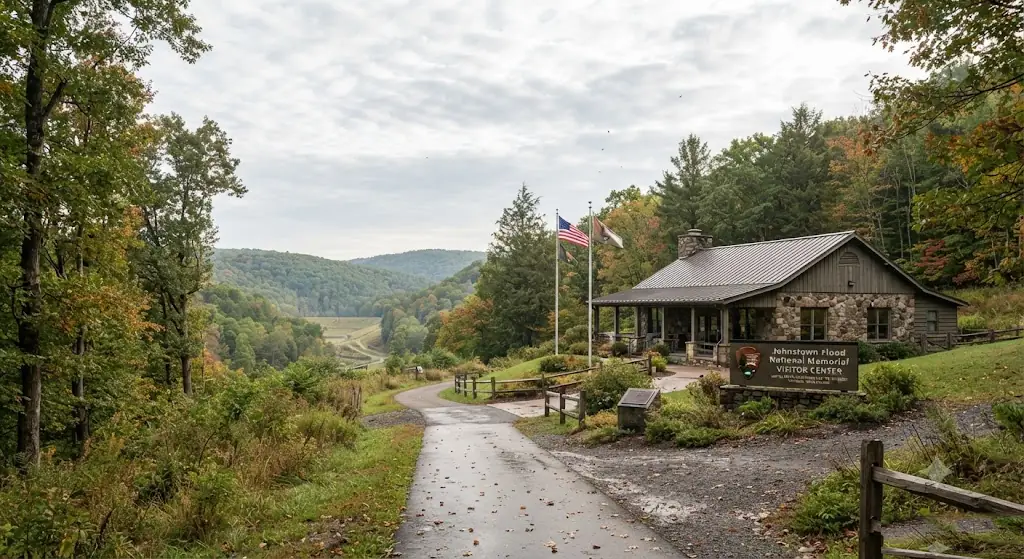
Our Johnstown Flood National Memorial guide covers practical planning for Johnstown Flood National Memorial Pennsylvania — best time to visit, getting there, and what to do on the ground. We've compiled essential 2026 facts on hours, fees, parking, and reservations to help you plan a seamless and impactful journey to this significant historical site.
Why Visit Johnstown Flood National Memorial
The Johnstown Flood National Memorial in Pennsylvania stands as a solemn testament to one of America's most devastating man-made disasters. On May 31, 1889, the catastrophic failure of the South Fork Dam unleashed 20 million tons of water, obliterating the city of Johnstown and claiming 2,209 lives. Visiting this memorial offers more than just a history lesson; it's an immersive experience that allows us to grasp the immense scale of the tragedy and understand its profound impact on the community and the nation.
Our team believes that the memorial provides crucial insights into the human elements of the disaster, from the engineering decisions that led to the dam's failure to the heroic relief efforts that followed. It's a place for reflection, education, and understanding how a single event can shape a region's identity and resilience. The National Park Service preserves the remains of the ill-fated South Fork Dam and a portion of the former Lake Conemaugh bed, allowing visitors to see the physical evidence of this historical event.
Who It's Best For
The Johnstown Flood National Memorial is a powerful destination for a diverse range of visitors. It's particularly impactful for history enthusiasts and those interested in civil engineering or disaster studies, offering a deep dive into the causes and consequences of the 1889 flood. The exhibits and film provide a comprehensive narrative that appeals to those who appreciate detailed historical accounts.
Families with older children will also find the memorial a valuable educational experience. While the subject matter is somber, the memorial presents the story in an accessible way, encouraging discussion about historical responsibility, community resilience, and the power of nature. We recommend it for anyone seeking a meaningful and thought-provoking travel experience, rather than just a casual sightseeing stop. It's also an excellent complement to a broader Pennsylvania trip, offering a unique historical perspective alongside other attractions like the Gettysburg National Military Park or the Eastern State Penitentiary.
Getting There & Parking
The Johnstown Flood National Memorial is located at 733 Lake Road, South Fork, PA 15956. Our team advises planning your route in advance, as it's situated about 15 miles north of Johnstown in St. Michael. To get to Johnstown Flood National Memorial, take US Route 219 to the St. Michael/Sidman exit. From the exit ramp, head east on PA 869 for approximately 1.5 miles, then turn left onto Lake Road at the memorial sign. The visitor center will be on your right after about 1.5 miles.
Parking at Johnstown Flood National Memorial is convenient and free. The Visitor Center offers ample parking, including accessible spaces and oversized spots for buses or RVs. Additionally, parking is available at the South Abutment, and during special events like the May 31st anniversary, a shuttle runs between the Visitor Center and the North Abutment. We recommend utilizing the designated parking areas and not blocking emergency access roads.
Top Things to Do
There are many things to do at Johnstown Flood National Memorial that offer a comprehensive understanding of the 1889 disaster. Our team recommends allocating at least a few hours to fully experience the site.
- Visitor Center and Exhibits: Begin your visit at the Visitor Center, which houses two floors of exhibits detailing the flood's history, its causes, and its aftermath. You can explore a large model, an area map, and audio exhibits. The center also features artifacts, a fiber optic map showing the flood's path, and large photos from the period.
- "Black Friday" Film: Watch the award-winning 35-minute park film, "Black Friday," which plays at quarter past each hour in the Visitor Center's theater. This film provides a powerful and often moving account of the flood. We advise seeing the film before exploring the outdoor sites to gain essential historical context.
- South Fork Dam Remains: Walk the grounds to see the actual remains of the South Fork Dam, the site of the catastrophic breach. You can cross a bridge over the spillway to the very edge where the dam failed, offering a profound sense of the disaster's scale.
- Club House and Cottages: Drive past the historic South Fork Fishing and Hunting Club House and the remaining cottages in the town of St. Michael. While the interior of the Club House is generally closed to the public, you can walk around the porch and imagine the lives of the wealthy members who owned the dam.
- Trails: Explore the park's trails, including the Path of the Flood Trail, which follows a portion of the floodwaters' devastating route. The 9/11 Bike Trail also enters the park and is shared with the Path of the Flood Trail. The Carriage Road Nature Trail / Arbor Trail Loop starts at the Johnstown Flood National Memorial picnic area, offering a more leisurely walk. These things to do at Johnstown Flood National Memorial offer both historical immersion and opportunities for quiet reflection.
- Ranger Programs: Check the park's calendar for ranger-led programs and guided walks, which can offer deeper insights and answer questions.
Best Time to Visit
The best time to visit Johnstown Flood National Memorial largely depends on your preferences for weather and crowd levels. Our team generally recommends late spring, early summer, or early fall for the most pleasant experience.
- **Spring (April-May):** As temperatures rise, the landscape around the memorial begins to green, and the weather is generally mild. The anniversary of the flood on May 31st is a significant event, with special programs and a luminary lighting ceremony honoring the victims. The Visitor Center will be open extended hours, from 9:00 a.m. until 10:00 p.m. on May 31, 2026. If you plan to visit on this date, expect larger crowds and potentially limited parking, though shuttles are typically provided.
- **Summer (June-August):** Summer offers warm weather, making it ideal for exploring the outdoor sites and trails. Ranger programs are typically more frequent during this season. However, it can also be the busiest time, especially on weekends and during school holidays.
- **Fall (September-October):** The autumn foliage in Pennsylvania is stunning, providing a beautiful, contemplative backdrop for your visit. Temperatures are cooler and comfortable for walking the grounds. Crowds tend to be smaller than in the peak summer months.
- **Winter (November-March):** While the park grounds and trails remain open from sunrise to sunset year-round, weather permitting, the Visitor Center is closed on Wednesdays and Thursdays and on Thanksgiving Day, Christmas Day, and New Year's Day. Snow can add a stark beauty to the landscape, but some trails might be less accessible, and ranger programs are less frequent.
No matter when you visit, we advise checking the official National Park Service website for the most current operating hours and any alerts or closures, especially regarding specific programs or weather-related conditions.
Where to Stay Nearby
When considering Johnstown Flood National Memorial lodging, you'll find a range of options primarily in the greater Johnstown area, about 15 miles from the memorial itself. While there aren't accommodations directly adjacent to the memorial, several hotels offer convenient access and a comfortable stay.
For those seeking proximity to downtown Johnstown's attractions, the Holiday Inn Johnstown Downtown by IHG is a top choice, located just 0.2 miles from the Johnstown Flood Museum. This hotel provides a full-service experience and is close to the historic Inclined Plane and the Amtrak station.
Other reliable Johnstown Flood National Memorial lodging options a bit further out, but still within a short drive, include the Hampton Inn Johnstown, offering amenities like free hot breakfast, free WiFi, and an outdoor pool. The Comfort Inn & Suites Johnstown - Richland Town Center and the Holiday Inn Express & Suites Johnstown by IHG are also popular choices in the Richland Town Center area, providing modern comforts and easy access to shopping and dining. The Super 8 by Wyndham Johnstown and Red Roof Inn Johnstown offer more budget-friendly accommodations with essential amenities.
Many of these hotels are conveniently located near major routes like US-219 and PA-56, making travel to the memorial and other regional attractions straightforward. We recommend booking your Johnstown Flood National Memorial lodging in advance, especially during peak seasons or around the May 31st anniversary, to ensure availability and the best rates.
Sample 2-Day Itinerary
Our team has crafted a sample 2-day itinerary to help you make the most of your visit to the Johnstown Flood National Memorial and the surrounding area.
Day 1: Immersion at the Memorial
- Morning (9:00 AM - 1:00 PM): Johnstown Flood National Memorial
- Begin at the Visitor Center. Watch the "Black Friday" film and explore the two floors of exhibits to gain a foundational understanding of the flood.
- Walk out to the remains of the South Fork Dam, visualizing the scale of the former lake and the dam's breach.
- Take a leisurely stroll along a portion of the Path of the Flood Trail or the 9/11 Bike Trail to reflect on the disaster's path.
- Lunch (1:00 PM - 2:00 PM): Picnic or Local Eatery
- Enjoy a picnic at the memorial's shaded picnic area, which offers grills and tables on a first-come, first-served basis.
- Alternatively, drive into St. Michael or South Fork for a quick bite at a local restaurant.
- Afternoon (2:00 PM - 5:00 PM): South Fork Fishing and Hunting Club & Ranger Programs
- Drive through the historic St. Michael district to see the South Fork Fishing and Hunting Club House and its remaining cottages.
- If available, participate in a Ranger Program or a guided walk to deepen your understanding of the site.
- Evening: Dinner in Johnstown
- Head into Johnstown for dinner. Explore local dining options, from casual to more upscale.
Day 2: Johnstown Exploration & Regional History
- Morning (9:00 AM - 12:00 PM): Johnstown Flood Museum & Inclined Plane
- Visit the Johnstown Flood Museum in downtown Johnstown to see additional artifacts and exhibits related to the disaster and the city's rebuilding efforts. Admission is $10 for adults.
- Experience the Johnstown Inclined Plane, the world's steepest vehicular inclined plane. While it is currently closed for major renovation, when open, it offers panoramic views of the city and the Conemaugh Valley, providing context for the flood's impact.
- Lunch (12:00 PM - 1:00 PM): Downtown Johnstown
- Grab lunch at one of the eateries in downtown Johnstown.
- Afternoon (1:00 PM - 5:00 PM): Heritage & Outdoor Recreation
- Explore the Heritage Discovery Center, which features exhibits on immigrant history, the iron and steel industries, and a children's museum. A combined ticket for the Johnstown Flood Museum and Heritage Discovery Center is available for $16 for adults.
- Consider a visit to the Allegheny Portage Railroad National Historic Site & Staple Bend Tunnel, which ties into the region's transportation history and is about 34 miles northeast of Johnstown. This offers a different historical perspective on Pennsylvania's development.
- Alternatively, if you prefer outdoor activities, explore more of the Path of the Flood Trail for cycling or walking, or check out the Stonycreek River for "Coal Tubin'" excursions.
- Evening: Leisure or Arts
- Enjoy a performance at the Pasquerilla Performing Arts Center or catch a local concert at Peoples Natural Gas Park, depending on the season and schedule.
This itinerary balances the solemn history of the flood with other enriching experiences in the Johnstown area. For more ideas on planning your trip, consult our Plan Your US Trip guide or our USA Road Trip Planner.
Top Things to Do in Johnstown
Beyond the Johnstown Flood National Memorial, the city of Johnstown and its immediate vicinity offer a wealth of attractions that reflect its rich industrial heritage, resilient spirit, and natural beauty. Our team has curated a list of top things to do in Johnstown to complement your visit to the memorial.
- Johnstown Flood Museum: Located in downtown Johnstown, this museum provides a deeper dive into the 1889 flood with additional artifacts, exhibits, and a 26-minute Academy Award-winning documentary. Admission is $10 for adults, $8 for seniors, and $8 for children aged 3-18.
- Johnstown Inclined Plane: An iconic landmark, this funicular railway is known as the world's steepest vehicular inclined plane. While it is currently closed for major renovation, when operational, it offers breathtaking panoramic views of the city and the Conemaugh Valley from the top, providing a unique perspective on the flood's path.
- Heritage Discovery Center: This center is a hub for Johnstown's preservation efforts, featuring exhibits on immigrant history, the iron and steel industries, and even the Johnstown Flood. It also houses the Johnstown Children's Museum, making it a family-friendly destination.
- The Stone Bridge: A significant survivor of the 1889 flood, this historic railroad bridge still stands today and is a powerful visual reminder of the disaster's force.
- Path of the Flood Trail: This National Recreation Trail follows the path of the floodwaters for nearly 14 miles, offering a scenic route for cyclists and walkers. It’s an excellent way to connect with the landscape and reflect on the historical event.
- Peoples Natural Gas Park: This outdoor music venue hosts various events, including the annual Flood City Music Festival, typically held in July. It's a great spot to experience local culture and entertainment.
- Allegheny Portage Railroad National Historic Site & Staple Bend Tunnel: Located nearby in Cresson, these National Park Service sites explore the area's transportation history, including the first railroad to circumvent the Allegheny Mountains and the first railroad tunnel in the United States.
- Coal Tubin': For those seeking outdoor adventure, Coal Tubin' offers river excursions with tubes, rafts, and inflatable kayaks on Johnstown's Stonycreek River, with guided whitewater options for the more adventurous.
- Art Off the Rails Trail: Explore Johnstown's vibrant arts scene with this self-guided walking tour of downtown artists, featuring 27 unique stopping points.
These things to do in Johnstown provide a well-rounded experience, blending history, culture, and outdoor recreation. We encourage you to explore these attractions to gain a deeper appreciation for the region's unique story. You might also consider visiting other Pennsylvania gems like the Andy Warhol Museum or the Carnegie Museum of Natural History in Pittsburgh, or the natural beauty of the Delaware Water Gap.
Is It Worth Visiting?
Our team unequivocally believes that the Johnstown Flood National Memorial is worth visiting. This isn't a frivolous tourist trap; it's a place of profound historical significance that offers a deeply moving and educational experience. The memorial effectively conveys the immense scale of the 1889 Johnstown Flood, a disaster that shaped American history and prompted a national outpouring of aid.
The National Park Service has done an exceptional job of preserving the site and presenting the story through compelling exhibits and the powerful "Black Friday" film. Visitors can walk the remnants of the South Fork Dam, gaining a tangible sense of the catastrophe. For anyone interested in American history, engineering failures, disaster response, or the resilience of communities, the Johnstown Flood National Memorial offers invaluable lessons and a unique perspective. It’s a place that encourages reflection and understanding, making it a truly worthwhile destination. If you're pondering, "is Johnstown Flood National Memorial worth visiting," our answer is a resounding yes, for its educational value and emotional impact are undeniable.
Last updated: 2026-07-13 by the Roam States team.