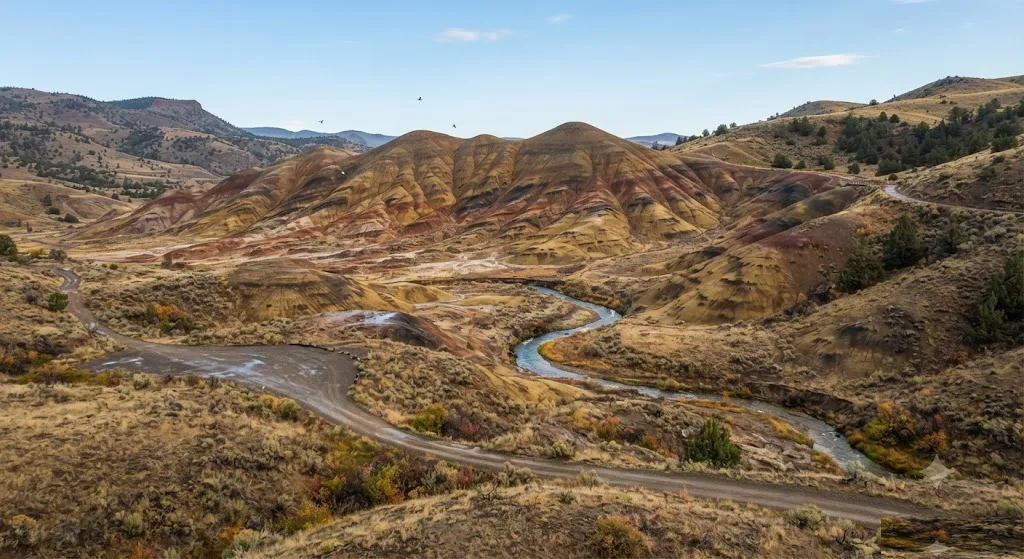
Welcome to the Roam States guide to the Painted Hills Oregon, one of the most mesmerizing natural wonders in the Pacific Northwest. Our team has explored the vibrant, stratified hills of this unique unit within the John Day Fossil Beds National Monument to bring you an independent, confident, and specific guide to planning your visit. Here, millions of years of climate change are dramatically displayed in layers of colored soils, creating a landscape that feels otherworldly and deeply ancient. We'll cut through the generic fluff to give you the essential details for an unforgettable trip to the Painted Hills Oregon.
Why Visit Painted Hills
The Painted Hills offer a visual spectacle unlike almost anywhere else on Earth, making it one of Oregon's "7 Wonders". We find the sheer geological artistry here to be the primary draw. Imagine rolling hills painted in stripes of red, gold, black, and yellow, with occasional hints of green and lavender, all shifting in hue with the changing light and moisture. These aren't just pretty colors; they are a direct record of millions of years of Earth's history, revealing ancient ecosystems from tropical forests to swamps and savannas, all preserved in layers of volcanic ash and claystone.
For us, visiting the Painted Hills is an opportunity to connect with deep time. Each colored band tells a story: the red and orange hues are often from lateritic soils formed during warmer, wetter periods, while the black layers represent lignite, indicating ancient swamps. The yellow and tan layers are typically volcanic ash. It's a living, breathing geology lesson that is both educational and incredibly beautiful. Beyond the visual appeal, the tranquility and remote nature of the area provide a profound sense of escape. It’s a place for quiet contemplation, photography, and simply marveling at the forces that shaped our planet.
Who It's Best For
The Painted Hills are ideal for a diverse range of travelers, though some will find it particularly rewarding. We believe it's best for:
- Geology Enthusiasts and Paleontologists: This is ground zero for understanding Cenozoic Era geology and paleontology. The John Day Fossil Beds National Monument, of which Painted Hills is a unit, holds a world-renowned record of plants and animals spanning over 40 million years. You can even visit the Thomas Condon Paleontology Center in the Sheep Rock Unit to see fossils and paleontologists at work.
- Photographers: The ever-changing light on the hills creates dynamic and stunning photographic opportunities. We recommend late afternoon or early morning for the most vibrant colors.
- Nature Lovers and Hikers: With several short, easy trails, it’s perfect for those who enjoy gentle walks amidst unique landscapes. Even the longest trail is manageable for most fitness levels.
- Families with Kids: The short, accessible trails and the "otherworldly" appearance of the hills make it an engaging destination for children. Interpretive signs along the trails help explain the geological history in an understandable way. Kids will love imagining the ancient creatures that once roamed here.
- Road Trippers: If you're planning an Oregon road trip, the Painted Hills makes an excellent stop. It's easily integrated into a longer itinerary that might include other Oregon gems like Crater Lake National Park or the Columbia River Gorge.
It's perhaps less suited for those seeking extensive wilderness backpacking or high-adrenaline adventure sports within the unit itself, as the focus is on shorter, interpretive walks and scenic viewing.
Getting There & Parking
How to Get There
The Painted Hills unit is located in central Oregon, approximately 9 miles northwest of the small town of Mitchell. Its remote location is part of its charm, but it requires a bit of planning to reach. Here’s how to get to Painted Hills from major Oregon cities:
- From Portland: The drive is about 3.5 to 4.5 hours (approximately 240 miles), depending on your route and stops. We recommend taking I-84 E, then Highway 97 S, and finally Highway 26 E towards Mitchell. Alternatively, some routes involve US-25 and Burnt Ridge Road.
- From Bend: This is a shorter drive, roughly 2 hours (about 90-100 miles). Take Highway 97 S and then Highway 26 E. The highway through the Ochoco National Forest can be curvy, so allow extra time, especially in winter.
Once you're near Mitchell, you'll turn onto Burnt Ranch Road, which leads directly into the Painted Hills unit. Be aware that cell service can be spotty in the area, so we strongly advise downloading offline maps before you go.
Painted Hills Parking
Parking at the Painted Hills is straightforward and generally ample, with dedicated lots for each of the main trails and overlooks. There is no entrance fee for the Painted Hills unit, and parking is also free. As you enter the park from Burnt Ranch Road, you'll pass parking for the Carroll Rim Trail and Painted Hills Overlook first. We recommend continuing to the furthest trail (Red Scar Knoll/Red Hill Trail) and working your way back, as each trail has its own parking lot, eliminating the need to hike between them. For those driving RVs, be cautious past the Painted Hills Overlook parking lot due to narrow and curvy roads.
Top Things to Do
While the Painted Hills unit is compact, there are plenty of things to do at Painted Hills to fill a half-day or more. Our team's top recommendations focus on experiencing the unique geology up close and capturing its beauty.
The primary things to do at Painted Hills revolve around exploring the five short, well-maintained trails, each offering a distinct perspective on the colorful landscape.
- Painted Cove Trail: This is arguably the most iconic spot, featuring a boardwalk that winds directly through vibrant red and yellow mounds. It's an easy, quarter-mile loop that gets you up close and personal with the striking claystone layers. We recommend visiting early in the morning to avoid crowds, as it's a very popular photo spot.
- Carroll Rim Trail: For panoramic views of the entire Painted Hills valley, the Carroll Rim Trail is a must-do. This 1.6-mile round trip trail is considered moderate due to its 400-foot elevation gain, but the reward is unparalleled vistas, especially at sunset. It provides a sweeping perspective of the Red Knoll and Painted Cove below.
- Painted Hills Overlook Trail: An easy, half-mile out-and-back trail that offers spectacular views of an iconic set of hills. This is a great starting point for your visit, providing a broader understanding of the landscape. We've found the views here particularly dramatic as the sun begins to set.
- Red Scar Knoll / Red Hill Trail: This easy, quarter-mile loop takes you to a prominent red hill. It's a great spot to appreciate the intense crimson hues and the desert-like vegetation.
- Leaf Hill Trail: A quarter-mile loop, this trail is significant for its paleontological history. Thousands of fossils have been excavated here, and interpretive signs explain the ancient plant life that once thrived in the area. While perhaps less visually dramatic than the Painted Cove, we find its historical context fascinating. Remember, collecting fossils is strictly prohibited.
Beyond hiking, consider bringing a picnic to enjoy at one of the benches with a view. Stargazing is also exceptional here due to the remote location and lack of light pollution. For those interested in the broader John Day Fossil Beds National Monument, we highly recommend visiting the Thomas Condon Paleontology Center in the Sheep Rock Unit, about an hour east, to delve deeper into the region's fossil history. You could also explore the Clarno Unit, known for its Mars-like pillars and the Trail of Fossils.
Best Time to Visit
Choosing the best time to visit Painted Hills significantly impacts your experience. We generally recommend late spring and early fall for the most comfortable temperatures and vibrant colors.
- Spring (April, May, early June): This is a "sweet spot" for many visitors. Temperatures are pleasant, ranging from 50°F to 70°F (10°C to 21°C). There's a higher chance of rain, but this is actually a benefit, as recent precipitation makes the hills' colors pop even more vividly. May is particularly good for seeing wildflowers blooming around the hills.
- Fall (late September, October): Similar to spring, fall offers cooler temperatures, typically ranging from 60°F to 80°F (16°C to 27°C). The days are still sunny, making for comfortable hiking, and the light is often softer, which is excellent for photography. The fall foliage in the surrounding areas also adds another layer of beauty.
- Summer (June through August): While the hills are beautiful under clear blue skies, summer can be extremely hot, with temperatures often soaring into the 90s°F (27°C to 35°C) and sometimes even reaching 110°F (43°C). There's very little shade, which can make hiking uncomfortable. If you must visit in summer, we strongly advise going early in the morning or late in the afternoon to avoid the midday heat.
- Winter (December to March): Winters are generally mild, with temperatures between 30°F and 50°F (-1°C to 10°C). Snow is rare but can occasionally blanket the hills, creating a unique, serene, and less crowded experience. However, snow can also obscure the vibrant colors, which is the main draw. Some limited facilities may be closed, and winter weather can affect the driveability of gravel roads.
Regardless of the season, we recommend visiting during sunrise or sunset. The low-angle light dramatically enhances the colors and creates stunning shadows, making the landscape truly come alive. For photography, the late afternoon is particularly good as the hills are mostly west-facing.
Where to Stay Nearby
Given the remote nature of the Painted Hills, finding suitable accommodations nearby is a key part of planning your trip. While there are no hotels directly within the Painted Hills unit, several options exist in the surrounding towns and for those interested in Painted Hills camping.
Hotels and Lodges
- Mitchell, Oregon: This small town is the closest community to the Painted Hills, just 9 miles away. Options here include The Oregon Hotel and Painted Hills Cottages and Retreat. The Painted Hills Vacation Cottages offer charming cabins.
- Prineville, Oregon: Located about 50 miles (an hour's drive) from the Painted Hills, Prineville is the closest town with more standard hotel options.
- Dayville, Oregon: Further east, Dayville offers some lodging and dining options, including the Dayville Cafe.
- John Day, Oregon: A larger town further east, offering more amenities and lodging choices.
Painted Hills Camping
For those who prefer to immerse themselves in nature, Painted Hills camping is an excellent choice. Camping is not allowed directly within the three units of the John Day Fossil Beds National Monument, but several options are available nearby.
- Priest Hole Recreation Site (BLM): This is a popular spot for free dispersed camping along the John Day River, about 30 minutes north of the Painted Hills. It's accessible via dirt roads past the visitor center. We've found it to be a peaceful spot with beautiful views.
- Mitchell City Park: Located in downtown Mitchell, this park offers 4 RV hookups with water and electricity (no sewer) for $30/night, and open lawn tent spaces for $15/night (as of 2026). It has restrooms, picnic tables, and a playground. RV reservations are handled via email Monday-Thursday from 9:00 AM to 2:00 PM, but tent camping is first-come, first-served. Note that water is seasonal, and the park is closed to campers during Labor Day weekend (September 4-5, 2026) for the Painted Hills Festival.
- Dispersed Camping on BLM Land: Numerous free dispersed camping sites are available on Bureau of Land Management (BLM) land surrounding the Painted Hills. These typically lack amenities, so you'll need to be self-sufficient (pack in and pack out). We recommend obtaining a map showing current property boundaries from the BLM (541-573-4400 or 541-416-6700) or USFS (541-575-3000 or 541-416-6500).
- Burnt Ranch Recreation Site: This site also offers camping and a swimming hole on the John Day River.
When considering Painted Hills camping, remember that cell service is limited or non-existent in many areas, so download offline maps and be prepared.
Sample 2-Day Itinerary
To truly experience the Painted Hills and its surroundings without feeling rushed, we suggest a two-day itinerary. This allows for exploring the main unit, visiting other parts of the John Day Fossil Beds, and enjoying the local charm.
Day 1: Arrival & Painted Hills Exploration
- Morning (Travel & Arrival): Drive to Mitchell, Oregon. If coming from Portland, this is a 3.5-4.5 hour journey. From Bend, it's about 2 hours. We recommend an early start to maximize your time.
- Lunch: Grab lunch in Mitchell. Options include Bridge Creek Café for classic American fare or Painted Hills Pastry for French baked goods.
- Afternoon (Painted Hills Unit): Head to the Painted Hills unit. Start with the Painted Hills Overlook Trail for a broad perspective. Then, tackle the Painted Cove Trail to walk among the vibrant red hills. Continue to the Red Scar Knoll Trail and Leaf Hill Trail, spending about 2-3 hours exploring all five trails.
- Late Afternoon/Sunset: Revisit the Carroll Rim Trail for its panoramic views, especially as the sun begins to set and the colors intensify. This is prime photography time.
- Evening (Dinner & Accommodation): Have dinner in Mitchell. Tiger Town Brewing offers craft brews and pub fare. Check into your accommodation in Mitchell or set up camp at a nearby site like Priest Hole Recreation Site.
Day 2: Fossils, Other Units & Departure
- Morning (Sheep Rock Unit & Paleontology): After breakfast, drive approximately one hour east to the Sheep Rock Unit of the John Day Fossil Beds National Monument. Spend your morning at the Thomas Condon Paleontology Center, where you can explore exhibits showcasing millions of years of fossils and even watch paleontologists at work. Don't miss the dramatic views of Sheep Rock itself.
- Lunch: Enjoy a picnic at the historic Cant Ranch, located across the highway from the visitor center in the Sheep Rock Unit. Alternatively, grab a meal in Dayville at the Dayville Café.
- Afternoon (Blue Basin or Clarno Unit):
- Option A (Blue Basin): Explore the Blue Basin within the Sheep Rock Unit, just a few miles from the Thomas Condon Center. Hike the 3.25-mile Blue Basin Overlook Trail for stunning views of its unique blue-green formations.
- Option B (Clarno Unit): If coming from Portland or heading north, consider a detour to the Clarno Unit (about 2 hours from Painted Hills). Here, you can see ancient volcanic formations and find leaf and wood fossils on the Trail of Fossils.
- Late Afternoon/Evening: Begin your drive back to your next destination, perhaps stopping at other notable Oregon destinations like Cannon Beach & Haystack Rock or Multnomah Falls if your route allows.
FAQ Longtails
What are some things to do in Mitchell, Oregon?
Mitchell, Oregon, though small, serves as the primary gateway town to the Painted Hills and offers a few charming local experiences. We recommend checking out Tiger Town Brewing for craft beers and pub food, or enjoying pie and classic breakfasts at Bridge Creek Café. Painted Hills Pastry is known for its French baked goods. You can also shop for geological treasures discovered by local rockhounds. For those interested in local history, the Mitchell City Park is a pleasant spot, and the town is part of the Painted Hills Scenic Bikeway, making it popular with cyclists.
Is Painted Hills good for kids?
Absolutely! We find the Painted Hills to be an excellent destination for families with kids. Most of the trails are short and easy, like the 0.25-mile Painted Cove Trail with its boardwalk, which even preschoolers can manage. The vibrant colors and unique geological formations spark imagination, making kids feel like they've landed on another planet. Interpretive signs along the trails explain the geological history in an engaging way, and kids often enjoy learning about the ancient plants and animals that once lived here. Just be sure to bring plenty of water and sun protection, especially in warmer months, as shade is limited.
What are some tips for visiting Painted Hills?
Our top tips for visiting the Painted Hills include:
- Timing is Key: Visit during late spring or early fall for the best weather and most vivid colors. Aim for early morning or late afternoon/sunset for optimal lighting and photography.
- Download Offline Maps: Cell service is spotty to non-existent in the area, so have directions and trail maps downloaded before you lose signal.
- Hydrate and Protect: Carry plenty of water, especially in summer, as there's little shade. Wear sunscreen, a hat, and appropriate footwear for hiking on dirt and gravel trails.
- Stay on Trails: The clay layers are extremely fragile. Walking on or touching the hills causes damage that doesn't recover, so always stay on marked trails and boardwalks.
- Leave No Trace: Pack out everything you pack in, as garbage services are limited. Collecting fossils or other natural items is strictly prohibited.
- Combine Units: Consider visiting the other units of the John Day Fossil Beds National Monument—Sheep Rock and Clarno—to get a fuller picture of the region's geological and paleontological significance.
Is there designated parking at Painted Hills?
Yes, there is designated parking at the Painted Hills. Each of the five main trails and overlooks within the unit has its own dedicated parking lot. This means you can drive directly to each trailhead, eliminating the need to hike long distances between them. Parking is free of charge. We advise caution for RV drivers past the Painted Hills Overlook parking lot due to potentially narrow and curvy roads.
What is the best time to visit Painted Hills?
The best time to visit Painted Hills is during late spring (April, May, early June) or early fall (late September, October). These seasons offer comfortable temperatures, ranging from 50°F to 70°F in spring and 60°F to 80°F in fall, making for pleasant hiking conditions. The colors of the hills are often most vibrant after rain, which is more likely in spring and fall. Additionally, wildflowers bloom in spring, adding another layer of beauty. We also highly recommend visiting during sunrise or, especially, sunset, when the low-angle light dramatically enhances the hues and shadows of the hills.
What are the Painted Hills hours and fees?
The Painted Hills unit of the John Day Fossil Beds National Monument is open year-round, 24 hours a day. There are no gates or specific operating hours for entry. Importantly, there are no entrance fees or passes required to visit the Painted Hills, or any of the units of the John Day Fossil Beds National Monument. Parking is also free.
Our team at Roam States hopes this guide helps you plan an extraordinary visit to the Painted Hills Oregon. It’s a truly unique destination that showcases the incredible geological history of our planet in a breathtaking display of color and form. We’re confident that once you’ve witnessed these ancient, vibrant hills, you’ll understand why they hold such a special place in the heart of Oregon.
Last updated: 2026-07-08 by the Roam States team.