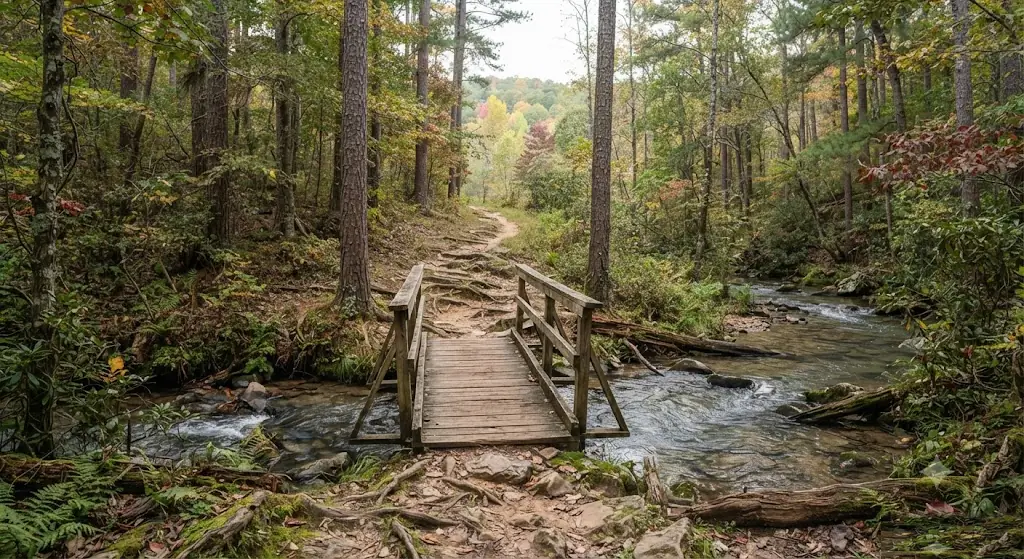
For those seeking an authentic immersion into the heart of the Southern Appalachians, the Pinhoti Trail Alabama offers an unparalleled opportunity. This long-distance trail, whose name means "turkey home" in the Native American Creek language, winds through Alabama's diverse landscapes, providing hikers with a unique blend of challenging terrain, serene wilderness, and rich history. Our team at Roam States has compiled this comprehensive guide to help you plan your adventure, ensuring you experience the best of what this remarkable trail has to offer.
Why Visit Pinhoti Trail
The Pinhoti Trail is a true gem of the Southeast, often serving as a training ground for those aspiring to tackle longer thru-hikes like the Appalachian Trail. Spanning over 170 miles within Alabama, it offers a varied hiking experience, from rolling hillsides to rocky crags and panoramic vistas atop the Talladega National Forest mountains. We recommend this trail for its unique blend of natural beauty and historical significance, traversing landscapes that were once thought to be the boundary between the Creek and Cherokee nations.
Hikers can expect to encounter diverse ecosystems, including remnant mountain longleaf and American chestnut forests. The trail is well-marked with blue blazes or white markers featuring the distinctive "turkey foot" moniker, making navigation straightforward. The commitment of volunteer organizations like the Alabama Pinhoti Trail Association ensures the trail remains well-maintained and accessible for all. In 2026, the Talladega National Forest is expanding by 1,446 acres along its southern boundary in Clay County, further protecting wildlife habitat and enhancing scenic views from the Pinhoti Trail. This expansion underscores the ongoing dedication to preserving this natural treasure.
Who It's Best For
The Pinhoti Trail caters to a wide range of outdoor enthusiasts. It's an excellent choice for **novice thru-hikers** looking to build skills and confidence before attempting longer treks, as it offers a moderately challenging journey without overwhelming logistics. The Alabama portion, specifically, can take two to three weeks to complete, allowing ample time to evaluate gear and gain experience.
For **experienced backpackers**, the Pinhoti provides rugged climbs, switchbacks, and descents over steep, rocky slopes, particularly in areas like the Cheaha and Dugger Mountain Wilderness areas. Those seeking **solitude and seclusion** will appreciate the trail's less crowded nature compared to more famous long-distance routes. While hunters may be present in certain areas, especially during winter, the overall experience offers a peaceful escape into nature.
The trail is also suitable for **day hikers** and **families** looking for shorter excursions, with numerous access points allowing for customizable trips. Sections near Cheaha State Park or with waterfalls and lakes are particularly popular for day use. We also find it ideal for **wildlife enthusiasts**, with opportunities to spot white-tailed deer, wild turkeys, and various bird species.
Getting There & Parking
Accessing the Pinhoti Trail Alabama is relatively straightforward, with several key entry points along its length. The southern terminus of the Pinhoti Trail is located near Flagg Mountain in Coosa County, Alabama, approximately a 90-minute drive from Birmingham. Parking is available near Weogufka State Forest, close to the trail's starting point at Flagg Mountain. The Flagg Mountain Observation Tower, which reopened in June 2019, marks the southern end and offers fresh drinking water to visitors.
Other significant access points include those within the Talladega National Forest, such as Coleman Lake Trailhead, Pine Glen Campground, and various road crossings like AL Highway 148 at Bulls Gap or US Highway 78 near Heflin. Cheaha State Park also provides direct access to the trail and amenities. For those driving, we recommend placing a vehicle at your intended northern terminus trailhead if planning a section hike, as cell service can be spotty.
While public transportation options are limited, you can take a bus to nearby cities like Sylacauga and then arrange for a taxi or rideshare to a trailhead. **Shuttle services** are available and highly recommended, especially for thru-hikers or those planning point-to-point section hikes. Companies like the Pinhoti Outdoor Center in Sylacauga and Backcountry Transit in Northeast Alabama offer shuttle services for various trailheads and towns, including resupply stops. We advise arranging shuttle services well in advance, as cellular service can be nonexistent in parts of the trail. As of 2026, there are no permits required to hike the Pinhoti Trail in Alabama.
Top Things to Do
When considering things to do at Pinhoti Trail, the primary activity is, of course, hiking, but the trail offers much more than just putting one foot in front of the other. Our team recommends focusing on these key experiences:
- Thru-Hiking or Section Hiking: Embark on an end-to-end journey of the Alabama Pinhoti Trail (171 miles) or tackle a multi-day section. Many hikers use the Pinhoti as a training ground for the Appalachian Trail.
- Day Hikes to Scenic Overlooks: Explore shorter segments that lead to breathtaking vistas. The areas around Cheaha Mountain, Alabama's highest point, offer panoramic views. We particularly enjoy the overlooks found just before mile 4 on certain loops, providing expansive views of the surrounding mountains.
- Wildlife Viewing: Keep an eye out for white-tailed deer, wild turkeys, and a variety of bird species. The "Pinhoti" name itself means "turkey home," so spotting these birds is a common and rewarding experience.
- Camping and Backpacking: Numerous designated campsites and primitive camping opportunities are available along the trail. Shelters are spaced roughly 10 miles apart in some sections, offering convenient overnight stops. We recommend planning for water sources, as some streams are seasonal.
- Exploring Water Features: The trail passes by countless waterfalls and crosses numerous creeks and streams. The Shoal Creek area, for example, is noted for its beautiful canyon by the creek with cascading rocks.
- Connecting with Trail Towns: Experience the hospitality of communities along the trail, such as Sylacauga, Heflin, and Piedmont, which offer resupply options, lodging, and local charm.
- Visiting Flagg Mountain: Start your adventure at the official southern terminus, Flagg Mountain, which is the southernmost mountain in the Appalachian chain over 1,000 feet. The recently reopened observation tower provides excellent views.
- Cheaha State Park Exploration: Take a detour to Cheaha State Park, home to Alabama's highest point. The park offers amenities like a general store for resupply, restrooms, and cabins.
These things to do at Pinhoti Trail provide a comprehensive outdoor experience, blending adventure with natural beauty and local culture.
Pinhoti Trail Hiking Trails
The Pinhoti Trail hiking trails offer a diverse range of experiences, from challenging ascents to serene forest walks. The entire Alabama section is approximately 171 miles long. Here are some notable Pinhoti Trail hiking trails and sections we recommend:
- Flagg Mountain to Bull's Gap: This early section from the southern terminus offers a good introduction to the trail. The Flagg Mountain Observation Tower is a highlight.
- Bull's Gap to Mount Cheaha (Sections 6-10): Many hikers consider this one of the best sections, offering a mix of views, creeks, and waterfalls. This stretch includes the challenging "Stairway to Heaven" ascent, a steep climb up boulders. You'll also encounter the "Rock Garden," a 1.9-mile section with 14 rock fields that require careful footing.
- Pin-Chin-Sky Loop (near Cheaha State Park): This popular 17-mile loop combines sections of the Pinhoti, Chinabee Silent Trail, and Skyway Trail. It's often compared to Appalachian Trail hiking and features beautiful creeks and waterfalls. Parking is available at Adams Gap.
- Dugger Mountain Wilderness (Section 11): This area is known for its rugged climbs and incredible views, especially during late fall and winter when leaves are off the trees. A challenging 1.8-mile ascent at Mile 6.4 in this section gains 1,040 feet.
- Terrapin Creek Watershed to Oakey Mountain Crossing (Section 12): This section, while challenging with a series of steep, rocky climbs, rewards hikers with incredible views, particularly from the top of Davis Mountain. The Pinhoti also joins the Chief Ladiga Trail, a rail trail, for a short portion in this area.
- Porters Gap to Adams Gap: This segment includes several rock gardens and the challenging "Stairway to Heaven" leading towards Cheaha.
- Trammel Trailhead to Porter's Gap (Sections 3 & 4): This roughly 27.7-mile point-to-point hike in the Talladega National Forest is known for scenic ridgetop traverses and significant elevation gain, with limited water sources.
The Pinhoti Trail hiking trails are generally well-marked with blue blazes. However, some sections involve road walks, particularly in Alabama (estimated 16 miles) and Georgia (around 60 miles), connecting forested trailways. While these are part of the official trail, some hikers choose to shuttle around them.
Best Time to Visit
The Pinhoti Trail is one of the few long-distance trails in the Southeast that can be hiked year-round, but certain seasons offer more favorable conditions. Our team recommends visiting during the **fall, winter, and spring** for the most enjoyable experience.
- Spring (Late March to April): This is often considered the best time to hike, with mild temperatures (highs in the 60s and 70s, lows in the 50s and 60s) and abundant wildflowers blooming along the trail. Water sources are typically reliable during this period. However, prospective hikers should be aware that tornadoes are most prevalent in Alabama during the spring.
- Fall (September to November): Fall offers cooler temperatures, lower humidity, fewer insects, and vibrant tree foliage, making it an excellent time for hiking. The Pinhoti Fest in late September kicks off the fall hiking season. However, low summer rainfall can lead to scarcer water sources in the fall.
- Winter (December to February): For those who enjoy solitude and expansive views through leafless trees, winter is a great option. Temperatures are cold but mostly snow-free. Be prepared for potentially cold water crossings.
- Summer (May to August): Hiking during the summer months is generally discouraged due to high heat, humidity, and an increase in bugs like ticks and mosquitoes. Many seasonal streams also dry out, making water planning more critical.
Ultimately, the best time to visit depends on your preferences for weather, trail conditions, and crowd levels. We advise checking current weather forecasts and trail conditions before your trip.
Where to Stay Nearby
Finding Pinhoti Trail lodging options is essential for a comfortable trip, whether you're planning a thru-hike or a shorter section hike. Our team has identified various accommodations to suit different preferences and budgets:
- Hostels: These are popular among thru-hikers for their affordability and communal atmosphere.
- The **Pinhoti Outdoor Center (POC)** in Sylacauga, Alabama, offers bunks, tent space, limited resupply, and shuttle services. It's located 1.6 miles off the trail near US Route 280.
- The **Coosa Hiker Hostel**, also near the southern terminus, provides bunks, beds, a shower, Wi-Fi, and tent sites.
- **8 Acorns** in Heflin, Alabama, offers hostel services and shuttles to town for resupply.
- Cabins: For a more private and rustic experience with modern comforts, several cabin rentals are available near the trail.
- **Pinhoti Ridge Retreat** in Talladega, Alabama, offers log cabins nestled by the Talladega National Forest and Talladega Creek, with easy access to the Pinhoti Trail. These cabins feature central heat/air, Wi-Fi, full kitchens, and amenities like firepits and fishing areas.
- You can find mountain cabins bordering the Chief Ladiga bike path, Terrapin Creek, and the Pinhoti Trail, offering amenities like kitchens, washers, and mountain views.
- Expedia also lists options like "Flagg Mountain Cabins and Pinhoti Trail Tours" in Weogufka, though specific details on these cabins require checking availability.
- Hotels/Motels: Nearby towns provide more traditional lodging options for those seeking full-service accommodations.
- **Sylacauga, Alabama,** has options like the Holiday Inn Express Hotel & Suites Sylacauga.
- **Heflin, Alabama,** offers a motel slightly outside of town, with the city hall providing a pavilion area for tenting and hammocking.
- Other towns like **Oxford** and **Piedmont** also offer various lodging and dining choices.
- Camping: Dispersed camping is generally allowed along much of the trail within the Talladega National Forest, following Leave No Trace principles. Designated campsites and shelters are also available. Cheaha State Park offers camping facilities.
When planning your Pinhoti Trail lodging, we recommend booking in advance, especially during peak hiking seasons, and considering the proximity to your planned trail sections and resupply points.
Sample 2-Day Itinerary
For those looking to experience a significant segment of the Pinhoti Trail Alabama without committing to a full thru-hike, our team suggests a rewarding 2-day itinerary focusing on the scenic and challenging areas around Cheaha State Park and the Talladega National Forest.
Day 1: Cheaha Mountain & The Stairway to Heaven
- Morning (8:00 AM - 12:00 PM): Arrival and Ascent to Cheaha Mountain
Begin your adventure by driving to Cheaha State Park, Alabama's highest point. Park at the Cheaha State Park trailhead (check for any parking fees or reservation requirements for 2026, though generally, none are required for the Pinhoti itself, park fees may apply). From here, we recommend hiking a section of the Pinhoti Trail that leads towards the park's summit and its amenities. The trail around Cheaha offers panoramic views. You can take a spur trail into the park to access the general store for any last-minute resupply items or a complimentary coffee.
- Lunch (12:00 PM - 1:00 PM): Picnic with a View
Enjoy a packed lunch at one of the picnic areas within Cheaha State Park, taking in the expansive views from Alabama's highest point.
- Afternoon (1:00 PM - 5:00 PM): Challenge of the Stairway to Heaven
After exploring Cheaha, head north on the Pinhoti Trail towards Adams Gap. This section includes the infamous "Stairway to Heaven," a steep ascent up boulders that provides a significant physical challenge and a taste of the trail's ruggedness. Continue hiking until you find a suitable campsite or shelter. There are numerous primitive camping spots along this stretch within the Talladega National Forest.
- Evening (5:00 PM onwards): Backcountry Camping
Set up camp at a designated site or suitable primitive spot. Enjoy a quiet evening under the stars. Remember to practice Leave No Trace principles, especially regarding food storage to deter wildlife. Water sources may be seasonal, so plan to carry enough or filter from reliable spots.
Day 2: Ridge Walks & Waterfalls
- Morning (8:00 AM - 12:00 PM): Ridge Line Traverses and Descent
Wake up early and enjoy breakfast at your campsite. Continue your hike north from your camping spot. This area is known for its beautiful ridge lines and dense forests. Depending on your starting point, you might traverse parts of the Dugger Mountain Wilderness, offering more rugged terrain and excellent views, particularly in the cooler months.
- Lunch (12:00 PM - 1:00 PM): Trailside Meal
Find a scenic spot along the trail for a trailside lunch, perhaps near one of the many stream crossings or smaller waterfalls that dot this part of the Pinhoti Trail.
- Afternoon (1:00 PM - 4:00 PM): Return to Civilization
Continue hiking towards a pre-arranged pick-up point or a trailhead with parking, such as Coleman Lake or a road crossing near Heflin. If you arranged a shuttle, this is when they would meet you. Alternatively, if you parked a second vehicle, you can retrieve it. Consider exploring other nearby attractions in East Alabama, such as Cathedral Caverns State Park or Ave Maria Grotto, before heading home.
This itinerary provides a challenging yet rewarding experience, showcasing some of the best hiking and scenery the Pinhoti Trail Alabama has to offer. For more Alabama adventures, explore our guide to Best Places in Alabama.
Is It Worth Visiting?
Our team confidently asserts that the Pinhoti Trail is worth visiting for any outdoor enthusiast. Its reputation as a premier long-distance trail in the Southeast is well-earned, offering a unique blend of natural beauty, challenging terrain, and a sense of solitude that is increasingly rare on popular trails. The trail's connection to the larger Appalachian Trail system via the Benton MacKaye Trail also adds to its allure, making it a significant part of the Eastern Continental Trail.
From the diverse landscapes of the Talladega National Forest, with its rolling hills, rocky outcrops, and stunning ridge line views, to the opportunity to spot abundant wildlife, the Pinhoti Trail provides a rich and immersive experience. We believe the Pinhoti Trail is worth visiting not just for its physical challenge, but for the chance to connect with Alabama's natural heritage and enjoy a quieter, more reflective hiking journey. The ongoing efforts of volunteer organizations to maintain and improve the trail further solidify its value as a top-tier destination.
Last updated: 2026-07-13 by the Roam States team.