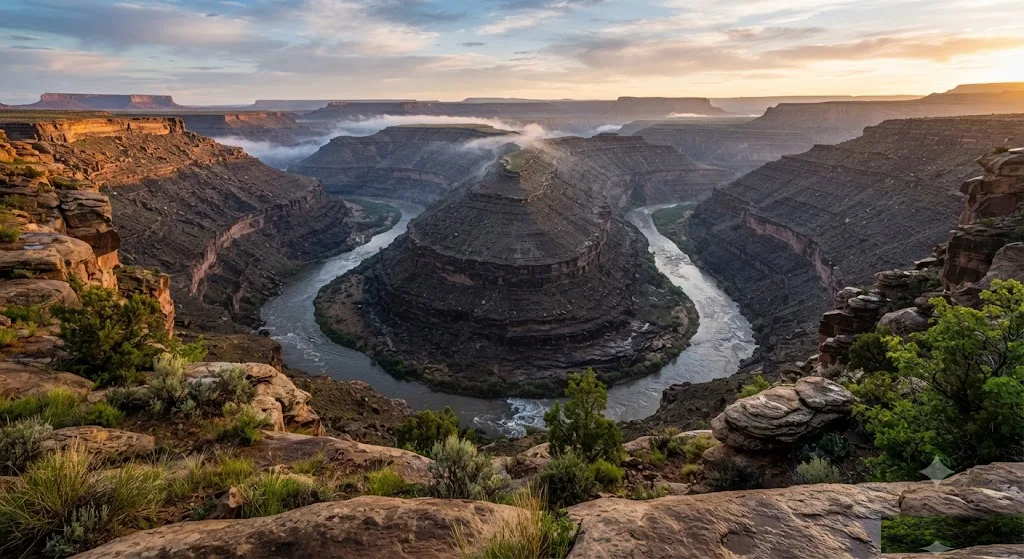
Our Goosenecks State Park guide covers practical planning for Goosenecks State Park Utah — best time to visit, getting there, and what to do on the ground. This stunning destination offers a unique perspective on millions of years of geological activity, where the San Juan River carves a dramatic, entrenched meander. We'll provide you with the essential details to make your visit unforgettable, from understanding the park's fees and facilities to finding the best nearby lodging and maximizing your time in this remarkable corner of Utah.
Why Visit Goosenecks State Park
Goosenecks State Park Utah is a testament to the immense power of geological forces, showcasing one of the most striking examples of an entrenched river meander on the North American continent. Here, the San Juan River twists and turns through a deep canyon, flowing over six river miles while advancing only about 1.5 miles west towards Lake Powell.
From the park's overlook, you'll gaze down 1,000 feet to the river below, observing layers of rock and sediment that tell a story spanning over 300 million years. Geologists consider this area one of the finest examples of "entrenched meanders" anywhere in the world, making it a captivating destination for anyone interested in earth sciences or simply breathtaking natural beauty. The sheer scale and intricate patterns carved by the river are truly mesmerizing, offering a perspective on geological time that few places can match. If you're wondering "is Goosenecks State Park worth visiting," our team confidently says yes, especially for those who appreciate unique landscapes and geological wonders. The park's untouched, undeveloped nature adds to its raw appeal, allowing visitors to connect with the natural world without significant human interference. The views here are truly amazing, and many visitors compare the experience favorably to other famous natural landmarks, often noting fewer crowds.
Who It's Best For
Goosenecks State Park is an ideal destination for a diverse range of travelers, particularly those drawn to the raw, untamed beauty of the American Southwest. It's a photographer's paradise, offering unparalleled panoramic views, especially during sunrise and sunset, or under the pristine dark skies. The dramatic lighting at these times accentuates the canyon's contours and colors, providing endless opportunities for stunning shots.
Geology enthusiasts will find themselves in awe, as the park provides a textbook example of entrenched meanders and exposes rock formations over 300 million years old. It's a living classroom, showcasing the slow, persistent work of the San Juan River. Road trippers exploring Southern Utah or the Four Corners region will find Goosenecks State Park a perfect, impactful stop. It's easily accessible and offers a profound natural spectacle without requiring extensive time or strenuous activity. Families can enjoy the scenic overlook and picnic areas, though caution is advised with small children due to the cliff edges. Stargazers will be particularly delighted, as Goosenecks State Park was named an International Dark Sky Park in March 2021, offering incredible views of the night sky free from light pollution.
Getting There & Parking
Navigating to Goosenecks State Park is part of the scenic adventure through southeastern Utah. To answer "how to get to Goosenecks State Park," the park is approximately 349 miles southeast of Salt Lake City. It's conveniently located about 8 miles northwest of Mexican Hat and 25 miles southwest of Bluff. From Bluff, you'll drive west on US 163 for about 20 miles, then turn north onto UT-261. After approximately 0.9 miles, turn left onto UT-316 West, following signs to Goosenecks State Park. The entrance will be about 3.5 miles down this road.
If you're coming from Monument Valley, drive about 25 miles north on US-163 to Utah-261 West, then take Utah-316 South for about four miles to reach the park. The road to the park is paved and generally smooth, making it accessible for most vehicles, including RVs, though larger vehicles should be prepared for some winding sections. The park itself is essentially a parking lot perched at the edge of a 1,000-foot cliff, with a very short walk to the main viewpoint. There is ample parking available. When considering "how to get to Goosenecks State Park," remember its remote nature means limited cell service, so downloading offline maps is a wise precaution.
The park is open 24 hours a day, year-round, allowing for visits at any time, from sunrise to stargazing. A day-use fee of $5 per private vehicle (up to 8 people) is required. Utah seniors (62 and older) pay a reduced day-use fee of $2 per private vehicle. Bus tour groups are charged $2 per person. Fees can be paid to a park ranger upon arrival or via a self-service fee tube if no ranger is on duty, often requiring cash or a QR code scan. The Annual Utah State Park Pass is also accepted for entry.
Top Things to Do
While Goosenecks State Park is primarily a scenic overlook, the "things to do at Goosenecks State Park" extend beyond simply admiring the view. The main attraction is, of course, the panoramic vista of the San Juan River's entrenched meanders. We recommend spending time at the viewpoint, allowing the immense scale and geological history to sink in. From here, you can observe the river's winding path 1,000 feet below, a sight that has been millions of years in the making.
- Photography: This is a prime location for photography, especially during the golden hours of sunrise and sunset, when the canyon walls glow with vibrant colors. Bring a wide-angle lens to capture the full scope of the meanders.
- Stargazing: As an International Dark Sky Park, Goosenecks offers exceptional stargazing opportunities. On a clear night, the Milky Way is often visible to the naked eye.
- Picnicking: The park provides picnic tables and benches, some with shade structures, making it an ideal spot for a scenic meal.
- Geological Observation: Take time to appreciate the exposed layers of sedimentary rock, which reveal over 300 million years of geological history.
Regarding "Goosenecks State Park hiking trails," it's important to note that there are no maintained or marked hiking trails within the park itself. The park is designed more as a viewpoint. However, for those seeking a more adventurous experience, the historic Honaker Trail is located a few miles to the northwest. This challenging 2.5-mile (4-kilometer) trail, originally built for gold prospectors in the late 1800s and early 1900s, provides access down to the San Juan River. While not within the state park boundaries, it's a notable option for experienced hikers in the vicinity. Always exercise caution and be prepared for strenuous conditions if attempting this trail.
Best Time to Visit
The best time to visit Goosenecks State Park largely depends on your priorities, but our team generally recommends the spring and fall seasons. During these times, temperatures are typically milder and more tolerable, making for a more enjoyable experience. The intense summer heat can be challenging, as there is very little shade available at the park, and temperatures can easily exceed double digits. If you do visit in summer, early mornings or late afternoons are preferable for cooler temperatures and dramatic lighting for photography.
Winter visits are also possible, as the park is open year-round, but be prepared for cold temperatures and potentially icy conditions. Regardless of the season, the park offers stunning views, but the comfort level for visitors is significantly impacted by the weather. For stargazing, any clear night is exceptional, but avoiding moonlit nights will enhance the visibility of the Milky Way. Given its designation as an International Dark Sky Park, visiting at night is a truly unique experience.
Where to Stay Nearby
When planning your trip to Goosenecks State Park, understanding "Goosenecks State Park lodging" options is key, as the park itself only offers primitive camping. The nearest towns providing accommodations are Mexican Hat, Bluff, and Oljato-Monument Valley. These towns serve as excellent bases for exploring the wider region, including Monument Valley Navajo Tribal Park and Bears Ears National Monument.
Mexican Hat, Utah
Located just 8 miles from Goosenecks State Park, Mexican Hat is the closest town with lodging options. It offers a few hotels and inns, often with a rustic, Southwestern charm.
- San Juan Inn and Trading Post: This inn provides comfortable lodging with views of the San Juan River. It's known for its rustic, Southwestern-style rooms and an on-site restaurant, the Olde Bridge Grille, which serves American and Navajo dishes and holds the only liquor license for 100 miles.
- Hat Rock Inn: A family-owned inn offering clean, comfortable rooms with amenities like air conditioning, cable TV, free WiFi, microwaves, and mini-fridges. Guests can enjoy a complimentary continental breakfast and access to an outdoor pool and hot tub.
Bluff, Utah
Approximately 25 miles northeast of Mexican Hat, Bluff offers a wider selection of accommodations, ranging from resorts to cabins and motels. Bluff is also an International Dark Sky Community.
- Bluff Dwellings Resort: This spa hotel offers free WiFi, free parking, a full-service spa, an outdoor pool, and a fitness center. Guests often praise its spacious rooms and helpful staff.
- Desert Rose Resort & Cabins: A business-friendly hotel with an indoor pool, free breakfast, free WiFi, and free parking. It features rustic-chic accommodations and an on-site restaurant, Duke's, serving American cuisine.
- Bluff Gardens Cabins & Willow Street Cottages: These offer more secluded, cabin-style lodging with amenities like free WiFi and gardens.
- La Posada Pintada: A welcoming motel surrounded by desert landscapes, offering complimentary breakfast, parking, and WiFi.
Oljato-Monument Valley, Arizona/Utah
While a bit further, staying near Monument Valley offers iconic views and a unique experience.
- The View Hotel: Located within Monument Valley Navajo Tribal Park, this hotel offers rooms with balconies overlooking the famous buttes.
- Goulding's Lodge: Another popular option near Monument Valley, offering a range of amenities and a historical trading post museum.
For those interested in "Goosenecks State Park lodging" that's a bit more off-the-grid, primitive camping is available within the park itself. We'll cover that in more detail in the FAQ section.
Sample 2-Day Itinerary
To truly appreciate the unique geological wonders and surrounding attractions, we recommend a two-day itinerary for your visit to Goosenecks State Park Utah and the surrounding area. This allows for ample time to soak in the views, explore nearby natural landmarks, and experience the region's dark skies.
Day 1: Geological Wonders & Stargazing
- Morning (Arrival & Goosenecks): Arrive at Goosenecks State Park in the late morning. Pay your day-use fee and spend a couple of hours at the main overlook, marveling at the San Juan River's entrenched meanders. Take your time for photography and geological observation.
- Lunch: Enjoy a picnic at one of the park's designated picnic areas, or head to Mexican Hat for a meal.
- Afternoon (Valley of the Gods & Mexican Hat Rock): Drive the scenic 17-mile unpaved loop through Valley of the Gods, often described as a mini-Monument Valley with fewer crowds. Afterwards, visit the iconic Mexican Hat Rock, a natural monument resembling a gigantic sombrero.
- Late Afternoon/Evening (Check-in & Dinner): Check into your chosen accommodation in Mexican Hat or Bluff. Enjoy dinner at a local restaurant.
- Night (Stargazing at Goosenecks): Return to Goosenecks State Park for an unparalleled stargazing experience. As an International Dark Sky Park, the night sky here is truly spectacular. Bring blankets and a red-light flashlight to preserve your night vision.
Day 2: Scenic Drives & Ancient History
- Morning (Monument Valley or Bears Ears):
- Option A (Monument Valley): Drive south to explore Monument Valley Navajo Tribal Park. Consider a guided tour with a Navajo guide to learn about the cultural significance of the towering buttes and mesas. This is a must-see while in the area.
- Option B (Bears Ears & Moki Dugway): Head north to explore parts of Bears Ears National Monument. Drive the Moki Dugway (Utah State Route 261), a breathtaking unpaved switchback road climbing 1,100 feet up the cliff face, offering expansive views over the San Juan River canyon and Valley of the Gods. Continue to Muley Point Viewpoint for panoramic vistas.
- Lunch: Grab lunch near your chosen morning activity (e.g., at Goulding's Lodge near Monument Valley or a packed lunch for Bears Ears).
- Afternoon (Natural Bridges National Monument or Bluff Exploration):
- Option A (Natural Bridges): Visit Natural Bridges National Monument, about 40 miles north of Goosenecks, to see impressive natural rock bridges.
- Option B (Bluff History): Explore the historic town of Bluff, visiting Bluff Fort and the Sand Island Petroglyphs.
- Departure: Begin your journey to your next US travel destination, perhaps further into Utah's national parks like Arches National Park or Canyonlands National Park, or towards the Grand Canyon in Arizona.
This itinerary offers a blend of iconic sights and hidden gems, ensuring a comprehensive experience of the Goosenecks region. Remember to check current conditions and any tribal land restrictions before visiting Monument Valley.
Is It Worth Visiting?
Our team at Roam States unequivocally believes that Goosenecks State Park is worth visiting. While it might not be a full-day destination like some of Utah's larger national parks, its unique geological spectacle makes it an essential stop for anyone traveling through southeastern Utah. The park offers an easily accessible viewpoint (no hiking required) that provides spectacular views of the San Juan River's entrenched meanders. This dramatic landscape, carved over millions of years, is a powerful reminder of nature's artistry and is considered one of the best examples of its kind globally.
Many visitors praise Goosenecks State Park for its breathtaking scenery and often compare it to more crowded sites like Horseshoe Bend, but with a more serene and less-trafficked atmosphere. The opportunities for stunning photography, especially during sunrise and sunset, are abundant, and its designation as an International Dark Sky Park makes it a world-class destination for stargazing. For a modest entrance fee, you gain access to an unforgettable natural wonder that provides a profound sense of geological time. So, if you're asking "is Goosenecks State Park worth visiting," our answer is a resounding yes – it's a quick detour with a big reward, a truly unique and awe-inspiring experience that should be on every Utah road trip itinerary.
FAQ Longtails
Goosenecks State Park camping
Goosenecks State Park offers primitive camping on a first-come, first-served basis, with no reservations accepted. There are typically eight designated campsites along the rim, equipped with fire rings and picnic tables, some with shade covers. The camping fee is $10 per night per campsite. Amenities are basic, including vault toilets and trash bins, but there is no drinking water, electricity, or dump station available, so campers must bring all necessary supplies, including water. The park can be very windy, and the ground can be rocky, which might be challenging for tent camping; it's often considered better suited for RVs. Open fires are generally restricted to properly shielded gas or liquid-fueled portable camp stoves with a shut-off valve, due to fire restrictions.
Things to do in Mexican Hat
Mexican Hat, a small town near Goosenecks State Park, serves as a gateway to numerous attractions. Beyond Goosenecks, you can visit the iconic Mexican Hat Rock, a natural monument that gave the town its name. The Valley of the Gods, a scenic loop road with impressive rock formations, is also nearby and offers a less-crowded alternative to Monument Valley. Other attractions include Forrest Gump Point, a famous photo spot with Monument Valley in the background, and the Moki Dugway, a thrilling unpaved switchback road offering panoramic views. Mexican Hat is also a convenient base for exploring Monument Valley Navajo Tribal Park, Bears Ears National Monument, and Natural Bridges National Monument.
Goosenecks State Park with kids
Goosenecks State Park can be visited with kids, but parents should exercise extreme caution due to the park's location on a 1,000-foot cliff edge. While there are no designated hiking trails within the park, the main viewpoint is easily accessible from the parking area. Kids will likely be fascinated by the dramatic river meanders and the vastness of the landscape. The park offers picnic tables, which are great for a family meal. However, the lack of fences in some areas and the sheer drop-offs mean constant supervision is essential. Camping with small children might be less ideal due to the proximity to cliffs and rocky terrain. Focus on the scenic overlook, photography, and perhaps stargazing for older children, and ensure they understand and adhere to safety rules.
Best hotels near Goosenecks State Park
The best hotels near Goosenecks State Park are primarily found in Mexican Hat and Bluff. In Mexican Hat, the San Juan Inn and Hat Rock Inn are popular choices, offering comfortable stays and proximity to the park. The San Juan Inn also features a restaurant with a liquor license, a rarity in the area. In Bluff, options like the Bluff Dwellings Resort, Desert Rose Resort & Cabins, and La Posada Pintada provide more amenities, including pools, spas, and on-site dining. These Bluff hotels are highly rated for their comfort and service. For a unique experience, The View Hotel inside Monument Valley Navajo Tribal Park offers rooms with direct views of the iconic buttes, though it's a bit further away.
Goosenecks State Park tips
When visiting Goosenecks State Park, our team recommends several tips to enhance your experience. First, plan your visit for spring or fall for the most comfortable temperatures, as summer can be extremely hot with no shade. Always bring plenty of water, as there is no drinking water available in the park. If camping, be aware that sites are first-come, first-served, and the area can be very windy and rocky; consider camping further inland from the cliff edge. Carry cash for the entrance and camping fees, as payment is often via a self-service tube or QR code. Don't miss the opportunity for stargazing, as it's an International Dark Sky Park. Finally, while the views are stunning, remember that there are no maintained hiking trails within the park itself, so plan for nearby hikes like the Honaker Trail if you desire more activity.
Where to stay near Goosenecks State Park
For visitors seeking accommodations, the primary areas to stay near Goosenecks State Park are the towns of Mexican Hat and Bluff. Mexican Hat, located just 8 miles away, offers the closest lodging options such as the San Juan Inn and Hat Rock Inn. Bluff, about 25 miles from the park, provides a wider range of hotels, resorts, and cabins, including the highly-rated Bluff Dwellings Resort and Desert Rose Resort & Cabins. These towns serve as excellent hubs for exploring Goosenecks and other regional attractions like Monument Valley, Valley of the Gods, and Bears Ears National Monument. For those preferring to camp, primitive, first-come, first-served campsites are available directly within Goosenecks State Park.
Goosenecks State Park Utah offers a profound glimpse into the Earth's geological past, presenting a landscape sculpted over millions of years by the persistent flow of the San Juan River. Its dramatic entrenched meanders, spectacular vistas, and world-class dark skies make it a truly unique and memorable destination. Whether you're a photographer, a geology enthusiast, a road tripper, or simply seeking a tranquil escape into nature, this park delivers an awe-inspiring experience that stands apart from more heavily trafficked destinations. We encourage you to include this gem in your USA road trip planner, allowing its timeless beauty to leave a lasting impression.
Last updated: 2026-07-13 by the Roam States team.