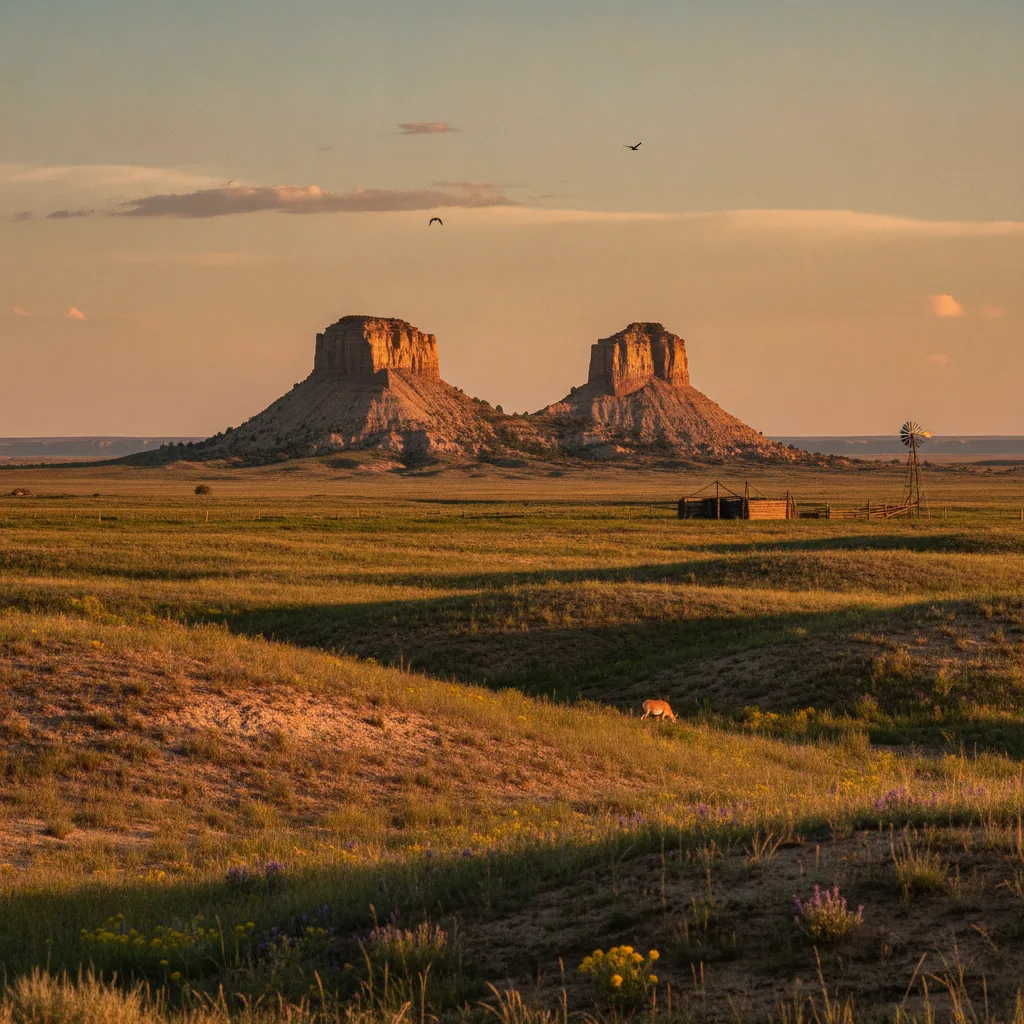
Our Pawnee Buttes guide covers practical planning for Pawnee Buttes Colorado — best time to visit, getting there, and what to do on the ground.
Rising dramatically from the flat landscape of northeastern Colorado, the Pawnee Buttes are iconic geological formations offering excellent birdwatching and hiking opportunities. This remote area is a favorite for nature photographers and those seeking solitude. The Pawnee Buttes, Colorado, are a prominent feature within the vast Pawnee National Grassland, managed by the U.S. Forest Service. We've compiled everything you need to know for an unforgettable visit to this unique corner of the Centennial State, from navigating the gravel roads to finding the best spots for wildlife viewing.
Why Visit Pawnee Buttes
For those who crave vast open spaces and a connection with nature, the Pawnee Buttes offer a truly distinctive Colorado experience. Unlike the towering peaks of the Rockies, this landscape presents a different kind of grandeur – an expansive shortgrass prairie punctuated by striking sandstone formations that rise approximately 300 feet above the surrounding plains. We find that the allure of the Pawnee Buttes lies in their dramatic beauty and the profound sense of solitude they provide. It's a place where the sky feels impossibly big, and the quiet is broken only by the whisper of the wind and the calls of diverse birdlife.
The area is a haven for birdwatchers, with over 300 species documented, including the state bird, the Lark Bunting, as well as various raptors like hawks and falcons. Beyond birding, the Pawnee Buttes are a treasure trove for nature photographers, offering unparalleled opportunities to capture sweeping landscapes, unique geological features, and abundant wildlife. We've seen incredible shots of pronghorn, prairie dogs, and even swift foxes here. History enthusiasts will also appreciate the chance to imagine the lives of early pioneers and the geological forces that shaped these ancient formations over millions of years. It's a place that truly allows you to step back in time and appreciate the raw, untamed beauty of the American West.
Who It's Best For
The Pawnee Buttes are ideal for independent travelers, nature lovers, and those seeking a peaceful escape from crowded tourist destinations. If you're a birdwatcher, photographer, or simply someone who appreciates wide-open spaces and geological wonders, our team highly recommends a visit. It's particularly well-suited for:
- **Birdwatchers:** With hundreds of species, including nesting raptors and prairie birds, it's a prime destination for avian enthusiasts.
- **Nature Photographers:** The unique landscape, dramatic buttes, and abundant wildlife provide endless photographic opportunities, especially during sunrise and sunset.
- **Hikers:** The Pawnee Buttes hiking trails offer relatively easy to moderate walks with rewarding views.
- **Solitude Seekers:** The remote nature of the Pawnee National Grassland ensures a tranquil experience away from the hustle and bustle.
- **Families with Older Children:** While not a playground, the open spaces and wildlife can be engaging for children who enjoy exploring and nature.
However, it's important to note that this is a remote area with limited services. Visitors should be prepared for self-sufficiency, bringing plenty of water, sun protection, and a good map. If you prefer paved trails, extensive facilities, or mountain climbing, you might find Rocky Mountain National Park or Garden of the Gods more aligned with your interests. But if the idea of an expansive, wild prairie calls to you, the Pawnee Buttes will not disappoint.
Getting There & Parking
Navigating to the Pawnee Buttes, Colorado, requires a bit of planning, as it's located in a remote part of Weld County, approximately 13 miles south of the Wyoming border. The area is part of the Pawnee National Grassland, and while the roads are generally well-maintained gravel, conditions can change quickly with weather, especially after rain or snow. We recommend checking local road conditions before you depart.
How to Get There
The Pawnee Buttes Trailhead is about 60 miles northeast of Greeley, Colorado. Here are common routes:
- From Ault, Colorado: Head east on Colorado Highway 14 for about 27 miles. Turn left onto Weld County Road 105, travel about 4 miles north, and continue onto County Road 390. After 2 miles, turn right onto County Road 103. Travel 2 miles north, then take a right onto County Road 104. Travel 4 miles east, and turn left onto County Road 111. Turn right onto County Road 110, followed by a left onto County Road 113. Travel 0.5 miles to the trailhead parking area.
- From Fort Collins, Colorado (via I-25): Take exit 269-A (CO 14/Mulberry St.) and head east for approximately 55 miles, passing through Briggsdale, to County Road 105. Go north on CR 105. It will "T" at CR 390; go northwest for a short distance to reconnect with CR 105 heading north. CR 105 will then end at CR 104; go east on CR 104 for three miles to CR 111. Head north on CR 111 to CR 110. Go east on CR 110; it will curve north and change to CR 113. Continue on, and when the road curves east, go north onto Pawnee Butte Trailhead Road. Continue north to the parking lot on the east.
- From Cheyenne, Wyoming: Take I-80 east to Exit 386. Head south on 214. At a fork, head southeast, away from Carpenter. 14.8 miles from the interstate, you'll reach Hereford. Go straight at the stop sign on a graveled County Road 390 for another 14.5 miles to Grover. Continue straight through Grover and south for 7 miles to a signed left turn towards Pawnee Buttes on County Road 112. Follow signs from there (East on CR112 6.5 miles to a fork, stay on CR112 by taking right fork, then east for another 2 miles to a left turn on FR685, another 1.2 miles to the trailhead).
While many of the county roads are gravel, a high-clearance vehicle or 4x4 is generally not required in dry conditions, but it's always wise to be prepared, especially if there's been recent precipitation. Public transport is limited, making driving the most feasible way to access the Pawnee Buttes.
Parking
Ample parking is available at the Pawnee Buttes Trailhead, including space for trailers. We've found the parking area to be well-signed and equipped with vault toilets and picnic tables, offering a good starting point for your hike. There are no fees to access the Pawnee Buttes or the trails.
Top Things to Do
The Pawnee Buttes offer a surprising array of activities for such a remote location, primarily centered around its unique natural environment. Our team believes these are the top things to do at Pawnee Buttes:
-
Hiking the Pawnee Buttes Trail
The primary attraction is the Pawnee Buttes Trail, a moderately difficult out-and-back trail that leads hikers to the base of the prominent formations. The main trail is about 1.5 to 2 miles long to the first butte, with the total round trip covering approximately 4.3 to 4.4 miles (7 kilometers) and an elevation gain of about 328 feet (100 meters). As you hike, you'll descend into a maze-like arroyo, offering unique perspectives of the buttes. We always recommend staying on the designated Pawnee Buttes hiking trails to protect the fragile ecosystem and respect private land boundaries. While the trail is open year-round, parts of the surrounding area, including Lips Bluff and the Buttes Overlook, are closed from March 1 to June 30 to protect nesting raptors. Climbing on the buttes themselves is not recommended due to crumbling sandstone.
-
Birdwatching
The Pawnee National Grassland is internationally recognized as a premier birdwatching destination, especially for birds of prey. Over 300 bird species have been identified here, making it a must-visit for avian enthusiasts. Keep your binoculars ready for sightings of Lark Buntings (Colorado's state bird), Horned Larks, Burrowing Owls, Mountain Plovers, Prairie Falcons, and various hawks. The cliffs of the buttes provide crucial nesting sites for many raptors. For a broader birding experience, consider driving the Pawnee Pioneer Trails Scenic Byway, which includes a self-guided birding tour.
-
Wildlife Viewing & Photography
Beyond birds, the vast shortgrass prairie is home to a variety of wildlife. Our team frequently spots pronghorn, black-tailed prairie dogs, coyotes, and jackrabbits. Lucky observers might even catch a glimpse of a swift fox or a golden eagle. The open landscape provides excellent opportunities for wildlife photography, particularly during the active hours of dawn and dusk. Remember to give all animals ample space and never disturb their natural habitat.
-
Stargazing
With minimal light pollution and an expansive, flat horizon, the Pawnee National Grassland offers incredible stargazing opportunities. We recommend visiting on a clear night, especially in late fall when the nights are longer, to witness millions of stars lighting up the sky. It's a truly awe-inspiring experience that highlights the vastness of the universe.
-
Fossil Hunting & Geology
The Pawnee Buttes are renowned as one of the world's best sites for vertebrate fossils, with over 100 species located nearby. While you can't remove them (it's against the law), keeping an eye out for fossils along the trail adds another layer of discovery to your hike. The buttes themselves, rising to 5,320 feet in elevation, are remnants of a geological past when they stood thousands of feet taller, gradually eroded by wind and rain.
-
Scenic Drives
For a broader exploration of the area, consider driving the Pawnee Pioneer Trails Scenic and Historic Byway. This 128-mile route traverses the rugged Colorado Piedmont, offering stunning views of the Pawnee Buttes and the surrounding shortgrass prairie. It's a fantastic way to appreciate the unique landscape and historical significance of the region.
Best Time to Visit
Choosing the right time to visit the Pawnee Buttes can significantly enhance your experience. Our team generally recommends spring and fall as the best seasons, offering pleasant weather and optimal conditions for various activities.
- Spring (April-May): This is an excellent time for birdwatching, as thousands of migrating birds stop in the Pawnee National Grassland for nesting. Wildflowers begin to bloom, adding vibrant colors to the prairie, and the temperatures are generally mild, making for comfortable hiking. However, be aware that some areas, particularly Lips Bluff and the Buttes Overlook, are closed from March 1 to June 30 to protect nesting raptors. You can still access the main Pawnee Buttes trail during this time, but staying on the designated path is crucial.
- Summer (June-August): Summer brings warmer temperatures, often topping one hundred degrees in July and August, and the climate can be hot and dry. While still a viable time to visit, we strongly advise bringing plenty of water, sunscreen, and a hat. Wildlife is active, but the heat can make midday hiking less enjoyable. Thunderstorms are also common, and rain can quickly make dirt roads difficult to drive.
- Fall (September-October): Fall offers crisp air, beautiful prairie colors, and fewer crowds. Temperatures are comfortable for hiking, and wildlife remains active. It's also an excellent time for stargazing, as the nights grow longer.
- Winter (November-March): Winter can be cold and windy, with snow potentially limiting access to some areas. However, if you're prepared for the conditions, the stark beauty of the snow-dusted buttes can be incredibly striking for photography. Cross-country skiing is also an option on the flatlands leading up to the buttes. Always check road conditions before heading out during winter months.
Regardless of the season, the weather in the Pawnee National Grassland can change quickly, so we always recommend dressing in layers and being prepared for varying conditions.
Where to Stay Nearby
Given the remote nature of the Pawnee Buttes, dedicated Pawnee Buttes lodging options directly at the site are limited to camping. For those seeking more conventional accommodations, we recommend looking to nearby towns such as Greeley, Fort Collins, Sterling, or Fort Morgan. Each offers a different experience and range of services.
Camping at Pawnee Buttes
For a truly immersive experience, camping is the way to go. The Pawnee National Grassland offers both developed campgrounds and dispersed camping opportunities.
- Crow Valley Recreation Area: Located in the southern part of the grassland near Briggsdale, this is the one established campground in the area. It features elm- and cottonwood-shaded campsites with picnic tables, water, fire grates, and grills. There are 10 family campsites, and reservations can be made on recreation.gov for most of the year, though it operates on a first-come, first-served basis from September 20 to November 14. Crow Valley also has a baseball diamond, volleyball court, and horseshoe pits. Dogs are allowed on leash.
- Dispersed Camping: Permitted year-round on many of the roads within the Pawnee National Grassland, dispersed camping offers a more primitive experience. The most concentrated section for dispersed camping is around the Pawnee Buttes itself. We advise checking a Motor Vehicle Use (MVU) map to ensure you are on public land (shaded grey on the maps) and not private property. You can camp within 300 feet of the road, and existing fire rings often mark good spots. Be prepared for windy conditions and bring all your own water, as potable water is not available. Vault toilets are available at the Pawnee Buttes Trailhead parking area.
Hotels Near Pawnee Buttes
For those preferring a comfortable bed and amenities, we recommend staying in one of the larger towns nearby. While none are directly adjacent, they offer a good base for day trips to the buttes.
- Greeley, Colorado: Approximately an hour and a half drive from the Pawnee Buttes, Greeley offers the widest selection of hotels, dining, and services. Options include the DoubleTree by Hilton Greeley at Lincoln Park, Best Western Greeley, Hampton Inn & Suites Greeley, and Fairfield Inn & Suites Greeley. Greeley is a vibrant city with its own attractions (see FAQ below).
- Fort Collins, Colorado: About two hours from the Pawnee Buttes, Fort Collins is a larger city with a bustling downtown, craft breweries, and a wide range of accommodations. It's a great option if you plan to combine your Pawnee Buttes trip with other Northern Colorado explorations.
- Sterling, Colorado: Located to the east, Sterling offers a few lodging options and is a good stop if you're approaching the buttes from that direction.
- Fort Morgan, Colorado: Also to the east, Fort Morgan provides additional choices for accommodations and services.
When planning your Pawnee Buttes lodging, consider how much driving you're willing to do each day versus the desire for modern comforts. We often find that a combination of camping for a night or two and then a hotel stay provides a balanced experience.
Sample 2-Day Itinerary
To help you make the most of your visit to the Pawnee Buttes, our team has crafted a sample two-day itinerary. This plan balances hiking, birdwatching, and enjoying the unique atmosphere of the Pawnee National Grassland.
Day 1: Arrival, Hiking, and Sunset Views
- Morning (Travel & Arrival): Depart from your chosen base (e.g., Greeley, Fort Collins). We recommend fueling up and grabbing any last-minute supplies, especially water and snacks, as services are extremely limited closer to the buttes. Allow ample time for the drive on gravel roads.
- Late Morning (Pawnee Buttes Trail): Arrive at the Pawnee Buttes Trailhead. Utilize the vault toilets and picnic tables available. Embark on the Pawnee Buttes Trail, a 4.3 to 4.4-mile round trip hike to the base of the buttes. Take your time to absorb the vastness of the prairie, look for fossils, and keep an eye out for prairie dogs and other wildlife. Remember to stay on the designated trail and respect any seasonal closures for nesting raptors (March 1 - June 30).
- Afternoon (Exploration & Photography): After your hike, explore the immediate area around the trailhead. The landscape offers fantastic opportunities for photography. If you're feeling adventurous and have a suitable vehicle, consider driving a portion of the Pawnee Pioneer Trails Scenic Byway for broader views of the grassland.
- Evening (Camping & Stargazing): Set up camp at one of the dispersed camping spots near the Pawnee Buttes (consult an MVU map for public land) or head to Crow Valley Recreation Area if you prefer a developed campground. Prepare a simple meal and settle in for an evening of unparalleled stargazing. The lack of light pollution here makes for an incredible celestial display. Be prepared for potentially windy conditions.
Day 2: Birdwatching, Scenic Drives, and Departure
- Morning (Sunrise & Birding): Wake up early to catch the sunrise over the buttes – a truly magical photographic opportunity. This is also prime time for birdwatching, as many species are most active at dawn. Spend time with your binoculars, scanning the cliffs and prairie for raptors, Lark Buntings, and other prairie birds.
- Late Morning (Crow Valley Recreation Area or Pawnee Pioneer Trails): If you camped near the buttes, consider driving to Crow Valley Recreation Area (about an hour's drive) for a different birding experience along its trails and to see the historical exhibits. Alternatively, if you didn't do so on Day 1, drive more of the Pawnee Pioneer Trails Scenic Byway to fully appreciate the expanse of the Pawnee National Grassland.
- Afternoon (Departure): Begin your journey back to civilization. We recommend stopping in a town like Greeley or Fort Morgan for a late lunch and to reflect on your remote Colorado adventure.
This itinerary is flexible and can be adjusted based on your interests and the time of year. Always prioritize safety, especially regarding weather and road conditions.
Last updated: 2026-07-05 by the Roam States team.