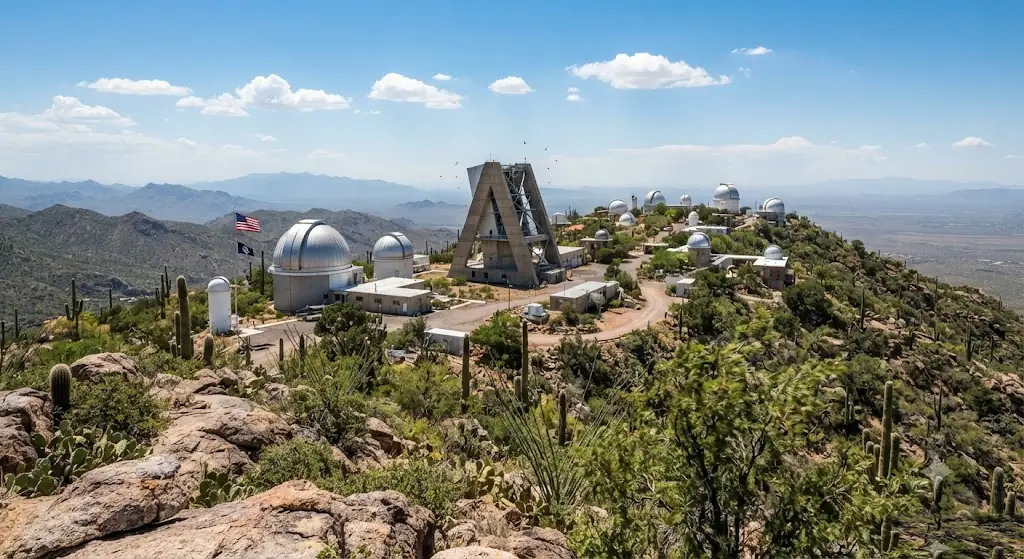
For those captivated by the cosmos, a journey to Kitt Peak Observatory Arizona promises an unparalleled experience. Our team at Roam States considers this remote mountaintop, home to one of the world's largest collections of astronomical instruments, an essential pilgrimage for any serious stargazer or science enthusiast. We've compiled this comprehensive guide to ensure your visit is as smooth and awe-inspiring as the celestial wonders you'll witness.
Why Visit Kitt Peak Observatory
Is Kitt Peak Observatory worth visiting? Absolutely. Perched at nearly 7,000 feet (2,096 meters) above the Sonoran Desert, Kitt Peak National Observatory offers breathtaking panoramic views and some of the clearest, darkest night skies on Earth. It's not just a collection of telescopes; it's an active research facility where groundbreaking discoveries are made daily, including the ongoing Dark Energy Spectroscopic Instrument (DESI) project to map the universe in 3D.
Visiting Kitt Peak provides a unique opportunity to step inside these headline-making research observatories, learn about the universe from expert docents, and directly engage with the science of astronomy. We find the combination of educational tours, stunning natural beauty, and the sheer scale of the scientific endeavor here to be profoundly impactful. From experiencing magnificent sunsets to observing distant galaxies through powerful telescopes, the observatory delivers an unforgettable blend of natural wonder and scientific marvel.
Moreover, the observatory is located on the sacred lands of the Tohono O'odham Nation, offering a chance to appreciate the cultural significance of the region and the partnership between the Tohono O'odham Nation and NSF's NOIRLab. This rich cultural context adds another layer of depth to your visit, making it more than just a scientific excursion.
Who It's Best For
Kitt Peak Observatory Arizona caters to a wide range of visitors, but it particularly shines for:
- Astronomy Enthusiasts: With its vast collection of optical and radio telescopes, including the Nicholas U. Mayall 4-meter Telescope and the McMath-Pierce Solar Telescope, this is a dream destination for anyone passionate about space and scientific discovery. The guided tours delve deep into the workings of these instruments and the research conducted here.
- Families with Older Children: While younger children might find some tours extensive, older kids and teenagers with an interest in science will be enthralled. The daytime tours involve walking and climbing stairs, so comfortable shoes are a must. Evening programs are particularly magical for families looking to stargaze together.
- Nature Lovers and Photographers: The drive up to Kitt Peak offers stunning desert vistas, and the observatory itself provides panoramic views of the surrounding mountains and the Sonoran Desert. Sunsets from the peak are legendary, offering incredible photographic opportunities.
- Couples Seeking a Unique Getaway: For those looking for an experience beyond the ordinary, a trip to Kitt Peak, especially a nighttime program, offers a romantic and awe-inspiring adventure under a canopy of stars.
Visitors should be aware that the observatory is at nearly 7,000 feet elevation, so those with health concerns related to altitude should consult a doctor before visiting.
Getting There & Parking
Understanding how to get to Kitt Peak Observatory is crucial for a smooth trip. Kitt Peak National Observatory is situated approximately 56 miles (90 km) southwest of Tucson, Arizona, within the Schuk Toak District on the Tohono O'odham Nation.
From Tucson, we recommend taking State Route 86 (Ajo Way) west. After about 37 miles, you'll see a sign for State Route 386; turn left here and follow the winding 12-mile road to the summit. The drive itself is scenic, offering expansive views of the desert landscape. Allow at least 90 minutes of driving time from downtown Tucson to reach the observatory. Public buses do not service the area, so a rental car or private shuttle is necessary.
Regarding Kitt Peak Observatory parking, there is free public parking available near the Visitor Center for both day and evening activities. However, overnight RV parking is not permitted on observatory grounds. It's always a good idea to check the official website for current road conditions before heading out, as wildfires can occasionally impact access. The gate at the bottom of State Route 386 is generally open from 9 a.m. to 4 p.m. to coincide with visitor hours. If you are arriving for an evening program after 4 p.m. and see the right lane closed, you can carefully drive around it to proceed up the mountain.
Top Things to Do
There are numerous things to do at Kitt Peak Observatory, making it a full-day or even multi-day destination for those truly immersed in astronomy. The observatory offers both daytime and nighttime programs, each providing a unique perspective on the cosmos.
Daytime Exploration
- Visitor Center and Exhibits: The Visitor Center is open seven days a week from 9 a.m. to 4 p.m.. General admission, which includes access to the Visitor Center, gift shop, solar telescope, and the new Taṣogida Ki: Center for Astronomy Outreach science center, is available. This new science center, opened in December 2025, is notably the world's first inside a working telescope.
- Guided Daytime Tours: We highly recommend booking one of the guided tours to truly appreciate the scale and science of Kitt Peak. These hour-long docent-led tours are available daily and visit one of the large, historic telescopes, such as the McMath-Pierce Solar Telescope, the KPNO 2.1-meter Telescope, or the Nicholas U. Mayall 4-meter Telescope. Reservations are strongly recommended as spaces are limited to 24 guests per tour. Regular daytime tours cost $19.95, with discounted rates of $15.95 for seniors (62+), groups of 8+, active military, and students. Kids 13 and under may have free daytime admission during summer 2026 promotions.
- Self-Guided Tours: Pick up a map at the Visitor Center and explore some of the impressive telescopes and viewing galleries on your own. This allows for a more flexible pace, but still requires comfortable walking shoes due to hilly terrain and elevation.
- Picnic with a View: Pack a lunch and enjoy it at one of the picnic tables with scenic views of the surrounding area. Please note that public picnic grounds may be closed during periods of high fire danger.
Nighttime Stargazing Programs
The nighttime programs are truly what set Kitt Peak apart. These popular experiences allow you to delve into the night sky with expert guidance.
- Nightly Observing Program (NOP): This is Kitt Peak's most popular nighttime program, running nightly year-round. It includes a light meal, an introduction to astronomy and the night sky by a docent, high-powered binocular viewing, and observations through a powerful telescope (such as the Visitor Center's 24-inch telescope). The program costs $89.00 per person, with discounts for seniors, youth, groups, and active military. Reservations are essential and should be made in advance.
- Overnight Telescope Observing Program: For the ultimate immersive experience, this program allows you to spend a full night under the stars, acting as a visiting astronomer. You'll get exclusive access to one of the Visitor Center telescopes for visual observing and imaging of deep-sky objects. This semi-private tour can accommodate up to four guests.
When considering things to do at Kitt Peak Observatory, remember to dress warmly for evening programs, even in summer, as temperatures drop significantly at 7,000 feet.
Things to do in Sells and Nearby
While the primary draw is the observatory, Sells, Arizona, as the capital of the Tohono O'odham Nation, offers a glimpse into local culture. The Tohono O'odham Nation Culture Center & Museum is highly recommended for those interested in the history, traditions, and art of the Tohono O'odham people. You can also find unique local crafts, such as basketry, at the Kitt Peak Visitor Center gift shop or other local stores. For a taste of traditional desert food, the Desert Rain Café in Sells has been noted for its healthy, organic offerings. Other things to do in Sells and the surrounding area include exploring nearby national parks and monuments, or even a self-guided Tucson day trip. For outdoor enthusiasts, hiking trails like those around Picacho Peak offer invigorating adventures and panoramic views.
Best Time to Visit
The best time to visit Kitt Peak Observatory largely depends on your priorities, but generally, the cooler months offer the most comfortable daytime experience, while clear nights are consistently good for stargazing.
- Fall (September-November) and Spring (March-May): These seasons offer pleasant daytime temperatures, making guided tours and self-exploration more enjoyable. The skies are often clear, providing excellent visibility for both day and night programs. Sells itself sees peak visitor numbers in September.
- Winter (December-February): While it can be quite cold at 7,000 feet, winter often brings some of the clearest and darkest skies, ideal for stargazing. Be sure to dress in very warm layers. Sells also sees peak visitor numbers in January and February.
- Summer (June-August): Kitt Peak offers a welcome escape from the intense desert heat of Southern Arizona, with temperatures typically 15-25°F cooler than in Tucson. However, summer is also monsoon season, meaning afternoon thunderstorms can occur, potentially impacting daytime visibility or leading to temporary closures due to fire danger. Nightly observing programs are generally unaffected, but it's always wise to check the weather forecast.
For nighttime programs, advance reservations are crucial year-round, especially for the popular Nightly Observing Program. We recommend checking the official Kitt Peak website for specific program availability and any potential closures due to weather or maintenance.
Where to Stay Nearby
While there is no Kitt Peak Observatory lodging directly on the mountain—no gas stations, full-service restaurants, or hotels are available on Kitt Peak itself, and overnight parking is not permitted—there are several excellent options in nearby towns. Most visitors choose to stay in Tucson, which is approximately 56 miles away, or in closer communities like Three Points or Marana.
Tucson (Approx. 90-minute drive)
Tucson offers the widest range of Kitt Peak Observatory lodging options, from luxury resorts to budget-friendly hotels. It also provides a vibrant downtown with numerous dining and entertainment choices.
- Luxury: The 4.5-star JW Marriott Starr Pass Resort and Spa and the 4-star Casino Del Sol Resort are both excellent choices, offering amenities like pools, spas, and golf courses.
- Mid-Range: Options like the DoubleTree Suites by Hilton Tucson Airport or various SpringHill Suites properties provide comfortable stays.
- Unique Stays: Consider vacation rentals or ranches in the Tucson area for a more secluded experience, such as the "LAZY H BAR RANCH ESTATE" or "Cozy Airstream with WiFi, AC Amazing Desert Views 300 Acre Private Saguaro Park".
Tucson is also a great base for exploring other Arizona attractions, such as Saguaro National Park or the Desert Botanical Garden in Phoenix.
Marana (Approx. 38 miles from Kitt Peak)
Northwest of Tucson, Marana offers some upscale options, including the 5-star Ritz-Carlton, Dove Mountain, and the White Stallion Ranch. These provide a luxurious desert retreat, often with stunning views and outdoor activities.
Three Points (Approx. 19 miles from Kitt Peak)
For a slightly closer, quieter stay, Three Points is a charming village offering a blend of family-friendly activities and outdoor adventures. While specific hotel names aren't as prominent in search results for Three Points itself, vacation rentals or smaller guesthouses might be available. This area is ideal for those who want to unwind and soak in a serene atmosphere closer to the observatory.
When planning your Kitt Peak Observatory lodging, we always recommend booking well in advance, especially during peak seasons, to secure the best rates and availability.
Sample 2-Day Itinerary
To fully experience the wonders of Kitt Peak Observatory Arizona and its surroundings, we've crafted a sample two-day itinerary.
Day 1: Arrival and Daytime Exploration at Kitt Peak
- Morning (9:00 AM - 1:00 PM): Drive and Daytime Tours. Depart from Tucson early, allowing about 90 minutes for the scenic drive up to Kitt Peak. Arrive at the Visitor Center, pick up your general admission, and embark on a guided daytime tour. We suggest the 10:00 AM or 11:30 AM tour to the KPNO 2.1-meter Telescope or the Nicholas U. Mayall 4-meter Telescope to learn about the research conducted here. Explore the new Taṣogida Ki: Center for Astronomy Outreach science center.
- Lunch (1:00 PM - 2:00 PM): Picnic with a View. Enjoy a packed lunch at one of the observatory's picnic areas, taking in the expansive desert views. Snacks and drinks are also available for purchase at the Visitor Center.
- Afternoon (2:00 PM - 5:00 PM): Self-Guided Exploration & Gift Shop. Spend the afternoon exploring the grounds further on a self-guided tour, visiting other visible telescopes. Browse the gift shop for astronomy-themed souvenirs and unique Tohono O'odham crafts. Remember to check for any temporary closures of picnic areas due to fire danger.
- Early Evening (5:00 PM - 7:00 PM): Sunset and Dinner. Find a prime spot on the mountain to witness the spectacular Arizona sunset. For those participating in a Nightly Observing Program, a light meal is typically included. If not, head back down the mountain for dinner in Tucson or Three Points.
- Night (7:00 PM onwards): Nightly Observing Program. Return to Kitt Peak for a pre-booked Nightly Observing Program. This is the highlight for many, offering guided stargazing through powerful telescopes and binoculars under incredibly dark skies.
Day 2: Local Culture, Desert Exploration, and Departure
- Morning (9:00 AM - 12:00 PM): Tohono O'odham Culture. Start your day with a visit to the Tohono O'odham Nation Culture Center & Museum in Sells. This offers a valuable insight into the indigenous culture and history of the region.
- Lunch (12:00 PM - 1:00 PM): Taste of Sells. Enjoy lunch at a local eatery in Sells, such as the Desert Rain Café, known for its traditional desert food.
- Afternoon (1:00 PM - 4:00 PM): Sonoran Desert Exploration. Depending on your interest and onward travel, spend the afternoon exploring the natural beauty of the Sonoran Desert. Consider a visit to Saguaro National Park (West Unit is closer) for scenic drives and short hikes among the iconic saguaro cacti. Alternatively, explore other things to do in Sells, like a self-guided Tucson day trip.
- Late Afternoon: Departure. Begin your journey home or to your next Arizona destination. Consider extending your trip to explore other incredible Arizona sites like Antelope Canyon, the Grand Canyon National Park, Canyon de Chelly, or the Bisbee Historic District. For more inspiration, check out our guide to Best Places in Arizona.
FAQ
Kitt Peak Observatory with kids
Kitt Peak can be an enriching experience for kids, especially those with an interest in science and space. Daytime tours are suitable for older children who can handle walking and climbing stairs. Strollers are not permitted on guided tours. Evening programs, like the Nightly Observing Program, are often a highlight for families, offering a magical introduction to stargazing. During summer 2026, kids 13 and under can enjoy free daytime admission. We recommend preparing children for the altitude and cooler temperatures, especially in the evenings, by bringing warm layers.
best hotels near Kitt Peak Observatory
Since there's no overnight Kitt Peak Observatory lodging directly on the mountain, the best hotels near Kitt Peak Observatory are found in Tucson, about a 90-minute drive away. Top-rated options include the JW Marriott Starr Pass Resort and Spa and Casino Del Sol Resort for a luxurious stay. For more budget-friendly or unique experiences, consider the DoubleTree Suites by Hilton Tucson Airport, or various vacation rentals and ranches listed on platforms like Orbitz and Expedia. Marana, further north, also offers upscale choices like The Ritz-Carlton, Dove Mountain.
Kitt Peak Observatory tips
Our top Kitt Peak Observatory tips include making reservations for guided tours and evening programs well in advance, as spaces are limited. Dress in layers, as temperatures can be 15-25°F cooler than Tucson and drop significantly after sunset, even in summer. Bring comfortable walking shoes for tours, which involve considerable walking and stairs. Have a full tank of gas before heading up, as there are no gas stations on the mountain. Check the official website for current hours, road conditions, and any closures due to weather or fire danger before your visit. Finally, if attending a night program, bring a red flashlight to preserve night vision.
where to stay near Kitt Peak Observatory
As there is no direct Kitt Peak Observatory lodging, visitors typically stay in Tucson, which is about 56 miles (90 km) away and offers a full spectrum of accommodations. Towns like Three Points (19 miles away) and Marana (38 miles away) also provide options, though they may have fewer choices. For a comprehensive list of hotels and vacation rentals, we recommend checking major booking sites for Tucson, Marana, or Sells to find the best fit for your travel style and budget.
Kitt Peak Observatory parking
Kitt Peak Observatory parking is free and readily available in a public parking area near the Visitor Center for both daytime and evening activities. However, it's important to note that overnight RV parking is not permitted on observatory grounds. If you arrive after 4:00 p.m. for a nighttime program and see the gate on Route 386 closed in the right lane, you can carefully drive around it to proceed up the mountain.
best time to visit Kitt Peak Observatory
The best time to visit Kitt Peak Observatory for comfortable daytime exploration and generally clear skies is during the fall (September-November) and spring (March-May). For optimal stargazing, the winter months (December-February) often provide the clearest and darkest nights, though it will be very cold. While summer offers cooler temperatures than the desert floor, it is monsoon season, which can bring afternoon thunderstorms and potential temporary closures due to fire risk. Always check the observatory's official website for current conditions and program schedules before planning your trip.
Last updated: 2026-07-13 by the Roam States team.